本书暂未推出简体中文版。现有版本:English。
University Computer Science — Year 3 · 本科三年级
17NP-Completeness
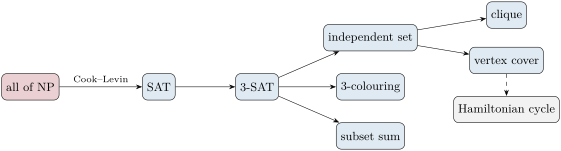
Chapter 16 defined NP, the problems whose yes-answers have certificates that are quick to check, and left open whether they can all be solved quickly. Nobody knows. What is known is that thousands of problems from scheduling, routing, packing and logic are equally hard: a fast algorithm for any one of them would give fast algorithms for all of NP. This chapter proves the first such result, the Cook–Levin theorem, by turning the run of any nondeterministic machine into a Boolean formula, and then spreads it by reductions, each one a program tested against brute force: satisfiability to 3-SAT, to independent set, clique and vertex cover, to 3-colouring, to subset sum. It ends with what such a proof tells an engineer: which special cases are easy, and why a “polynomial” dynamic program can still be exponential.
You already know
A formula in conjunctive normal form is a conjunction of clauses, each a disjunction of literals; SAT asks whether it has a satisfying assignment, and -SAT is SAT for clauses of at most literals (Year 1 volume). A strongly connected component of a directed graph is a maximal set of vertices that can all reach one another; the components can be found in linear time, and contracting them leaves a graph with no cycle (Year 1 volume). A vertex cover of a graph is a set of vertices touching every edge (Year 2 volume). Dynamic programming fills a table of answers to subproblems (Year 1 volume). P, NP and verifiers are those of Chapter 16.
17.1 Polynomial reductions
Definition 17.1 (Polynomial-time reduction, NP-hard, NP-complete)
A polynomial-time reduction from a problem to a problem is a many-one reduction computable in polynomial time: if and only if . We write . A problem is NP-hard when for every in NP, and NP-complete when, in addition, is in NP.
Reductions compose: if and , then , since a polynomial of a polynomial is a polynomial (the output of the first reduction has polynomial size). And they carry speed one way: if and , then . So one NP-complete problem in P would put all of NP in P; and to prove a new problem NP-complete it suffices to show and for one known NP-complete . The direction matters: the reduction goes from the known hard problem to the new one. Reducing the new problem to SAT shows only that it is no harder than SAT.
Richard Karp introduced completeness by polynomial-time many-one reductions in 1972 and used it to show 21 problems NP-complete.
Michael Garey and David Johnson’s book of 1979 lists over 300. All of them rest on a first one.
17.2 The Cook–Levin theorem
Theorem 17.2 (Cook–Levin theorem)
SAT is NP-complete.
Stephen Cook published it in 1971, with a different notion of reduction; Leonid Levin, working independently in the Soviet Union, published an equivalent result for search problems in 1973; the proof with polynomial-time reductions is Karp’s.
Proof. SAT is in NP: an assignment is a certificate, checked clause by clause. Let be in NP, decided by a nondeterministic machine in time (Definition 16.3). For an input of length , let . A run of on is a tableau: rows, each a configuration written as with the state just left of the cell under the head, all padded to the same width . Build the formula on the variables , “cell of row holds symbol ”, with four parts.
- Cells: each cell holds exactly one symbol, a clause of all its symbols and a clause for each pair.
- Start: row 0 is the start configuration on , one unit clause per cell.
- Accept: some cell of some row holds the accepting state, one clause.
- Windows: every window, three adjacent cells of a row and the three below, is legal, that is, occurs in some configuration and one of its successors.
Only one cell per row holds a state, and a step changes only the cells next to it; so if every window is legal, each row is a successor of the one above, and the tableau is an accepting run. Conversely an accepting run fills a tableau whose windows are all legal, once its last configuration is repeated down to the last row: an accepting configuration counts as its own successor, as it does in cook_levin.py. So is satisfiable if and only if accepts . The legal windows form a fixed finite set, depending on only. The formula has variables and clauses of constant size, and is written in polynomial time. ∎
The window condition says “one of the legal windows is here”, a disjunction of conjunctions. cook_levin.py writes it in conjunctive normal form with one new variable per window and position, a clause “some is true” and clauses each of its six cells. It builds the formula for a three-state machine that guesses where the pair 11 begins in its input, and dpll.py, a plain DPLL solver that Chapter 18 develops, finds the accepting run.
def formula(word, steps):
    width = max(len(word), steps + 1) + 3  # room for the input and for the head
    num = {}

    def x(i, j, s):  # variable "cell j of row i holds symbol s"
        return num.setdefault((i, j, s), len(num) + 1)
    clauses = []
    for i, j in itertools.product(range(steps + 1), range(width)):
        clauses.append([x(i, j, s) for s in SYMBOLS])  # at least one symbol
        clauses += [[-x(i, j, s), -x(i, j, t)]  # at most one
                    for s, t in itertools.combinations(SYMBOLS, 2)]
    start = ("#", "q0", *word, *"_" * (width - len(word) - 3), "#")
    clauses += [[x(0, j, s)] for j, s in enumerate(start)]
    clauses.append([x(i, j, "qa") for i in range(steps + 1) for j in range(width)])
    windows = legal_windows(width)
    for i, j in itertools.product(range(steps), range(width - 2)):
        choice = []
        for top, bottom in windows:  # y means "this legal window is here"
            y = num.setdefault(("w", i, j, top, bottom), len(num) + 1)
            choice.append(y)
            clauses += [[-y, x(i, j + d, top[d])] for d in range(3)]
            clauses += [[-y, x(i + 1, j + d, bottom[d])] for d in range(3)]
        clauses.append(choice)
return clauses, num, width, len(windows)$ python cook_levin.py
input 011, 3 steps: tableau 4 x 7, 193 legal windows
3,091 variables (196 for cells), 18,009 clauses
# q0 0 1 1 _ #
# 0 q0 1 1 _ #
# 0 1 q1 1 _ #
# 0 1 1 qa _ # 011, and the tableau read from its satisfying assignment: the machine guessed right at the first 1.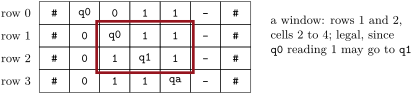
17.3 A chain of reductions
Every reduction below is a function in a listing, run on one small formula, and tested on random small formulas by comparing brute force on both sides; the tests generate the formulas with the hypothesis library.
Definition 17.3 (Independent set, clique, Hamiltonian cycle, subset sum problem)
An independent set of a graph is a set of pairwise non-adjacent vertices; a clique is a set of pairwise adjacent ones. The decision problems ask whether one of size exists. A Hamiltonian cycle is a cycle through every vertex exactly once. The subset sum problem asks whether some of given positive integers add up to a target .
Definition 17.4 (Gadget)
A gadget is a small fixed piece of the instance a reduction builds, one per variable or per clause of the formula, whose possible solutions behave like the truth values or the satisfied clauses.
17.3.1 From SAT to 3-SAT
A clause of one or two literals is padded with new variables taken with both signs, so that the new clauses hold exactly when the old one does; a clause with becomes a chain . If some is true, set the s before its clause to true and the others to false; if all are false, the chain forces , then , …, and the last clause fails.
def to_3sat(clauses):
    fresh = max(variables(clauses), default=0)
    out = []
    for c in clauses:
        if len(c) == 1:  # (a): all four ways to fill two new variables
            y, z = fresh + 1, fresh + 2
            fresh += 2
            out += [[c[0], s * y, t * z] for s in (1, -1) for t in (1, -1)]
        elif len(c) == 2:  # (a or b): one new variable, both signs
            fresh += 1
            out += [[c[0], c[1], fresh], [c[0], c[1], -fresh]]
        elif len(c) == 3:
            out.append(list(c))
        else:  # a chain: (l1 or l2 or y1)(not y1 or l3 or y2)...(not y or l_k-1 or l_k)
            fresh += 1
            out.append([c[0], c[1], fresh])
            for lit in c[2:-2]:
                out.append([-fresh, lit, fresh + 1])
                fresh += 1
            out.append([-fresh, c[-2], c[-1]])
return out$ python reduce_3sat.py
SAT: [[1], [-1, 2], [1, -2, 3, -4, 5], [-3, -5]]
3-SAT: [[1, 6, 7], [1, 6, -7], [1, -6, 7], [1, -6, -7], [-1, 2, 8], [-1, 2, -8], [1, -2, 9], [-9, 3, 10], [-10, -4, 5], [-3, -5, 11], [-3, -5, -11]]
4 clauses on 5 variables -> 11 clauses on 11 variables
satisfiable: True TrueSo 3-SAT, with clauses of exactly three literals, is NP-complete.
17.3.2 Independent set, clique, vertex cover
For a 3-CNF formula with clauses, build one vertex per literal occurrence, join the three vertices of each clause into a triangle, and join every pair of complementary literals and . Ask for an independent set of size . It can take at most one vertex per triangle, so it takes exactly one literal per clause, and never two complementary ones: making them true satisfies the formula. Conversely, a satisfying assignment makes one literal per clause true, and those vertices are independent.
def to_independent_set(clauses):
    vertices = [(j, lit) for j, c in enumerate(clauses) for lit in c]
    edges = []
    for a, b in itertools.combinations(range(len(vertices)), 2):
        (ja, la), (jb, lb) = vertices[a], vertices[b]
        if ja == jb or la == -lb:  # same clause, or contradictory literals
            edges.append((a, b))
    return vertices, edges, len(clauses)


def to_clique(n, edges, k):
    """An independent set of G is a clique of the complement of G."""
    present = set(edges)
    return n, [e for e in itertools.combinations(range(n), 2) if e not in present], k


def to_vertex_cover(n, edges, k):
    """S is independent if and only if the other n - |S| vertices cover every edge."""
return n, edges, n - k$ python reduce_is.py
9 vertices, 15 edges, k = 3
vertices: [(0, 1), (0, -2), (0, 3), (1, -1), (1, 2), (1, 3), (2, -1), (2, -2), (2, -3)]
clique instance: k = 3 edges 21 ; vertex cover instance: k = 6
satisfiable = has an independent set of size k: 200 of 200 random formulasThe other two follow at once. A set is independent in a graph if and only if it is a clique in the complement graph. And is independent if and only if the other vertices cover every edge, so has an independent set of size if and only if it has a vertex cover of size (Exercise 17.7). From vertex cover a longer chain of gadgets reaches Hamiltonian cycle: each edge becomes a gadget of twelve vertices that a tour crosses in one of three ways, according to which end of the edge is in the cover. It is told here, not built.
17.3.3 3-colouring
Three colours, three special vertices T, F and B in a triangle: in any colouring they take the three colours, and their names fix what the colours mean. For each variable, and are joined to each other and to B, so one is coloured T and the other F. For each clause , an OR gadget takes and and gives an output vertex that can be coloured T if and only if or is; a second gadget takes that output and ; its output is joined to F and B, so it must be T.
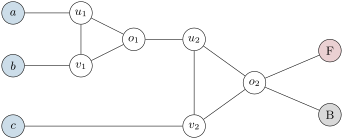
def to_colouring(clauses, n):
    edges = [(T, F), (F, B), (B, T)]
    def lit(x):  # the vertex of literal x: 3, 4 for x_1, not x_1; 5, 6 for x_2 ...
        return 3 + 2 * (abs(x) - 1) + (x < 0)
    for i in range(1, n + 1):
        edges += [(lit(i), lit(-i)), (lit(i), B), (lit(-i), B)]
    size = 3 + 2 * n

    def gadget(a, b):  # OR gadget: a triangle u, v, out with u - a and v - b
        nonlocal size
        u, v, out = size, size + 1, size + 2
        size += 3
        edges.extend([(u, a), (v, b), (u, v), (v, out), (out, u)])
        return out
    for a, b, c in clauses:
        out = gadget(gadget(lit(a), lit(b)), lit(c))
        edges.extend([(out, F), (out, B)])  # the clause's output must be T
return size, edges$ python reduce_col.py
n = 3 variables, m = 2 clauses: 21 vertices, 36 edges
2n + 6m + 3 = 21, 3n + 12m + 3 = 36
satisfiable = 3-colourable: 30 of 30 random formulas (0 unsatisfiable)
all 8 clauses on x1, x2, x3: satisfiable False, 3-colourable FalseExercise 17.10 proves the reduction correct.
17.3.4 Subset sum
Numbers can simulate clauses too, if their digits never carry. For variables and clauses, write numbers of decimal digits. For each variable , two numbers and have a 1 in digit ; also has a 1 in the digit of each clause containing , and in each clause containing . Each clause also gets two slack numbers with a 1 in its digit. The target has a 1 in each variable digit and a 3 in each clause digit. A digit sums to at most , so nothing carries. Reaching a 1 in digit means choosing exactly one of , : an assignment. Reaching 3 in a clause digit needs at least one true literal, since the slacks give at most 2.
def to_subset_sum(clauses, n):
    m = len(clauses)

    def number(var_digit, clause_digits):  # digits: variables first, then clauses
        digits = [0] * (n + m)
        if var_digit is not None:
            digits[var_digit] = 1
        for j in clause_digits:
            digits[n + j] += 1
        return int("".join(map(str, digits)))
    numbers = []
    for i in range(1, n + 1):
        numbers.append(number(i - 1, [j for j, c in enumerate(clauses) if i in c]))
        numbers.append(number(i - 1, [j for j, c in enumerate(clauses) if -i in c]))
    for j in range(m):
        numbers += [number(None, [j]), number(None, [j])]  # slack: at most 2 more
    target = int("1" * n + "3" * m)
return numbers, target$ python reduce_ss.py
numbers: [10010, 10001, 1001, 1010, 111, 100, 10, 10, 1, 1]
target: 11133
satisfiable = some subset reaches the target: 200 of 200 random formulas17.4 co-NP
Definition 17.5 (co-NP)
co-NP is the class of problems whose complement is in NP: those whose no-instances have certificates checkable in polynomial time.
Is a formula a tautology, true under every assignment? A no-answer has a short certificate, a falsifying assignment; a yes-answer seems to need all assignments. Tautology is in co-NP, and it is co-NP-complete, since is a tautology exactly when is unsatisfiable. P is inside NP co-NP, because P is closed under complement. If some NP-complete problem were in co-NP, then NP would equal co-NP (Exercise 17.12). Factoring, as the decision problem “does have a factor below ?”, is in NP co-NP, since the full factorisation, checked with a primality test, certifies both answers; it is not known to be in P, and if it were NP-complete, NP would equal co-NP.
17.5 What a proof of hardness tells an engineer
An NP-completeness proof says that no algorithm is known that is polynomial on every instance, and that finding one would settle P against NP. It does not say that the instances in front of you are hard. Three ways out are common: a special case that is easy, an algorithm polynomial in the numbers rather than their length, and the approximation and exact methods of Chapter 18.
Definition 17.6 (2-SAT, implication graph)
2-SAT is SAT for formulas whose clauses have at most two literals. The implication graph of such a formula has a vertex per literal and, for each clause , the edges and .
Theorem 17.7 (2-SAT is in P)
A 2-CNF formula is unsatisfiable if and only if some variable and its negation lie in the same strongly connected component of the implication graph. This is decided, and a satisfying assignment found, in time linear in the size of the formula.
The edges are implications that every satisfying assignment respects, so a path from to and back makes both values impossible. The converse, and the assignment “ is true when its component comes after that of in topological order”, are Exercise 17.9. Aspvall, Plass and Tarjan gave this linear-time algorithm in 1979.
def solve(clauses, n):
    comp = components(implication_graph(clauses, n))
    if any(comp[v] == comp[-v] for v in range(1, n + 1)):
        return None
    # x is true when its component comes later in topological order than not x's
return {v: comp[v] > comp[-v] for v in range(1, n + 1)}$ python two_sat.py
formula: [(1, 2), (-1, 3), (-2, -3), (2, 4), (-4, -1)]
components: {0: [1, -2, 3], 1: [-4], 2: [4], 3: [-1, 2, -3]}
assignment: {1: False, 2: True, 3: False, 4: True}
with (x1 or not x2) and (not x1 or not x2): NoneSo 2-SAT is linear while 3-SAT is NP-complete: the boundary between easy and hard can be one literal wide.
Definition 17.8 (Pseudo-polynomial algorithm, strongly NP-complete)
An algorithm is pseudo-polynomial when its running time is polynomial in the size of the input and in the magnitude of the numbers in it, rather than in their number of digits. A problem with numbers is strongly NP-complete when it remains NP-complete even with all its numbers bounded by a polynomial in the input size.
Subset sum has the dynamic program of the Year 1 volume: the set of sums reachable with the first numbers, for sums up to the target , filled in steps. That is polynomial in , but is written with about bits.
def dp_cells(numbers, target):
    """Decide subset sum; count the (number, sum) cells the table fills."""
    reachable, cells = [True] + [False] * target, 0
    for x in numbers:
        for s in range(target, x - 1, -1):  # downwards: each number used once
            cells += 1
            if reachable[s - x]:
                reachable[s] = True
return reachable[target], cells$ python subset_dp.py
n = 20 numbers of b bits; target = half their sum
b input bits target T table cells found
4 80 82 1,495 True
8 160 1,408 25,363 True
12 240 20,675 372,170 True
16 320 375,952 6,767,155 TrueThe reduction from 3-SAT builds targets with digits, so the dynamic program does not contradict NP-completeness. With numbers written in unary, or bounded by a polynomial, subset sum is in P; so, unless P = NP, it is not strongly NP-complete. 3-colouring has no numbers at all, and is NP-complete in the strong sense automatically.
17.6 Exercises
Exercise 17.1 ★
A student shows that a new scheduling problem is NP-complete by writing a polynomial-time reduction from to SAT. What has been proved, and what reduction is needed instead?
Solution
Solution of Exercise 17.1.
proves that is in NP, no harder than SAT; nothing about its hardness. For NP-hardness the reduction must go the other way: from SAT, or another known NP-complete problem, to . With both, is NP-complete.
Exercise 17.2 ★
Apply the chain of Listing 17.2 to the clause . Check by hand that the result is satisfied when is the only true literal of the clause ( and false, and true), and say how the new variables are set.
Solution
Solution of Exercise 17.2.
. With and false and and true, is the only true literal: the first clause needs true, the second then needs true, and the third is satisfied by alone. The rule: the s before the clause of the true literal are true, those after are false.
Exercise 17.3 ★
Draw the independent-set graph for and give an independent set of size 2 with the assignment it encodes.
Solution
Solution of Exercise 17.3.
Six vertices: a triangle and a triangle , plus the edges and . The two vertices are not joined, so , one per triangle, is independent of size 2: the assignment true, the others arbitrary. Another is : and true.
Exercise 17.4 ★
Predict the numbers and the target that to_subset_sum builds for the single clause , and give a subset reaching the target.
Solution
Solution of Exercise 17.4.
Digits : , , , , , , two slacks and ; target . For example : all three variables true; the clause digit gets 1 from , 1 from and 1 from a slack.
Exercise 17.5 ★★
exercises/ex5_clique.py has a reduction from 3-SAT to clique that joins every two literals that are not complementary. Find a formula on which it answers wrongly and fix it.
Solution
Solution of Exercise 17.5.
Joining literals of the same clause lets a clique take two literals from one clause and none from another. The eight clauses that forbid every assignment of form an unsatisfiable formula, yet the buggy graph has a clique of size 8: the literal occurs in four clauses and in four, and these eight occurrences are pairwise non-complementary, so all joined; a test checks it. The fix joins two occurrences only if they lie in different clauses and are not complementary; then a clique of size takes one literal per clause, consistently.
Exercise 17.6 ★★
Write colouring_to_sat(n, edges), a reduction from 3-colouring to SAT. It is tested against backtracking on random graphs.
Solution
Solution of Exercise 17.6.
exercises/ex6_col_to_sat.py: variables for 3 colours; per vertex one clause and three clauses ; per edge and colour , . A colouring gives a satisfying assignment and back; variables and clauses (test_exercise_6_colouring_to_sat).
Exercise 17.7 ★★
Prove that vertex cover is NP-complete, from independent set.
Solution
Solution of Exercise 17.7.
Vertex cover is in NP: the set is a certificate, checked edge by edge. Facts used: is independent if and only if covers every edge, since an edge with no end in has both ends in . Map to : has an independent set of size if and only if it has a vertex cover of size . The map is computed in linear time, so independent set vertex cover, and vertex cover is NP-complete.
Exercise 17.8 ★★
Count the variables and clauses of the formula of Listing 17.1 for steps, width , 7 symbols and legal windows, and check the counts of Output 17.1.
Solution
Solution of Exercise 17.8.
Cell variables: . Window variables: one per legal window and per position, . Clauses: per cell, one “at least one” and “at most one”: ; the start row, ; acceptance, 1; per window position, : . For , , : variables and clauses, as printed (test_cook_levin_counts_and_windows).
Exercise 17.9 ★★
Prove Theorem 17.7: if no shares a component with , the assignment of Listing 17.6 satisfies every clause. (Use the symmetry of the graph: is an edge if and only if is.)
Solution
Solution of Exercise 17.9.
Facts used: the graph is symmetric, being an edge if and only if is, so a path from to gives one from to , and the components come in mirror pairs; a satisfying assignment never has a true literal implying a false one along an edge.
If and share a component, and along paths, so neither value is possible. Conversely, number the components in a topological order and make true when its component comes after that of . Suppose a clause is false: and are false, so the component of comes after that of , and the same for . The edge puts ’s component at or after ’s, and the edge puts ’s at or after ’s. Then in the order, with strictly before : a contradiction. The algorithm finds the components and their order in linear time (test_two_sat).
Exercise 17.10 ★★★
Prove that the 3-colouring reduction is correct: the graph is 3-colourable if and only if the formula is satisfiable.
Solution
Solution of Exercise 17.10.
Facts used: in a 3-colouring the palette T, F, B takes three different colours, which we name by it; a literal vertex is adjacent to B, so it is T or F, and , differ.
The OR gadget on inputs , coloured T or F: if both are F, and avoid F, so they are T and B in some order, and the output, adjacent to both, is F. If is T, colour F, B (allowed, since is T or F) and the output T; if is T, symmetrically. So the output is F whenever both inputs are F, and it can be T when or is T. It is not always T or F: with T and F, the colouring F, T gives the output B. The first argument holds for any input that is F, literal or not.
If the graph is 3-colourable, read the assignment from the literal vertices. Each clause’s last output is adjacent to F and B, so it is T; then the first output and are not both F. If is not T it is F, being a literal, so the first output is not F, and then and are not both F: , or is T, and the clause is satisfied. Conversely, from a satisfying assignment colour the literals, then each gadget as above with output T whenever possible; the last output of each clause is T, compatible with its edges to F and B. Sizes are linear, so the reduction is polynomial.
Exercise 17.11 ★★★
Prove that subset sum is NP-complete, and explain why the dynamic program of Listing 17.7 does not show it is in P.
Solution
Solution of Exercise 17.11.
Subset sum is in NP: the subset is the certificate. The reduction of the chapter is correct. If the formula is satisfiable, take or as is true or false; each variable digit is 1, each clause digit has 1 to 3 from the literals, completed to 3 by slacks. If a subset reaches the target, no digit carries, since a digit’s total is at most 5; each variable digit is 1, so exactly one of , is chosen, an assignment; each clause digit is 3 with at most 2 from slacks, so some true literal is in the clause. The numbers have digits, written in polynomial time. The dynamic program takes steps, and here : exponential in the input size, which is about digits.
Exercise 17.12 ★★★
Prove that if some NP-complete problem is in co-NP, then .
Solution
Solution of Exercise 17.12.
Let be NP-complete and in co-NP. For in NP, by a function ; then by the same , and is in NP, so is in NP: is in co-NP. So . For in co-NP, is in NP, hence in co-NP, so is in NP: .
17.7 Weekend problem
Problem 17.1
Weekend problem — Timetabling the town’s exams
Brenmoor’s school sets its exams in a few time slots; two exams taken by a common student must not share a slot. Exams are vertices, clashes are edges, slots are colours. This problem shows that three slots make the problem NP-complete, with the gadgets of Listing 17.4, and that two slots do not.
Part I — The decision problem.
- State the timetabling problem with slots as a decision problem on graphs.
- Show it is in NP for every : what is the certificate, and how long does checking take?
- Six exams, A to F; clashes AB, BC, CA, CD, DE, EF, FD. How many slots are needed?
- Why does a triangle of clashes need three slots, whatever the rest of the graph?
- Why is the optimisation problem “fewest slots” no easier than the decision problem with ?
Part II — The gadgets.
- In the palette triangle, why can the names T, F and B be given to the colours after the colouring is found?
- Why is exactly one of , coloured T in any 3-colouring?
- In an OR gadget, show that if and are both F then the output is F.
- Show that if is T, the gadget can be coloured with output T, whatever is.
- Why must the second output of each clause be T?
- Why does a clause with three false literals make the graph uncolourable?
Part III — Sizes.
- Count the vertices: .
- Count the edges: .
- Check both counts against Output 17.4.
- A timetable instance built from a formula with 100 variables and 430 clauses: how many exams and clashes?
- Why is the reduction computable in polynomial time?
- What do the counts say about the size of the hard instances 3-colouring inherits from 3-SAT?
Part IV — Two slots against three.
- Show that a graph has a 2-colouring if and only if it has no cycle of odd length.
- Give a linear-time algorithm for two slots, and say what it returns when there is no timetable.
- Reduce 2-slot timetabling to 2-SAT: one variable per exam.
- Why does the same idea fail for three slots?
- The school has 40 exams and three slots. Does NP-completeness mean that its timetable cannot be found?
- What does a school with too many clashes for three slots learn from a failed search, and what would a certificate of impossibility look like?
- Sum up: what changes between two slots and three?
Solution
Solution of Problem 17.1.
1. Given a graph and , is there a map from vertices to giving different values to the two ends of every edge?
2. The certificate is the timetable; checking looks at every vertex and edge once, .
3. Three: ABC and DEF are triangles; A, B, C get three slots, D a slot other than C’s, E and F the other two.
4. Its three exams pairwise clash, so they need three different slots.
5. An algorithm for the fewest slots answers the decision with by comparing; so the optimisation is NP-hard too.
6. The three palette vertices are pairwise adjacent, so they take three different colours; calling those colours T, F and B is just naming them.
7. and are adjacent to B and to each other, so they take the two colours other than B’s, one each.
8. is adjacent to (F) and to (F), so , different from each other; the output is adjacent to both, so it is F.
9. Colour F (its neighbour is T), B ( is T or F), the output T.
10. It is adjacent to F and B.
11. The first gadget’s output is F (question 8), and then the second gadget’s inputs are both F, so its output is F, but it must be T.
12. 3 palette vertices, literal vertices, 6 per clause.
13. 3 palette edges, 3 per variable, 12 per clause: 5 per OR gadget and 2 to F and B.
14. , : and , as printed.
15. exams and clashes.
16. It writes vertices and edges, each by a fixed rule.
17. They are linear: a formula of size becomes a graph of size , so if 3-SAT needs time in the worst case, so does 3-colouring, up to the constant in the exponent.
18. In a 2-colouring colours alternate along any walk, so a cycle has even length. Conversely, if there is no odd cycle, colour each component by the parity of the distance from a start vertex; an edge between two vertices of the same parity would close an odd cycle.
19. Breadth-first search, colouring each new vertex opposite to its parent; on an edge whose ends have the same colour, stop: the two paths to the start and that edge form an odd closed walk, which contains an odd cycle, the certificate that no timetable exists.
20. means “exam in slot 1”; each clash gives and : exactly one of the two in slot 1.
21. With three slots a vertex needs more than one Boolean variable, and “different slots” is no longer a conjunction of two-literal clauses: “at least one slot” needs three literals.
22. No. It means no known algorithm is fast on every graph; with 40 exams, backtracking or a SAT solver (Chapter 18) finds a timetable or proves there is none quickly in practice.
23. That a solver found no timetable, which is not a short certificate: proofs of non-colourability can be long, since 3-colouring’s complement is in co-NP and not known to be in NP. A small certificate exists in special cases, such as four pairwise clashing exams.
24. Two slots: linear time, by breadth-first search or 2-SAT, with an odd cycle as a short proof of impossibility. Three slots: NP-complete by the gadgets, with vertices and edges per formula; solved in practice by search, with no short proof of impossibility known in general.