本书暂未推出简体中文版。现有版本:English。
University Computer Science — Year 2 · 本科二年级
2Copying, Moving and Smart Pointers
A function builds a vector of a million readings and returns it. In C the question would not arise: a function returns a pointer and the caller frees the block. In C++ the vector is an object returned by value, and an object returned by value is, in principle, a copy. The program below counts. Its element type Tracked (shown in Section 2.3) adds one to a global counter each time one of its values is copied or moved.
const Tracked *seen = nullptr;          // where the elements lived inside the function

std::vector<Tracked> make_readings(int n)
{
    std::vector<Tracked> v;
    v.reserve(n);
    for (int i = 0; i < n; i++)
        v.emplace_back(i);              // built in place: no copy, no move
    seen = v.data();
    return v;
}

int main()
{
    std::vector<Tracked> r = make_readings(1000000);
    std::printf("returned:  %ld copies, %ld moves, same elements: %s\n",
                counts.copies, counts.moves, r.data() == seen ? "yes" : "no");
    std::vector<Tracked> backup = r;    // now ask for a copy
    std::printf("backup:    %ld copies, %ld moves\n", counts.copies, counts.moves);
    return 0;
}$ g++ -std=c++20 -O2 -Wall -Wextra -o hook hook.cpp && ./hook
returned: 0 copies, 0 moves, same elements: yes
backup: 1000000 copies, 0 movesReturning the vector copied nothing and moved nothing: the elements the caller holds are the very ones the function built, at the same address. Writing backup = r copied all million. This chapter explains both lines: what a copy of an object that owns memory must do, how C++ hands over the memory instead of copying it when the source is about to die, and how the standard smart pointers express who owns a heap object.
You already know
Chapter 1: an object that owns a resource acquires it in its constructor and releases it in its destructor (RAII), and copying such an object was forbidden with = delete until this chapter. A dynamic array (Book 3) keeps elements in a block of capacity ; when it is full it allocates a larger block, carries the elements over and frees the old one. Doubling the capacity makes the amortised cost of an append constant.
2.1 Copying an object that owns memory
Definition 2.1 (Copy constructor, copy assignment operator)
The copy constructor of a class T is the constructor T(const T &): it builds a new object from an existing one, as in T b = a; or when a is passed by value. The copy assignment operator T &operator=(const T &) gives an existing object the value of another, as in b = a;. If a class declares neither, the compiler writes them: they copy each member in turn.
For a class whose members are numbers and strings, the compiler’s copy is right. For a class that holds a raw pointer to a block it owns, it copies the pointer and not the block. The Buffer below owns a heap copy of a street name; it has a destructor and lets the compiler write its copy.
class Buffer {
public:
    explicit Buffer(const char *text) : n_(std::strlen(text)), data_(new char[n_ + 1])
    {
        std::memcpy(data_, text, n_ + 1);
    }
    ~Buffer() { delete[] data_; }
    const char *c_str() const { return data_; }

private:
    std::size_t n_;
    char *data_;
};

int main()
{
    Buffer a("Harbour Road");
    Buffer b = a;                    // the implicit copy constructor
    std::cout << a.c_str() << " / " << b.c_str() << '\n';
    return 0;                        // b is destroyed, then a: the same block twice
}$ g++ -std=c++20 -O0 -g -fsanitize=address -o shallow shallow.cpp && ./shallow
=================================================================
==1000==ERROR: AddressSanitizer: attempting double-free on 0x502000000010 in thread T0:
#0 0x7ffff74b6e57 in operator delete[](void*) ../../../../src/libsanitizer/asan/asan_new_delete.cpp:163
#1 0x5555555557ff in Buffer::~Buffer() shallow.cpp:12
#2 0x555555555570 in main shallow.cpp:26
0x502000000010 is located 0 bytes inside of 13-byte region [0x502000000010,0x50200000001d)
freed by thread T0 here:
#0 0x7ffff74b6e57 in operator delete[](void*) ../../../../src/libsanitizer/asan/asan_new_delete.cpp:163
#1 0x5555555557ff in Buffer::~Buffer() shallow.cpp:12
#2 0x555555555563 in main shallow.cpp:26
previously allocated by thread T0 here:
#0 0x7ffff74b6357 in operator new[](unsigned long) ../../../../src/libsanitizer/asan/asan_new_delete.cpp:102
#1 0x555555555736 in Buffer::Buffer(char const*) shallow.cpp:8
#2 0x55555555549a in main shallow.cpp:22
SUMMARY: AddressSanitizer: double-free ../../../../src/libsanitizer/asan/asan_new_delete.cpp:163 in operator delete[](void*)
==1000==ABORTING
[exit status 1]The line printed by main is missing: the output stream had not been flushed when the sanitizer stopped the program. The report itself is exact: the block allocated on line 22 (for a) was freed by a destructor called on line 26 (that of b, destroyed first) and then again by the next destructor (that of a). Without the sanitizer, freeing a block twice is undefined behaviour, which in practice corrupts the allocator’s lists and fails far from the cause.
Definition 2.2 (Shallow copy, deep copy)
A shallow copy of an object copies its pointers, so that the copy and the original share the blocks they point to. A deep copy allocates new blocks for the copy and copies their contents, so that the two objects share nothing and each can change or free its blocks alone.
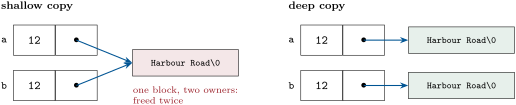
Buffer objects after Buffer b = a;. Each object holds the length of the text, 12, and a pointer to a block of 13 bytes. On the left, the compiler’s copy: both pointers name the same block. On the right, a copy constructor that allocates: each object owns its block.The fix writes the copy constructor and the copy assignment by hand. The constructor allocates a block of its own and copies the characters; the assignment is written in the form of Section 2.2.
class Buffer {
public:
    explicit Buffer(const char *text) : n_(std::strlen(text)), data_(new char[n_ + 1])
    {
        std::memcpy(data_, text, n_ + 1);
    }
    ~Buffer() { delete[] data_; }
    Buffer(const Buffer &o) : n_(o.n_), data_(new char[o.n_ + 1])   // a block of its own
    {
        std::memcpy(data_, o.data_, n_ + 1);
    }
    Buffer &operator=(const Buffer &o)          // copy and swap
    {
        Buffer tmp(o);                          // may throw: *this not touched yet
        std::swap(n_, tmp.n_);
        std::swap(data_, tmp.data_);
        return *this;                           // tmp dies with the old block
    }
    const char *c_str() const { return data_; }
    std::size_t size() const { return n_; }
    void upcase_first() { if (n_ > 0 && data_[0] >= 'a' && data_[0] <= 'z') data_[0] -= 32; }

private:
    std::size_t n_;
    char *data_;
};$ g++ -std=c++20 -O0 -g -fsanitize=address -o deep_copy deep_copy.cpp && ./deep_copy
harbour Road / Harbour Road / harbour Road
three blocks: trueChanging b left a alone, and the sanitizer found nothing to report. The three functions written here, the destructor, the copy constructor and the copy assignment, go together: a class that needs one of them almost always needs the three, since a destructor that frees means a raw resource that a member-wise copy would share. This is the rule of three, which Section 2.4 completes.
2.2 Value semantics
Definition 2.3 (Value semantics, reference semantics)
A type has value semantics if a copy of an object is a new, independent object with the same value: changing one never changes the other, as with int, std::string and the Buffer of Listing 2.3. A type has reference semantics if copying an object gives a second name for the same underlying data, as with a pointer, or with every object in Python.
The C++ standard library gives its containers value semantics, and a class that owns memory should do the same unless there is a reason not to. The assignment of Listing 2.3 has a pattern of its own, named after its two steps.
Method 2.4 (Copy and swap)
To write T &operator=(const T &o) for a class that owns resources:
- make a local copy
tmpofowith the copy constructor (all the work that may fail happens here, before*thisis touched); - exchange the members of
*thisandtmp, with operations that cannot throw (std::swapof pointers and numbers); - return
*this; at the end of the function,tmpis destroyed and frees the old resources.
Proposition 2.5 (Copy and swap is strong)
An assignment written by Method 2.4 gives the strong guarantee: if it throws, the target is unchanged. It is also correct when the source and the target are the same object.
Proof. Only step 1 can throw, since swaps of pointers and integers cannot. If it throws, the copy constructor has cleaned up after itself (its partly built members are destroyed, Chapter 1), and no statement has yet changed *this: the target keeps its value. If step 1 succeeds, tmp holds an independent copy of the value of o; the swaps give that value to *this and the old resources to tmp, whose destructor frees them. When o is *this, step 1 copies the target’s own value into fresh blocks before anything is freed, so the result is again that value. ∎
The self-assignment case is not academic: v[i] = v[j] with is one, and an assignment written as “free my block, allocate a new one, copy the source’s characters” reads freed memory in that case (Exercise 2.2). The price of copy and swap is a new allocation even when the target’s block was large enough; the standard containers reuse the target’s memory when they can, and in exchange do not promise the strong guarantee for their assignment.
2.3 Moving
A copy is the right meaning of b = a when a is used afterwards. When the source is a temporary about to be destroyed, copying its block and then freeing the original is wasted work: the target could take the block itself. C++ tells the two cases apart by the kind of expression the source is.
Definition 2.6 (Value category, lvalue, rvalue)
Every expression has a value category. An lvalue names an object that outlives the expression: a variable a, *p, v[i]. A prvalue computes a value that no name holds yet: 42, x + y, a call f() returning by value, Buffer("Quay"). An xvalue names an object whose resources may be taken, such as std::move(a). Prvalues and xvalues together are the rvalues.
Definition 2.7 (Rvalue reference)
An rvalue reference T && is a reference that binds only to rvalues. When a function is overloaded on const T & and T &&, a call with an lvalue picks the first and a call with an rvalue picks the second. std::move(a) does not move anything: it is a cast of the lvalue a to an xvalue, which tells the overload resolution that a may be emptied.
Definition 2.8 (Move constructor, move assignment, moved-from object)
The move constructor T(T &&o) and the move assignment operator T &operator=(T &&o) build or assign from an rvalue by taking o’s resources rather than copying them. Afterwards o is a moved-from object: it must still be valid, which means it can be destroyed and assigned a new value, but its value is unspecified unless its class documents it.
Rvalue references and moves arrived in C++11. The Buffer below has both a copy and a move constructor, each announcing itself; the move takes the pointer and leaves the source with none.
    Buffer(const Buffer &o) : n_(o.n_), data_(new char[n_ + 1])
    {
        std::memcpy(data_, o.data_, n_ + 1);
        std::puts("  copy constructor");
    }
    Buffer(Buffer &&o) noexcept : n_(o.n_), data_(o.data_)     // steal the block
    {
        o.n_ = 0;
        o.data_ = nullptr;                                     // the source owns nothing
        std::puts("  move constructor");
    }
    const char *c_str() const { return data_ ? data_ : "(empty)"; }

private:
    std::size_t n_;
    char *data_;
};

Buffer label(const char *t) { return Buffer(t); }   // a prvalue: built in place

int main()
{
    Buffer a("Mill Lane");
    std::puts("Buffer b = a;");
    Buffer b = a;                       // a is an lvalue: copy
    std::puts("Buffer c = std::move(a);");
    Buffer c = std::move(a);            // std::move(a) is an xvalue: move
    std::puts("Buffer d = label(...);");
    Buffer d = label("Quay Street");    // guaranteed elision: neither
    std::printf("a=%s b=%s c=%s d=%s\n", a.c_str(), b.c_str(), c.c_str(), d.c_str());
    return 0;
}$ g++ -std=c++20 -O0 -g -fsanitize=address -o move_demo move_demo.cpp && ./move_demo
Buffer b = a;
copy constructor
Buffer c = std::move(a);
move constructor
Buffer d = label(...);
a=(empty) b=Mill Lane c=Mill Lane d=Quay Streeta empty.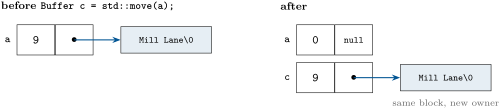
a into c and then empties a, so that exactly one object owns the block. Nothing is allocated, and the cost does not depend on the length of the text.The third statement printed no constructor at all: label returns the prvalue Buffer(t), and C++17 requires that it be built directly in d.
Definition 2.9 (Copy elision)
Copy elision is the construction of an object directly in its final place, which removes a copy or move. Since C++17 it is guaranteed when an object is initialised from a prvalue of its type: T x = T(...), T x = f() with f returning a prvalue, and return T(...);. When a function returns a named local object, the compiler may also build it in the caller’s object (the named return value optimisation), but is not required to; if it does not, the return moves.
This is the first line of Output 2.1: make_readings returns its local vector v by name, the compiler built v in the caller’s r, and had it not done so the return would have moved the vector, which copies three pointers and touches no element. The first line counts element copies and moves, so it would read the same either way: what it shows is that no element was copied, not which of the two happened. Returning a large object by value is therefore cheap in C++, and the usual style.
In practice — When to write std::move
Write std::move(x) only when x is a named object you will not read again: passing it to a function that keeps it, or pushing it into a container. Do not write return std::move(local);: it turns the returned name into an xvalue, which forbids the elision and forces a move. Do not move from a const object: std::move gives a const T &&, which binds only to the copy constructor, and the “move” silently copies.
A vector that grows faces the same choice. When it carries its elements to a larger block, moving them is cheaper than copying them. But if one move throws halfway, some elements are in the new block and some, already moved from, in the old one, and the strong guarantee of push_back is lost. The library therefore moves only if the move constructor is declared noexcept, and copies otherwise. Tracked, the type of the opening, comes in two versions that differ only in that word.
class Tracked {                        // its move constructor promises not to throw
public:
    explicit Tracked(int v = 0) : v_(v) {}
    Tracked(const Tracked &o) : v_(o.v_) { counts.copies++; }
    Tracked(Tracked &&o) noexcept : v_(o.v_) { counts.moves++; }
    Tracked &operator=(const Tracked &o) { v_ = o.v_; counts.copies++; return *this; }
    Tracked &operator=(Tracked &&o) noexcept { v_ = o.v_; counts.moves++; return *this; }
    int value() const { return v_; }

private:
    int v_;
};

class TrackedMayThrow {                // the same, without noexcept on the moves
public:
    explicit TrackedMayThrow(int v = 0) : v_(v) {}
    TrackedMayThrow(const TrackedMayThrow &o) : v_(o.v_) { counts.copies++; }
    TrackedMayThrow(TrackedMayThrow &&o) : v_(o.v_) { counts.moves++; }
    TrackedMayThrow &operator=(const TrackedMayThrow &o)
        { v_ = o.v_; counts.copies++; return *this; }
    TrackedMayThrow &operator=(TrackedMayThrow &&o)
        { v_ = o.v_; counts.moves++; return *this; }
int value() const { return v_; }template <class T> void fill(const char *name, int n)
{
counts = Counts{};
std::vector<T> v;
std::size_t cap = v.capacity(), regrowths = 0;
for (int i = 0; i < n; i++) {
v.push_back(T(i)); // the temporary T(i) is moved in
if (v.capacity() != cap) {
regrowths++;
cap = v.capacity();
}
}
std::printf("%-16s n=%d: %2zu regrowths, capacity %zu, %ld copies, %ld moves\n",
name, n, regrowths, cap, counts.copies, counts.moves);
}$ g++ -std=c++20 -O2 -Wall -Wextra -o growth growth.cpp && ./growth
noexcept move n=1000: 11 regrowths, capacity 1024, 0 copies, 2023 moves
move may throw n=1000: 11 regrowths, capacity 1024, 1023 copies, 1000 moves
noexcept move n=1025: 12 regrowths, capacity 2048, 0 copies, 3072 moves
move may throw n=1025: 12 regrowths, capacity 2048, 2047 copies, 1025 movesEach push moves its temporary into the vector, hence moves in every line. With the capacity went in 11 regrowths, which carried elements: 1023 more moves with noexcept, 1023 copies without it. The count is bounded for any growth factor.
Proposition 2.10 (Transfers of a growing array)
An array starts empty and receives elements by appends. Whenever it is full, it moves to a block whose capacity is at least times the old one, for a fixed , and carries all its elements over. Then the total number of elements carried over is less than . For elements whose move constructor is noexcept, each transfer of a std::vector is a move and no element is ever copied; otherwise each transfer is a copy.
Proof. Let be the capacities at which the array was full and regrew; regrowth carries elements. Since , we have , and
The last regrowth happened when the array already held elements and received another, so , and the sum is less than . If there was no regrowth the sum is . The last sentence is the rule of the library: it transfers with the move constructor exactly when that constructor cannot throw, or when there is no copy constructor. ∎
For the bound is ; the run made 1023 transfers for , under 1998, and 2047 for , under 2048. With just above a power of two the bound is nearly reached (Exercise 2.11). Added to the insertions themselves, a vector of elements is filled with fewer than element operations, which is the amortised constant cost recalled at the start, now counted exactly.
2.4 The rule of zero and the rule of five
A class can declare five special members beyond its ordinary constructors: the destructor, the copy constructor, the copy assignment, the move constructor and the move assignment. The compiler writes the missing ones, member by member, under rules that come down to this: declaring a destructor or a copy operation stops the compiler from writing the moves (copies are used instead), and declaring a move operation deletes the copies.
Definition 2.11 (Rule of zero, rule of five)
The rule of zero says that a class whose members all manage their own resources (strings, containers, smart pointers) should declare none of the five special members: the member-wise versions the compiler writes are correct. The rule of five says that a class that manages a resource itself, and so declares one of the five, should declare all five, each written or explicitly = default or = delete.
Method 2.12 (Applying the rule of zero)
To give a class correct copies and moves:
- hold each resource in a member of a type that already owns it:
std::string,std::vector,std::unique_ptr, or a small class of your own written once by the rule of five; - declare none of the five special members in the class itself;
- check the result: the class copies if every member copies, and moves cheaply if every member moves cheaply.
struct Station {                        // rule of zero: none of the five is written
    std::string name;
    std::vector<double> readings;
};

struct Sensor {                         // a move-only member makes the class move-only
    std::string id;
    std::unique_ptr<int> calibration;
};

int main()
{
    Station a{"Riverside", {18.5, 19.0}};
    Station b = a;                      // member-wise copy: a deep copy
    b.readings.push_back(21.5);
    Station c = std::move(b);           // member-wise move
    std::cout << a.readings.size() << ' ' << c.readings.size() << ' '
              << b.readings.size() << '\n';
    Sensor s{"T-4", std::make_unique<int>(12)};
    Sensor t = std::move(s);            // fine; Sensor u = t; would not compile
    std::cout << t.id << ' ' << *t.calibration << ' '
        << (s.calibration ? "full" : "empty") << '\n';
    return 0;
}$ g++ -std=c++20 -O2 -Wall -Wextra -o rule_of_zero rule_of_zero.cpp && ./rule_of_zero
2 3 0
T-4 12 emptyStation copies and moves correctly with no code at all, because std::string and std::vector do. Sensor cannot be copied, because one member cannot: a member that is move-only makes its class move-only. The moved-from b.readings printed 0, which is what the library’s vector leaves behind, though only its validity is promised. Of the five special members, a class following the rule of zero writes none; Buffer, which manages a raw block, is the kind of class that writes them all, once (Exercise 2.3).
2.5 Smart pointers
In C, a pointer returned by a function says nothing about who must free the block. C++ separates the two meanings of a pointer: an owning pointer, whose holder must free the object, and a plain pointer or reference, which only refers to an object owned by someone else. Owning pointers are objects of the standard library.
Definition 2.13 (Smart pointer, unique pointer, unique ownership)
A smart pointer is a class that holds a pointer to a heap object and releases the object in its destructor. The unique pointer std::unique_ptr<T> is the sole owner of its object (unique ownership): it cannot be copied, it can be moved, which transfers the ownership and leaves the source null, and its destructor deletes the object if it holds one. std::make_unique<T>(args) allocates and constructs the object.
struct Photo {
    std::string name;
    explicit Photo(std::string n) : name(std::move(n))
        { std::printf("  load %s\n", name.c_str()); }
    ~Photo() { std::printf("  free %s\n", name.c_str()); }
};

std::unique_ptr<Photo> open_photo(const char *name)
{
    return std::make_unique<Photo>(name);        // ownership leaves the function
}

int main()
{
    std::vector<std::unique_ptr<Photo>> album;
    album.push_back(open_photo("pier.jpg"));
    auto p = open_photo("dunes.jpg");
    album.push_back(std::move(p));               // album.push_back(p) does not compile
    std::printf("p is %s, album holds %zu\n", p ? "full" : "empty", album.size());
    album.erase(album.begin());                  // the photo goes with its owner
    std::puts("end of main");
    return 0;
}$ g++ -std=c++20 -O0 -g -fsanitize=address -o unique unique.cpp && ./unique
load pier.jpg
load dunes.jpg
p is empty, album holds 2
free pier.jpg
end of main
free dunes.jpgA std::unique_ptr holds one pointer and nothing else, so it costs what a raw pointer costs. The rule that follows is short: new and delete no longer appear in application code. Sometimes, though, an object has several owners and none of them knows which will finish last: a photo shown in two albums, a cached page held by several requests.
The count makes a shared pointer cost more than a unique one (a second block, and an update of the count on every copy), and it has a blind spot. In the program below a photo owns its album and the album owns its cover photo.
struct Album;
struct Photo {
    std::string name;
    std::shared_ptr<Album> album;               // a photo keeps its album alive
    ~Photo() { std::printf("free photo %s\n", name.c_str()); }
};
struct Album {
    std::string title;
    std::shared_ptr<Photo> cover;               // an album keeps its cover alive
    ~Album() { std::printf("free album %s\n", title.c_str()); }
};

int main()
{
    auto a = std::make_shared<Album>();
    a->title = "Coast";
    auto p = std::make_shared<Photo>();
    p->name = "pier.jpg";
    p->album = a;
    a->cover = p;
    std::printf("counts: album %ld, photo %ld\n", a.use_count(), p.use_count());
    std::fflush(stdout);                        // the leak report ends the program at once
    return 0;                                   // a and p die; the counts drop to 1
}$ g++ -std=c++20 -O0 -g -fsanitize=address -o shared_cycle shared_cycle.cpp && ./shared_cycle
counts: album 2, photo 2
=================================================================
==1000==ERROR: LeakSanitizer: detected memory leaks
Indirect leak of 64 byte(s) in 1 object(s) allocated from:
#0 0x7ffff74b61e7 in operator new(unsigned long) ../../../../src/libsanitizer/asan/asan_new_delete.cpp:99
#10 0x5555555576a4 in main shared_cycle.cpp:23
#11 0x7ffff6c29d8f (/lib/x86_64-linux-gnu/libc.so.6+0x29d8f)
Indirect leak of 64 byte(s) in 1 object(s) allocated from:
#0 0x7ffff74b61e7 in operator new(unsigned long) ../../../../src/libsanitizer/asan/asan_new_delete.cpp:99
#10 0x555555557655 in main shared_cycle.cpp:21
#11 0x7ffff6c29d8f (/lib/x86_64-linux-gnu/libc.so.6+0x29d8f)
SUMMARY: AddressSanitizer: 128 byte(s) leaked in 2 allocation(s).
[exit status 1]Neither destructor printed. When main returned, a and p were destroyed and each count fell from 2 to 1, the one held by the other object. Nothing outside the pair points to it any more, but each keeps the other above zero: the count only sees owners, not whether they are reachable. The fix is to decide that one direction of the edge observes rather than owns. A photo needs to know its album, but does not keep it alive.
struct Album;
struct Photo {
    std::string name;
    std::weak_ptr<Album> album;                 // does not keep the album alive
    ~Photo() { std::printf("free photo %s\n", name.c_str()); }
};
struct Album {
    std::string title;
    std::shared_ptr<Photo> cover;
    ~Album() { std::printf("free album %s\n", title.c_str()); }
};

int main()
{
    auto p = std::make_shared<Photo>();
    p->name = "pier.jpg";
    {
        auto a = std::make_shared<Album>();
        a->title = "Coast";
        p->album = a;
        a->cover = p;
        if (auto alb = p->album.lock())         // a shared_ptr while we use it
            std::printf("pier.jpg is in %s (album count %ld)\n",
                alb->title.c_str(), a.use_count());
    }
    std::printf("album gone: %s\n", p->album.expired() ? "yes" : "no");
    return 0;
}$ g++ -std=c++20 -O0 -g -fsanitize=address -o weak_fix weak_fix.cpp && ./weak_fix
pier.jpg is in Coast (album count 2)
free album Coast
album gone: yes
free photo pier.jpg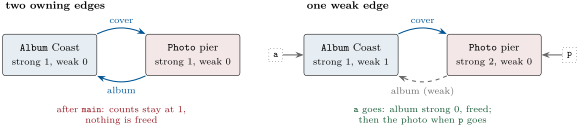
make_shared carries a control block counting its strong owners and its weak observers. Left: the cycle of Listing 2.9 once a and p are gone. Right: inside the block of Listing 2.10, while a and p still exist; the dashed edge does not count, so the album dies with a.In practice — Choosing an owner
Most objects should have exactly one owner, and std::unique_ptr or a plain member says so. Reach for std::shared_ptr only when the lifetime is genuinely shared, and then draw the ownership graph: every cycle in it must contain a weak edge. Pointers back to a parent, to an observer, or to a cache entry are the usual candidates. A child owned by its parent can even point back with a raw pointer, since the parent always outlives it (Exercise 2.9). Book 5 returns to reference counting as a technique for managing memory, and to its alternatives.
Moving costs a few pointer copies whatever the size of the object; copying costs time proportional to the data. The program below measures both for vectors of double of growing length.
int main()
{
    std::printf("%10s %14s %12s\n", "n", "copy (ns)", "move (ns)");
    for (int n = 1000; n <= 10000000; n *= 10) {
        std::vector<double> src(n, 1.5), dst;
        int reps = n >= 1000000 ? 20 : 2000;
        double c = ns([&] { dst = src; }, reps);   // dst already has room after the first copy
        std::vector<double>().swap(dst);                   // free dst before timing the moves
        double m = ns([&] { dst = std::move(src); src = std::move(dst); }, reps) / 2;
        std::printf("%10d %14.0f %12.1f\n", n, c, m);
    }
    return 0;
}ns returns the mean time of reps calls of its argument) code/bachelor-2/02-cpp-copy-move/listings/copy_vs_move.cpp$ g++ -std=c++20 -O2 -Wall -Wextra -o copy_vs_move copy_vs_move.cpp && ./copy_vs_move
n copy (ns) move (ns)
1000 39 0.2
10000 1388 0.2
100000 14065 0.2
1000000 387601 1.1
10000000 4900761 1.6The copy grows with : from a few hundredths to about a tenth of a nanosecond per element while the vectors fit in the processor’s caches, and about half a nanosecond once they do not (Chapter 12). The move stays below two nanoseconds whatever the length, because it copies three pointers and empties the source.
2.6 Exercises
Exercise 2.1 ★
Using Tracked from Listing 2.5, say for each of the lines A to F whether it copies, moves, or neither, and give the two numbers the program prints.
Tracked pass(Tracked t) { return t; }

int main()
{
    Tracked a(1);
    Tracked b = a;                              // line A
    Tracked c = std::move(a);                   // line B
    b = c;                                      // line C
    Tracked d = pass(b);                        // line D
    std::vector<Tracked> v;
    v.reserve(4);
    v.push_back(d);                             // line E
    v.push_back(Tracked(5));                    // line F
    std::printf("%ld copies, %ld moves\n", counts.copies, counts.moves);
    return 0;
}Solution
Solution of Exercise 2.1.
A: a is an lvalue, copy. B: std::move(a) is an xvalue, move. C: assignment from the lvalue c, copy assignment. D: the lvalue b initialises the parameter t by copy; return t; cannot be elided (a parameter is not built in the return slot) and moves. E: the lvalue d is copied into the vector. F: the prvalue Tracked(5) binds to push_back(T &&) and is moved in; thanks to reserve(4) no regrowth carries anything. Total: copies A, C, D, E and moves B, D, F.
$ g++ -std=c++20 -O2 -Wall -Wextra -o exo_count exo_count.cpp && ./exo_count
4 copies, 3 movesExercise 2.2 ★
The class Text below has a copy assignment written the obvious way. The program assigns an object to itself. Run under AddressSanitizer, it stops at once. Explain the report, then fix the assignment twice: with a test for self-assignment, and with Method 2.4. Which fix also gives the strong guarantee?
class Text {
public:
    explicit Text(const char *s) : data_(new char[std::strlen(s) + 1])
        { std::strcpy(data_, s); }
    ~Text() { delete[] data_; }
    Text(const Text &o) : data_(new char[std::strlen(o.data_) + 1])
        { std::strcpy(data_, o.data_); }
    Text &operator=(const Text &o)
    {
        delete[] data_;                                  // free the old text
        data_ = new char[std::strlen(o.data_) + 1];      // take room for the new one
        std::strcpy(data_, o.data_);
        return *this;
    }
    const char *c_str() const { return data_; }

private:
    char *data_;
};

int main()
{
    Text t("Old Harbour");
    Text &alias = t;
    t = alias;
    std::puts(t.c_str());
    return 0;
}$ g++ -std=c++20 -O0 -g -fsanitize=address exo_selfassign.cpp -o exo_selfassign
$ ./exo_selfassign
=================================================================
==1000==ERROR: AddressSanitizer: heap-use-after-free on address 0x502000000010 at pc 0x7ffff743daa7 bp 0x7fffffffebd0 sp 0x7fffffffe378
READ of size 2 at 0x502000000010 thread T0
#0 0x7ffff743daa6 in __interceptor_strlen ../../../../src/libsanitizer/sanitizer_common/sanitizer_common_interceptors.inc:389
#1 0x5555555555f7 in Text::operator=(Text const&) ~/session/exo_selfassign.cpp:15
#2 0x5555555553cc in main ~/session/exo_selfassign.cpp:29Solution
Solution of Exercise 2.2.
o is *this, so delete[] data_ frees the very text that strlen(o.data_) then reads: the report says so, a read of freed memory inside Text::operator= on line 15, called from line 29. First fix: begin with if (this == &o) return *this;. It cures self-assignment, but if new then throws, data_ still holds the freed pointer and the destructor will free it again: the operation does not even give the basic guarantee. Second fix, by Method 2.4: Text tmp(o); std::swap(data_, tmp.data_); return *this;. The copy is made before anything is freed, so self-assignment works without a test, and by Proposition 2.5 a throwing new leaves the target unchanged: only this fix is strong.
Exercise 2.3 ★
Complete the Buffer of Listing 2.3 by the rule of five: add a noexcept move constructor that leaves the source empty, and replace the copy assignment by a single assignment operator=(Buffer o) that takes its parameter by value. Explain why this one function serves as both copy and move assignment.
Solution
Solution of Exercise 2.3.
class Buffer {
public:
    explicit Buffer(const char *text) : n_(std::strlen(text)), data_(new char[n_ + 1])
    {
        std::memcpy(data_, text, n_ + 1);
    }
    ~Buffer() { delete[] data_; }
    Buffer(const Buffer &o) : n_(o.n_), data_(new char[o.n_ + 1])
    {
        std::memcpy(data_, o.data_, n_ + 1);
    }
    Buffer(Buffer &&o) noexcept : n_(std::exchange(o.n_, 0)),
        data_(std::exchange(o.data_, nullptr)) {}
    Buffer &operator=(Buffer o) noexcept  // by value: copied or moved by the caller's argument
    {
        std::swap(n_, o.n_);
        std::swap(data_, o.data_);
        return *this;                         // o dies with the old block
    }
    const char *c_str() const { return data_ ? data_ : ""; }
    std::size_t size() const { return n_; }

private:
    std::size_t n_;
    char *data_;
};
Buffer by the rule of five code/bachelor-2/02-cpp-copy-move/exercises/buffer5.hppstd::exchange(x, v) sets x to v and returns its old value, which writes “take and empty” in one expression. The parameter o of operator= is a new object built by the caller: by the copy constructor if the argument is an lvalue, by the move constructor (or directly, by elision) if it is an rvalue. Either way the body only swaps, and o takes the old block away with it. One function therefore provides both assignments; the price is a move constructor call more than a dedicated move assignment would make. Tested in tests/buffer_test.cpp.
Exercise 2.4 ★
A vector doubles its capacity from 1 whenever it is full. Count exactly the elements carried over while it receives elements, then . Check both against Proposition 2.10 and against Output 2.5.
Solution
Solution of Exercise 2.4.
With elements, the regrowths happen when the array is full at capacities , which carry elements. With there is one more regrowth, at , and the total is . Both are less than , the bound of Proposition 2.10 for . The run: lies between and , so the regrowths are those of , 1023 transfers; gives . Both match Output 2.5.
Exercise 2.5 ★★
For each of the eight numbered statements, say which special member of W runs, or that none does, and which rule of the chapter decides it. One of the eight depends on the compiler: which one, and what may another compiler print?
struct W {
    W() { std::puts("default"); }
    W(const W &) { std::puts("copy constructor"); }
    W(W &&) noexcept { std::puts("move constructor"); }
    W &operator=(const W &) { std::puts("copy assignment"); return *this; }
    W &operator=(W &&) noexcept { std::puts("move assignment"); return *this; }
};

W make() { return W(); }
W named() { W w; return w; }

int main()
{
    W a;                         // 1
    W b(a);                      // 2
    W c = std::move(b);          // 3
    a = c;                       // 4
    a = make();                  // 5
    [[maybe_unused]] W d = make();   // 6
    [[maybe_unused]] W e = named();  // 7
    const W f;
    [[maybe_unused]] W g = std::move(f);   // 8
    return 0;
}Solution
Solution of Exercise 2.5.
$ g++ -std=c++20 -O2 -Wall -Wextra -o exo_which exo_which.cpp && ./exo_which
default
copy constructor
move constructor
copy assignment
default
move assignment
default
default
default
copy constructor1: default constructor. 2: a is an lvalue, copy constructor. 3: an xvalue, move constructor. 4: assignment from an lvalue, copy assignment. 5: make() builds its W() (default) in a temporary, by guaranteed elision, and the temporary, an rvalue, is move-assigned to a. 6: guaranteed elision builds the result of make directly in d: default only. 7: named returns a named local; this compiler applied the named return value optimisation, so only default is printed. That is the statement that depends on the compiler: without the optimisation it prints default then move constructor. 8: f is built (default); std::move(f) has type const W &&, which cannot bind to W && but binds to const W &: the copy constructor runs.
Exercise 2.6 ★★
The program below should keep, for each day, the day’s list of jobs. Explain the output. Is it undefined behaviour? Fix the loop so that each day starts from the same three jobs, and say which line of the fix copies.
int main()
{
    std::vector<std::string> jobs = {"backup", "rotate logs", "send report"};
    std::vector<std::vector<std::string>> history;
    for (int day = 1; day <= 3; day++) {
        history.push_back(std::move(jobs));            // keep today's list
        std::cout << "day " << day << ": " << jobs.size() << " jobs\n";
    }
    std::cout << "history: " << history[0].size() << ' ' << history[1].size() << ' '
              << history[2].size() << '\n';
    return 0;
}$ g++ -std=c++20 -O2 -Wall -Wextra -o exo_after_move exo_after_move.cpp && ./exo_after_move
day 1: 0 jobs
day 2: 0 jobs
day 3: 0 jobs
history: 3 0 0Solution
Solution of Exercise 2.6.
The first push_back(std::move(jobs)) move-constructs the day’s list in history, and a vector’s move constructor leaves its source empty; from day 2 on, the empty jobs is moved, which gives empty lists. This is not undefined behaviour: a moved-from vector is valid, and calling size on it is allowed; the program does exactly what it says. The fix keeps jobs and copies it: history.push_back(jobs);, which is the line that copies (the three strings are copied, three times in all). If jobs is not needed after the loop, the last day may still move it.
Exercise 2.7 ★★
Write a class template UniquePtr<T> with the behaviour of Definition 2.13: a constructor from T *, no copies, a noexcept move constructor and move assignment (a self-move must not delete the object), *, ->, get, release, reset and a test for null. Test that a vector of a hundred UniquePtr frees each object exactly once.
Solution
Solution of Exercise 2.7.
template <class T> class UniquePtr {
public:
    UniquePtr() noexcept = default;
    explicit UniquePtr(T *p) noexcept : p_(p) {}
    ~UniquePtr() { delete p_; }
    UniquePtr(const UniquePtr &) = delete;
    UniquePtr &operator=(const UniquePtr &) = delete;
    UniquePtr(UniquePtr &&o) noexcept : p_(std::exchange(o.p_, nullptr)) {}
    UniquePtr &operator=(UniquePtr &&o) noexcept
    {
        if (this != &o)
            reset(std::exchange(o.p_, nullptr));
        return *this;
    }
    T &operator*() const { return *p_; }
    T *operator->() const noexcept { return p_; }
    T *get() const noexcept { return p_; }
    explicit operator bool() const noexcept { return p_ != nullptr; }
    T *release() noexcept { return std::exchange(p_, nullptr); }
    void reset(T *p = nullptr) noexcept
    {
        T *old = std::exchange(p_, p);        // set first: old's destructor may look at us
        delete old;
    }

private:
    T *p_ = nullptr;
};
UniquePtr code/bachelor-2/02-cpp-copy-move/exercises/unique_ptr.hppThe move assignment tests this != &o. With reset written as above, a self-move would be a no-op even without the test: the pointer is taken, which leaves p_ null, then put back, and the old p_ deleted is null, so nothing is deleted. The test only saves the two exchanges; it is needed with a reset that deletes the old pointer before storing the new one. The order “store the new pointer, then delete the old” also keeps the class correct when the deleted object’s destructor reaches back to its owner. tests/exercises_test.cpp counts live objects: a hundred UniquePtr pushed into a vector, which moves them at each regrowth, are freed exactly once each when the vector goes, and a moved-from pointer is null.
Exercise 2.8 ★★
Prove Proposition 2.5 again in the form of Exercise 2.3, where the parameter is taken by value. Where does the copy that may throw now happen, and why is the target still unchanged if it throws? Does the move assignment that this function also provides give the strong guarantee?
Solution
Solution of Exercise 2.8.
With Buffer &operator=(Buffer o) noexcept, the copy that may throw is the initialisation of the parameter o, which happens at the call, before the body of operator= starts. If it throws, operator= is never entered and no statement has touched the target: it keeps its value, which is the strong guarantee. If it succeeds, the body only swaps pointers and numbers, which cannot throw, and the destructor of o frees the old block, which does not throw either. For an rvalue argument, o is built by the noexcept move constructor, so the whole assignment cannot throw: it gives the no-throw guarantee, which implies the strong one. Self-assignment works as before, since o is a separate copy.
Exercise 2.9 ★★
Represent a tree of named places (town, quarters, buildings) with nodes that own their children through std::vector<std::unique_ptr<Node>> and point to their parent with a raw Node *. Write add, path (town/west/mill) and move_child(i, to), which moves a whole subtree under another node. Why is a raw parent pointer safe here, and why would a std::shared_ptr to the parent leak? Does the moved subtree change address?
Solution
Solution of Exercise 2.9.
struct Node {
    std::string name;
    Node *parent = nullptr;                          // observes; never deletes
    std::vector<std::unique_ptr<Node>> children;     // owns

    explicit Node(std::string n) : name(std::move(n)) {}
    Node &add(std::string n)
    {
        children.push_back(std::make_unique<Node>(std::move(n)));
        children.back()->parent = this;
        return *children.back();
    }
    std::string path() const
    {
        return parent ? parent->path() + "/" + name : name;
    }
    // Moves the subtree rooted at child i under the node `to` (not inside that subtree).
    void move_child(std::size_t i, Node &to)
    {
        std::unique_ptr<Node> c = std::move(children[i]);
        children.erase(children.begin() + i);
        c->parent = &to;
        to.children.push_back(std::move(c));
    }
};
A node is owned by the vector of its parent, so it is destroyed no later than its parent: whenever a node exists, its parent exists, and the raw pointer never dangles; move_child keeps this true by updating it. Had each child held a std::shared_ptr to its parent, with the parent holding its children by shared_ptr, each parent–child pair would be a cycle of owners and the whole tree would leak, as in Output 2.8. The moved subtree keeps its address: only the unique_ptr that owns it moves from one vector to the other, and the test checks that &mill is unchanged.
Exercise 2.10 ★★★
Write a string class SmallString that keeps strings of at most 15 characters inside the object, in a member array, and longer ones in a heap block (a small-buffer optimisation). Give it the five special members. What must the move constructor do when the source is small, and why is it then not cheaper than a copy? Test copies and moves between every combination of small and long strings, self-assignment, and growth of a vector of them.
Solution
Solution of Exercise 2.10.
    SmallString(const char *s = "") { init(s, std::strlen(s)); }
    ~SmallString() { if (!is_small()) delete[] ptr_; }
    SmallString(const SmallString &o) { init(o.ptr_, o.n_); }
    SmallString(SmallString &&o) noexcept { take(o); }
    SmallString &operator=(const SmallString &o)
    {
        if (this != &o) {
            SmallString tmp(o);                        // may throw; *this untouched
            *this = std::move(tmp);
        }
        return *this;
    }
    SmallString &operator=(SmallString &&o) noexcept
    {
        if (this != &o) {
            if (!is_small())
                delete[] ptr_;                         // free our block, then take o's state
            take(o);
        }
        return *this;
    }
    const char *c_str() const { return ptr_; }
    std::size_t size() const { return n_; }
    bool is_small() const { return ptr_ == buf_; }
    void take(SmallString &o) noexcept                 // o is left empty and small
    {
        n_ = o.n_;
        if (o.is_small()) {
            std::memcpy(buf_, o.buf_, n_ + 1);         // nothing to steal: copy the few bytes
            ptr_ = buf_;
        } else {
            ptr_ = std::exchange(o.ptr_, o.buf_);      // steal the block
        }
        o.n_ = 0;
        o.buf_[0] = '\0';
    }
SmallString code/bachelor-2/02-cpp-copy-move/exercises/small_string.hppA small string’s pointer points into the object’s own array buf_. Stealing it would leave the target pointing into the source, which is about to die; the move constructor must copy the characters into its own array and point to that. So moving a small string costs what copying it costs, at most 16 bytes, while moving a long one takes its block. The move assignment frees the target’s block, if it has one, and then takes the source’s state with take, the helper the move constructor also uses: nothing in it can throw. Destroying the target and rebuilding it in place with placement new would also work here, but it is a fragile habit, wrong as soon as the class is used as a base. tests/exercises_test.cpp covers copies and moves between small and long strings, self-assignment and self-move, and a vector of fifty strings that grows by moving them.
Exercise 2.11 ★★★
(a) Show that the bound of Proposition 2.10 cannot be improved to for any : exhibit, for , values of for which the number of transfers divided by tends to . (b) What does the proof give for , and how many transfers does a growth from 1 by the factor 1.5 rounded down, but by at least one place (capacities ), make up to ? (c) An array that grows by a fixed number of places instead of a factor makes how many transfers for elements? Conclude about the amortised cost.
Solution
Solution of Exercise 2.11.
(a) For and , Exercise 2.4 found transfers, and as : no constant can multiply the bound. (b) The proof gives transfers for any growth by a factor at least . The rounded rule does not satisfy that hypothesis ( is a factor , is ), so the proposition does not apply as stated; counting directly, the array is full and regrows at , which carry 284 elements for , still under . (c) With capacities , the regrowths up to carry elements with , about : quadratic in , so the amortised cost of an append grows like instead of staying constant. Only a multiplicative growth gives constant amortised cost.
Exercise 2.12 ★★★
A station keeps the displays that show its readings, and each display keeps its station. Explain the output, draw the ownership graph with the counts at the end of main, and fix the program with one std::weak_ptr. Which edge should it be, and why not the other? Prove that, in your fixed version, every object is freed when the last outside shared_ptr to the station goes, for any number of displays.
#include <vector>

struct Display;
struct Station {
    std::string name;
    std::vector<std::shared_ptr<Display>> watchers;     // to notify on each reading
    ~Station() { std::printf("free station %s\n", name.c_str()); }
};
struct Display {
    std::string room;
    std::shared_ptr<Station> source;                   // the station shown
    ~Display() { std::printf("free display %s\n", room.c_str()); }
};

void watch(const std::shared_ptr<Station> &s, const std::string &room)
{
    auto d = std::make_shared<Display>();
    d->room = room;
    d->source = s;
    s->watchers.push_back(d);
}

int main()
{
    auto s = std::make_shared<Station>();
    s->name = "Riverside";
    watch(s, "hall");
    watch(s, "office");
    std::printf("station count %ld\n", s.use_count());
    std::fflush(stdout);
    return 0;
}$ g++ -std=c++20 -O0 -g -fsanitize=address -o exo_observers exo_observers.cpp && ./exo_observers
station count 3
=================================================================
==1000==ERROR: LeakSanitizer: detected memory leaks
SUMMARY: AddressSanitizer: 232 byte(s) leaked in 4 allocation(s).
[exit status 1]Solution
Solution of Exercise 2.12.
station count 3: s and the source of each display. When main returns, s goes and the station’s count falls to 2; each display is owned once, by the station’s vector. The three objects own each other in two cycles (station and hall, station and office), nothing outside reaches them, and LeakSanitizer reports four blocks: the three objects, each with its control block, and the station’s vector of two pointers. The fix makes Display::source a std::weak_ptr<Station>. The other edge cannot be the weak one: the station’s vector is the only owner of each display, so with weak edges there the displays would die as soon as watch returned.
struct Station {
    std::string name;
    std::vector<std::shared_ptr<Display>> watchers;    // owns its displays
    Station() { alive++; }
    ~Station() { alive--; }
};
struct Display {
    std::string room;
    std::weak_ptr<Station> source;                     // observes: the fix
    Display() { alive++; }
    ~Display() { alive--; }
};

inline void watch(const std::shared_ptr<Station> &s, const std::string &room)
{
    auto d = std::make_shared<Display>();
    d->room = room;
    d->source = s;
    s->watchers.push_back(d);
}Proof that everything is freed. In the fixed version the station’s strong count counts only shared pointers held outside the station and its displays, since the displays hold weak ones. When the last of them goes the count reaches 0, so the station is destroyed; its members are destroyed, among them the vector, which destroys its shared pointers to the displays. Each display had exactly one strong owner, that vector, so each count reaches 0 and each display is destroyed; its weak_ptr member does not keep anything alive. This holds for any number of displays, and the test checks that the count of live objects returns to 0.
2.7 Problem: The photo library that copied itself
Problem 2.1
Weekend problem — The photo library that copied itself
A photo library edits images of pixels, one byte per pixel, held by value in an Image class that counts its copies and moves. It runs the same two-step edit in two styles and then files three images in an album.
class Image {
public:
    Image(int w, int h) : w_(w), h_(h), px_(std::size_t(w) * h, 128) {}
    Image(const Image &o) : w_(o.w_), h_(o.h_), px_(o.px_) { copies++; }
    Image(Image &&o) noexcept : w_(o.w_), h_(o.h_), px_(std::move(o.px_)) { moves++; }
    Image &operator=(const Image &o) { w_ = o.w_; h_ = o.h_; px_ = o.px_; copies++; return *this; }
    Image &operator=(Image &&o) noexcept { w_ = o.w_; h_ = o.h_; px_ = std::move(o.px_); moves++; return *this; }
    void add(int d) { for (auto &p : px_) p = std::uint8_t(p + d); }
    std::size_t bytes() const { return px_.size(); }

private:
    int w_, h_;
    std::vector<std::uint8_t> px_;
};
// Version 1: parameters by const reference, results by value.
Image brighten1(const Image &im) { Image out = im; out.add(10); return out; }
Image darken1(const Image &im) { Image out = im; out.add(-5); return out; }
// Version 2: parameters by value, changed in place and returned.
Image brighten2(Image im) { im.add(10); return im; }
Image darken2(Image im) { im.add(-5); return im; }
void report(const char *what)
{
    std::printf("%-34s %ld copies, %ld moves\n", what, copies, moves);
    copies = moves = 0;
}

int main()
{
    Image photo(4000, 3000);
    Image a = darken1(brighten1(photo));            report("1: const& in, value out");
    Image b = darken2(brighten2(photo));            report("2: by value, photo kept");
    Image c = darken2(brighten2(std::move(photo))); report("2: by value, photo moved in");
    std::vector<Image> album;
    album.push_back(a);
    album.push_back(std::move(b));
    album.push_back(std::move(c));                  report("3: three pushes, no reserve");
    std::printf("each copy: %zu bytes\n", a.bytes());
    return 0;
}Part I — Counting copies.
- How many bytes does one copy of an
Imageallocate and copy? - In version 1, which statements copy an
Imagewhenais computed? Predict the count of copies and moves for the first report. - Why does
return out;inbrighten1not count as a move in this run? What would it count with a compiler that does not apply the named return value optimisation? - In version 2, where does the one copy of the second report happen, and why must it happen if
photois used again? - Where do the two moves of the second report happen? Why is
return im;a move and not elided? - Why does the result of
brighten2reach the parameter ofdarken2with neither a copy nor a move?
Part II — Adding moves.
- Predict the third report (with
std::move(photo)). What may the program do withphotoafterwards? - Predict the fourth report: the three
push_backcalls, with the vector growing from capacity 0 as in Output 2.5. - How many bytes are copied in the whole run? Compare with a version where
Image’s move constructor lacksnoexcept. - Rewrite the album part with
album.reserve(3); what does the fourth report become? Imagedeclares its five special members only to count. Which of them would the rule of zero let it drop, and what would the class then do on a copy and a move?- State a rule for choosing between
const Image &andImageas the parameter type of an edit function, from the counts above.
Part III — Albums and photos.
- The library now lets one photo belong to several albums, and an album keeps its photos with
std::vector<std::shared_ptr<Photo>>. Why isstd::unique_ptrno longer possible? - Each photo keeps the list of albums that contain it, as
std::vector<std::shared_ptr<Album>>. Draw the ownership graph for two albums sharing one photo, with every strong count, once the library’s own pointers to the albums are gone. - Which objects leak? How many bytes, for photos of the size above?
- Fix it with weak pointers. Which edges become weak, and what are the counts afterwards?
- When an album is deleted, a photo’s list keeps an expired
weak_ptr. Write the loop that removes the expired entries, usingexpired()orlock(). - A photo shown on screen must not disappear while it is being drawn, even if its last album is deleted at that moment by another part of the program. Which call gives the drawing code that guarantee?
Part IV — What a copy costs.
- In Output 2.10, estimate the time per element of a copy for and for . Why do they differ?
- Estimate the time of one copy of an
Imagefrom those figures (its elements are bytes, notdoubles: state your assumption). - The library processes 50 000 photos a night with version 1 and then files them. Estimate the time spent in copies, and the time saved by version 2 with
std::move. - Why does the move column not grow with ? Name the members a move of
std::vectortouches. - A vector of images grows by doubling, without
reserve. With Proposition 2.10, bound the bytes copied ifImage’s moves were notnoexcept, for . - State the result of the problem: the number of transfers of a growing array, and what each costs with and without
noexceptmoves.
Solution
Solution of Problem 2.1.
$ g++ -std=c++20 -O2 -Wall -Wextra -o pipeline pipeline.cpp && ./pipeline
1: const& in, value out            2 copies, 0 moves
2: by value, photo kept            1 copies, 2 moves
2: by value, photo moved in        0 copies, 3 moves
3: three pushes, no reserve        1 copies, 5 moves
each copy: 12000000 bytes1. bytes, 12 MB, allocated and copied.
2. Image out = im; in brighten1 and the same line in darken1: 2 copies, 0 moves.
3. The compiler built each out directly in the caller’s object (named return value optimisation). Without it each return would move: 2 copies and 2 moves.
4. When photo, an lvalue, initialises the parameter im of brighten2. The edit changes im; if it shared photo’s pixels, photo would change too, and value semantics forbid that.
5. return im; in brighten2 and in darken2. A parameter is built by the caller before the call, in a place chosen before the return slot is known, so it cannot be built in the return slot; the language then treats the returned name as an rvalue and moves.
6. brighten2(photo) is a prvalue of type Image; it initialises the parameter of darken2 directly (guaranteed elision).
7. 0 copies, 3 moves: the parameter of brighten2 is now move-constructed. photo is moved-from: the program may destroy it or assign it a new value, and should not read its pixels.
8. First push: capacity 0 to 1, a copied (1 copy). Second: capacity 1 to 2, the one element moved over and b moved in (2 moves). Third: 2 to 4, two elements moved over and c moved in (3 moves). Total 1 copy and 5 moves, as printed.
9. Four copies in all, 48 MB. Without noexcept, the three transfers of regrowth become copies (the other moves are unchanged, since only the vector checks noexcept): seven copies, 84 MB.
10. No regrowth: 1 copy and 2 moves.
11. All five: the member-wise copy copies the pixel vector (a deep copy, the same work) and the member-wise move moves it, and the compiler’s moves are noexcept because the vector’s are. Only the counting is lost.
12. If the function needs its own copy of the argument to change it, take it by value: a caller who still needs its object pays the one copy it needs, and a caller with a temporary or a std::move pays nothing. If the function only reads, take const Image &. Version 1 copies even when the caller had a temporary.
13. A unique_ptr is the sole owner, and here a photo has one owner per album, none of which knows whether it will be the last.
14. Album 1 photo and album 2 photo (strong), photo album 1 and photo album 2 (strong). Once the library’s pointers are gone: photo strong 2, each album strong 1.
15. All three objects: each has a positive count and none is reachable. At least the photo’s 12 000 000 pixel bytes, plus the three objects and their control blocks.
16. The edges from the photo to its albums become weak: a photo observes the albums that contain it. While the library holds the albums: each album strong 1 and weak 1, the photo strong 2. When the library drops an album, its count reaches 0 and it is freed, which drops the photo to strong 1; when the second goes, the photo is freed too.
17. With C++20, std::erase_if(albums, gone); where gone is the lambda [](const std::weak_ptr<Album> &w) {return w.expired();}; or a loop that keeps the entries for which w.lock() is not null.
18. The drawing code holds a std::shared_ptr<Photo> for the whole drawing, obtained by copying another or by lock() on a weak_ptr: it is then one of the owners, and the count cannot reach 0 before it lets go. (Updating the count from several threads at once is the subject of Chapter 15.)
19. About 39 ns for elements, a few hundredths of a nanosecond per element; about 5 ms for , half a nanosecond per element. The small vectors stay in the caches, from which the processor copies many bytes per cycle; the large ones come from main memory, whose rate is about ten times lower.
20. Assuming a byte costs what it costs inside a large vector of double, about ns, a copy of 12 MB takes of the order of ms.
21. Version 1 makes 2 copies per photo: ms, of the order of a minute and a quarter per night. Version 2 with std::move makes none and saves all of it.
22. A move of a vector reads the three pointers of the source (start, end of the elements, end of the capacity), writes them into the target, and sets the source’s to null; it never touches the elements, so its time does not depend on .
23. With and doubling, fewer than transfers (in fact 1023); as copies of 12 MB each, at most about 24 GB copied (in fact about 12 GB). With noexcept moves, no pixel is copied.
24. Transfers of a growing array: fewer than for a growth factor , that is for doubling, and zero copies with noexcept moves: each transfer then costs a few pointer copies instead of a copy of the element’s data, 12 MB per image here.
本章定义的术语
- Copy constructor, copy assignment operator
- Copy elision
- Move constructor, move assignment, moved-from object
- Rule of zero, rule of five
- Rvalue reference
- Shallow copy, deep copy
- Shared pointer, shared ownership, weak pointer
- Smart pointer, unique pointer, unique ownership
- Value category, lvalue, rvalue
- Value semantics, reference semantics