এই বইটি এখনো বাংলা ভাষায় পাওয়া যায় না। সংস্করণ: English।
University Computer Science — Year 2 · স্নাতক দ্বিতীয় বর্ষ
4Templates and Generic Programming
Last year’s dynamic array held ints. The weather station needs one of doubles, the library one of titles. C offers two ways out, and the program below shows both: copy the code and change the type, or write it once for blocks of bytes, with void * and an element size.
/* The same with void *: one copy of the code, but the types are gone. */
struct any_vec { void *data; size_t size, cap, elem; };

int any_vec_push(struct any_vec *v, const void *x)
{
    if (v->size == v->cap) {
        size_t cap = v->cap ? 2 * v->cap : 1;
        void *p = realloc(v->data, cap * v->elem);
        if (!p)
            return -1;
        v->data = p;
        v->cap = cap;
    }
    char *slot = (char *)v->data + v->size++ * v->elem;
    for (size_t i = 0; i < v->elem; i++)
        slot[i] = ((const char *)x)[i];
    return 0;
}void * code/bachelor-2/04-cpp-templates/listings/int_vec.c$ gcc -std=c17 -O2 -Wall -Wextra -o int_vec int_vec.c -lm && ./int_vec
ints: 1 ... 25, doubles: 0.25 ... 1.25int, written for int, and an array of double, written for bytes.The first way multiplies the code: a bug fixed in the int version stays in the double one. The second keeps one copy but throws the types away: any_vec_push accepts the address of anything, copies bytes one by one with a loop the compiler cannot specialise, and every reader must cast data back to the right type, which nothing checks. The C library’s qsort is written the second way. C++ offers a third: write the code once, with the type as a parameter, and let the compiler write each typed copy.
You already know
Chapter 2: a class that owns memory follows the rule of five, moves are cheap and noexcept, and a growing array makes fewer than transfers when it doubles. Book 3 sorted with qsort, which receives the array as void *, the element size, and a comparison function called through a pointer.
4.1 Function templates
Definition 4.1 (Function template, class template, template parameter)
A template is a declaration preceded by template <typename T, ...>, whose template parameters stand for types (typename T) or for constant values (such as std::size_t N). A function template describes a family of functions, a class template a family of classes, one member of the family for each choice of the parameters.
template <typename T>
const T &larger(const T &a, const T &b)
{
    return a < b ? b : a;
}

int main()
{
    std::cout << larger(3, 7) << '\n';                      // T = int
    std::cout << larger(2.5, -1.0) << '\n';                 // T = double
    std::string p = "pier", q = "dunes";
    std::cout << larger(p, q) << '\n';                      // T = std::string
    std::cout << larger<double>(3, 7.5) << '\n';            // T given: 3 converts to 3.0
    // larger(3, 7.5) does not compile: T would be int and double at once
    return 0;
}$ g++ -std=c++20 -O2 -Wall -Wextra -o max_template max_template.cpp && ./max_template
7
2.5
pier
7.5Definition 4.2 (Template argument deduction)
At a call of a function template with no explicit arguments, the compiler finds the template arguments by template argument deduction: it matches each parameter type against the type of the corresponding argument. Each template parameter must be deduced to a single type from all the arguments in which it appears; a parameter that appears in no function parameter (only in the return type, say) cannot be deduced, and must be given explicitly, as in larger<double>(3, 7.5).
Deduction does not convert: larger(3, 7.5) would make T both int and double, and the call does not compile. Given explicitly, T = double turns the call into an ordinary one, where 3 converts to double.
4.2 Class templates
The growable array of the opening, written once for every type, is a class template. Unlike the C version, it must also respect what a C++ element needs: a std::string cannot be copied byte by byte, and its constructor and destructor must run. The array therefore allocates raw memory (::operator new, the C++ form of malloc), builds each element in it with a placement new, new (address) T(...), and destroys it with an explicit call to its destructor.
template <typename T>
class Vec {
public:
    Vec() = default;
    ~Vec() { clear(); ::operator delete(data_); }
    Vec(const Vec &o) : Vec()
    {
        reserve(o.size_);
        for (std::size_t i = 0; i < o.size_; i++)
            push_back(o[i]);
    }
    Vec(Vec &&o) noexcept
        : data_(std::exchange(o.data_, nullptr)), size_(std::exchange(o.size_, 0)),
          cap_(std::exchange(o.cap_, 0)) {}
    Vec &operator=(Vec o) noexcept      // copy and swap; moves when given an rvalue
    {
        std::swap(data_, o.data_);
        std::swap(size_, o.size_);
        std::swap(cap_, o.cap_);
        return *this;
    }

    void push_back(T x)                 // x is a copy or a moved value; it is moved in
    {
        if (size_ == cap_)
            reserve(cap_ ? 2 * cap_ : 1);
        new (data_ + size_) T(std::move(x));    // construct in raw memory
        size_++;
    }
private:
    T *data_ = nullptr;
    std::size_t size_ = 0, cap_ = 0;
};Vec<T>: the special members, push_back and the data code/bachelor-2/04-cpp-templates/listings/vec.hpp void reserve(std::size_t n)
{
if (n <= cap_)
return;
T *p = static_cast<T *>(::operator new(n * sizeof(T))); // raw memory, no T built
std::size_t i = 0;
try {
for (; i < size_; i++) // moves if they cannot throw, else copies
new (p + i) T(std::move_if_noexcept(data_[i]));
} catch (...) { // a copy threw: undo, the old block is intact
while (i > 0)
p[--i].~T();
::operator delete(p);
throw;
}
clear();
::operator delete(data_);
data_ = p;
size_ = i;
cap_ = n;
}
void clear() noexcept
{
for (std::size_t i = size_; i > 0; i--)
data_[i - 1].~T(); // destroy in reverse order
size_ = 0;
}reserve and clear code/bachelor-2/04-cpp-templates/listings/vec.hppreserve builds the elements in the new block before destroying the old ones. It moves them when their move constructor cannot throw and copies them otherwise (std::move_if_noexcept), so that if a copy throws the old block is still complete: the strong guarantee of Chapter 2, which tests/vec_test.cpp checks with an element whose fourth copy throws. The remaining members are one-liners: operator[], at, which checks its index, size, capacity, and begin and end, which make the range-for work.

Vec<T>: three members of 24 bytes in all, whatever T, and a heap block of cap_ slots of sizeof(T) bytes, the first size_ of which hold constructed objects. The destructor destroys exactly those, then frees the block.int main()
{
Vec<int> squares;
Vec<double> quarters;
Vec<std::string> streets;
for (int i = 1; i <= 5; i++) {
squares.push_back(i * i);
quarters.push_back(i / 4.0);
}
streets.push_back("Mill Lane");
streets.push_back("Quay Street");
Vec<std::string> copy = streets; // the template's copy constructor, for strings
copy[0] = "Harbour Road";
for (int x : squares) std::cout << x << ' ';
std::cout << "| " << quarters[4] << " | " << streets[0] << ", " << copy[0] << '\n';
std::cout << "sizes " << sizeof(Vec<int>) << ' '
<< sizeof(Vec<std::string>) << " bytes, capacity "
<< squares.capacity() << '\n';
return 0;
}$ g++ -std=c++20 -O2 -Wall -Wextra -o vec_demo vec_demo.cpp && ./vec_demo
1 4 9 16 25 | 1.25 | Mill Lane, Harbour Road
sizes 24 24 bytes, capacity 8Definition 4.3 (Generic programming)
Generic programming writes algorithms and data structures once, in terms of the operations they need from their element types (copy, compare, add), so that they apply to every type providing those operations, with no loss of type checking or of speed against a version written for one type.
4.3 Instantiation
A template is not code. It becomes code when it is used.
Definition 4.4 (Template instantiation)
Template instantiation is the generation, by the compiler, of a function or a class from a template and a list of template arguments, by substituting the arguments for the parameters. A use such as Vec<int> or larger(3, 7) causes the instantiation; a member function of a class template is instantiated only if it is used.
g++ -std=c++20 -O0 -c vec_demo.cpp -o vec_demo.o
nm -C vec_demo.o | grep -c ' Vec<'
nm -C vec_demo.o | grep 'push_back'$ g++ -std=c++20 -O0 -c vec_demo.cpp -o vec_demo.o
$ nm -C vec_demo.o | grep -c ' Vec<'
30
$ nm -C vec_demo.o | grep 'push_back'
0000000000000000 W Vec<std::__cxx11::basic_string<char, std::char_traits<char>, std::allocator<char> > >::push_back(std::__cxx11::basic_string<char, std::char_traits<char>, std::allocator<char> >)
0000000000000000 W Vec<double>::push_back(double)
0000000000000000 W Vec<int>::push_back(int)push_backs.nm lists the symbols of the object file and -C turns their encoded names back into C++. The three push_backs are three separate functions, compiled from one text for three types. Their type W (weak) tells the linker what to do when several object files contain the same instantiation, which is the normal case: every file that uses Vec<int> instantiates it.
Proposition 4.5 (One instantiation per argument list)
In each translation unit, a template is instantiated at most once for each distinct list of template arguments, however many times it is used with that list. When several translation units instantiate the same template with the same arguments, the linker keeps one copy of each function. A program therefore contains at most one copy of each instantiated function per distinct argument list, and a template used with argument lists, of which it uses member functions with each, yields at most functions.
Proof. Within a unit, the compiler records each specialisation it has generated, keyed by the template and its arguments, and reuses the record for later uses, so a second use generates nothing. Across units, each copy is emitted as a weak symbol with the same encoded name, built from the template and its arguments; the linker, on finding several weak definitions of one name, keeps one and discards the others, which the language allows because they are identical (they come from the same template with the same arguments). The bound follows: at most one function for each pair of an argument list and a used member. ∎
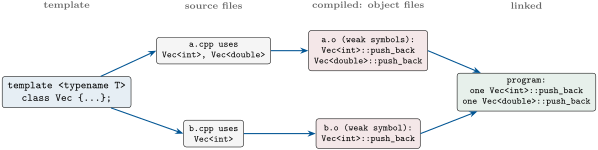
Vec<int>::push_back.Two consequences follow. A template’s definition must be visible wherever it is used, since the compiler can only instantiate what it can read: templates live in headers (Exercise 4.2 shows what happens otherwise). And errors in a template’s use appear at instantiation, inside the template’s body, as the next section shows. Some types deserve a different body from the general one; a template can be given one.
Definition 4.6 (Template specialisation)
A full specialisation template <> ... f<A>(...) gives the body of a template for one particular argument list A, used instead of the general body whenever those arguments are chosen. Function templates may also be overloaded: a second template with a more specific parameter (such as T * for T), chosen when it matches better.
template <typename T>
std::string describe(const T &x) { return "value " + std::to_string(x); }

template <>                                     // the full specialisation for bool
std::string describe<bool>(const bool &x) { return x ? "yes" : "no"; }

template <typename T>
std::string describe(T *p)
    { return p ? "pointer to " + describe(*p) : "null pointer"; }  // an overload

int main()
{
    int n = 42;
    bool open = true;
    std::cout << describe(n) << " | " << describe(2.5) << " | " << describe(open) << " | "
              << describe(&n) << " | " << describe(static_cast<int *>(nullptr)) << '\n';
    return 0;
}$ g++ -std=c++20 -O2 -Wall -Wextra -o specialise specialise.cpp && ./specialise
value 42 | value 2.500000 | yes | pointer to value 42 | null pointerTemplates also take values: std::array<double, 3> is a class with three doubles, its size fixed at compile time. Values computed at compile time come from constexpr functions, which the compiler runs while it compiles when their arguments are constants.
constexpr std::uint64_t power(std::uint64_t b, unsigned e)
{
    std::uint64_t r = 1;
    while (e--)
        r *= b;
    return r;
}

static_assert(power(2, 10) == 1024);            // checked at compile time
constexpr std::uint64_t KIB = power(2, 10), GIB = power(KIB, 3);
int table[power(3, 4)];                          // an array size must be a constant: 81

int main(int argc, char **)
{
    std::printf("%llu %llu %zu\n", (unsigned long long)GIB,
        (unsigned long long)power(argc + 1, 20),
                sizeof table / sizeof table[0]);
    return 0;
}$ g++ -std=c++20 -O2 -Wall -Wextra -o constexpr_pow constexpr_pow.cpp && ./constexpr_pow
1073741824 1048576 81GIB and the size of table were computed by the compiler; power(argc + 1, 20) depends on the command line, here, and was computed when the program ran. A static_assert is a test that runs at compile time: if it fails, the program does not compile.
4.4 Requirements on a type parameter
A template’s body uses operations of its type parameters (<, copying, +), and so requires them. Until C++20 the requirement was unwritten: the compiler found out at instantiation, inside the body. Below, the same function template is used with a type that has no <, first as it stands and then with its requirement written down.
no_concept.cpp: In instantiation of 'T smallest(const std::vector<T>&) [with T = Point]':
no_concept.cpp:20:23:   required from here
no_concept.cpp:12:15: error: no match for 'operator<' (operand types are 'const Point' and 'Point')
   12 |         if (x < best)
| ~~^~~~~~Definition 4.7 (Concept, constraint)
A concept is a named, compile-time predicate on template arguments, defined by template <typename T> concept C = expression;, where the expression may combine other concepts and requires expressions listing operations that must be valid. A constraint attaches concepts to a template, as template <C T> or requires C<T>: the template is then considered only for arguments that satisfy them. Concepts are a C++20 feature.
template <typename T>
concept Ordered = std::copyable<T> && requires(const T a, const T b) {
    { a < b } -> std::convertible_to<bool>;
};

template <Ordered T>
T smallest(const std::vector<T> &v)
{
    T best = v[0];
    for (const T &x : v)
        if (x < best)
            best = x;
    return best;
}with_concept.cpp: In function 'int main()':
with_concept.cpp:26:23: error: no matching function for call to 'smallest(std::vector<Point>&)'
26 | Point p = smallest(pts);
| ~~~~~~~~^~~~~
with_concept.cpp:14:3: note: constraints not satisfied
with_concept.cpp:10:9: note: the required expression '(a < b)' is invalid
10 | { a < b } -> std::convertible_to<bool>;
| ~~^~~The second message is longer but speaks to the caller: the call does not match, because Point does not satisfy Ordered, because a < b is invalid. The first speaks of a line inside a function the caller may never have read. In a library template ten calls deep, the difference is between one message and a page of them. The standard library predefines many concepts, such as std::copyable, std::integral or std::random_access_iterator.
Method 4.8 (Stating requirements first)
To write a function or class template:
- list the operations the body will use on each type parameter, with their result types;
- express them as a concept, reusing the library’s concepts where they fit, and constrain the parameter with it;
- write the body using only those operations, and check that each use is covered (a use the concept does not cover compiles for the types tried so far and fails, inside the body, for the next one, Exercise 4.6);
- test the template with two types that satisfy the concept and one that does not, checking that the last is refused at the call.
4.5 Static against dynamic polymorphism
A function template and a virtual function both let one piece of code work with many types. They choose at different times.
Definition 4.9 (Static polymorphism)
Static polymorphism is the use of templates to write code that works with every type satisfying its requirements, where the operation to run for each type is chosen at compile time, during instantiation. It is opposed to the subtype polymorphism of Chapter 3, chosen at run time through a dispatch table.
Static polymorphism costs no table pointer and no indirect call, and the compiler can inline the chosen operation into the caller, then optimise the result as a whole. It costs one copy of the code per type, and the set of types must be known when the program is compiled: a vector of mixed shapes read from a file needs dynamic dispatch. The two sorts of the standard libraries illustrate the difference. qsort receives its comparison as a function pointer and calls it for every comparison; std::sort is a template whose comparison type is a parameter, so that each instantiation can inline it.
int main()
{
    std::mt19937 gen(2025);
    std::printf("%10s %10s %12s %8s\n", "n", "qsort ms", "std::sort ms", "ratio");
    for (int n = 10000; n <= 10000000; n *= 10) {
        std::vector<int> a(n);
        for (int &x : a) x = int(gen());
        std::vector<int> b = a;
        double q = ms([&] { std::qsort(a.data(), a.size(), sizeof(int), compare_ints); });
        double s = ms([&] { std::sort(b.begin(), b.end(),
            [](int x, int y) { return x < y; }); });
        if (a != b) return 1;                        // both sorted the same values
        std::printf("%10d %10.2f %12.2f %8.1f\n", n, q, s, q / s);
    }
    return 0;
}compare_ints returns the sign of code/bachelor-2/04-cpp-templates/listings/sort_compare.cpp$ g++ -std=c++20 -O2 -Wall -Wextra -o sort_compare sort_compare.cpp && ./sort_compare
n qsort ms std::sort ms ratio
10000 0.57 0.36 1.6
100000 7.99 4.84 1.6
1000000 88.11 44.70 2.0
10000000 1006.54 566.32 1.8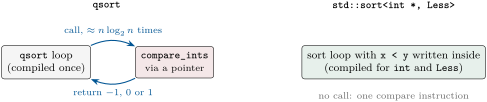
qsort is compiled once for every type, so it can only call the comparison through a pointer it receives; std::sort is instantiated for int and the lambda’s type, and the comparison becomes part of its own loop.Both sort the same values in time growing like , and std::sort is faster by a factor that the run shows to lie between 1.6 and 2, from the smallest array to the largest: the function call, the two loads through void * and the three-way result of compare_ints (computed without a branch, but tested by qsort after the call), repeated times, against a single comparison inside the loop. The C standard requires nothing of qsort’s speed: neither its algorithm nor its complexity is specified. std::sort must make comparisons in the worst case.
In practice — Templates or virtual functions
Use a template when the types are known at compile time and the operation is small and called often: containers, algorithms, numeric code. Use virtual functions when the set of types is open, or chosen at run time from data, or when one compiled copy must serve every type: plug-ins, the library’s fine policies. Mixed designs are common: a template container of std::unique_ptr to a base class holds objects of any derived class.
4.6 Exercises
Exercise 4.1 ★
For each call a to g, say which show runs, and with which T if it is a template. The rule: among the candidates that match, an exact match beats a conversion, and an ordinary function beats a template when both match equally well.
void show(int) { std::puts("show(int)"); }
void show(double) { std::puts("show(double)"); }
template <typename T> void show(T) { std::puts("show<T>(T)"); }
template <typename T> void show(T *) { std::puts("show<T>(T *)"); }

int main()
{
    int n = 1;
    show(1);            // a
    show(1.5);          // b
    show(1.5f);         // c
    show('x');          // d
    show<int>(1);       // e
    show(&n);           // f
    show(nullptr);      // g
    return 0;
}Solution
Solution of Exercise 4.1.
$ g++ -std=c++20 -O2 -Wall -Wextra -o exo_overload exo_overload.cpp && ./exo_overload
show(int)
show(double)
show<T>(T)
show<T>(T)
show<T>(T)
show<T>(T *)
show<T>(T)a: show(int) is an exact match and not a template, so it wins over the template with T = int. b: the same with show(double). c: 1.5f is a float; show(double) needs a promotion, the template with T = float is exact. d: 'x' is a char: exact for the template with T = char, a promotion for show(int). e: explicit template arguments leave only templates, T = int. f: both templates match exactly (T = int * and T = int); the one with parameter T * is more specialised and wins. g: nullptr has type std::nullptr_t, which converts to no int or double and from which T * cannot be deduced; only show<T>(T) matches.
Exercise 4.2 ★
A programmer moves the body of a function template into its own source file, as one does for ordinary functions: twice.hpp declares template <typename T> T twice(T x);, twice.cpp defines it, and main_twice.cpp calls twice(21). Each file compiles; the link fails. Explain, with Definition 4.4, and give two fixes.
/usr/bin/ld: main_twice.o: in function `main':
main_twice.cpp:(.text+0xe): undefined reference to `int twice<int>(int)'
collect2: error: ld returned 1 exit statusSolution
Solution of Exercise 4.2.
main_twice.cpp sees only the declaration, so the compiler emits a call to twice<int> and trusts the linker to find it. twice.cpp contains the template but never uses it, so nothing there is instantiated, and no file defines twice<int>: the linker reports it undefined. Fix 1, the usual one: define the template in the header. Fix 2: keep the definition in twice.cpp and add an explicit instantiation, template int twice<int>(int);, for every argument list the program will use, which only works when that list is known in advance.
Exercise 4.3 ★
Write clamp_to(x, lo, hi), which returns lo if , hi if and x otherwise, for any type with a <, stated as a concept; it throws if . Check that a type without < is refused at the call, and say why the function returns a const T &. Is that safe when lo is a temporary?
Solution
Solution of Exercise 4.3.
template <typename T>
concept TotallyOrdered = requires(const T a, const T b) {
    { a < b } -> std::convertible_to<bool>;
};

template <TotallyOrdered T>
const T &clamp_to(const T &x, const T &lo, const T &hi)
{
    if (hi < lo)
        throw std::invalid_argument("clamp_to: hi < lo");
    if (x < lo) return lo;
    if (hi < x) return hi;
    return x;
}
clamp_to code/bachelor-2/04-cpp-templates/exercises/clamp.hppIt returns a reference to one of its arguments to avoid a copy of a large value. That is safe when the result is used at once or copied, as in int y = clamp_to(x, 0, 10);. It dangles in const int &r = clamp_to(x, 0, 10); when the result is the temporary 0 or 10, which dies at the end of the statement: the same caveat as for the standard std::clamp. tests/exercises_test.cpp checks a type without < is refused, through a concept that asks whether the call is valid.
Exercise 4.4 ★
A program uses Vec<int>, Vec<double> and Vec<std::string>, calls push_back on all three, at on the first only, and copies the third. Using Proposition 4.5, list the instantiated member functions of Vec (count reserve and clear, which push_back and the destructor call). How does the list change if the program is split into two files that both use Vec<int>?
Solution
Solution of Exercise 4.4.
For each of int, double and std::string: the constructor and destructor, push_back, reserve and clear; plus at for Vec<int> and the copy constructor for Vec<std::string>, and the const operator[] that this copy constructor calls on its argument: 18 member functions (the defaulted constructor may generate no code). Members never used, such as capacity, are not instantiated. Split in two files that both use Vec<int>, each object file contains its own copies of the Vec<int> members, as weak symbols, and the linker keeps one of each: the program contains the same 18 functions.
Exercise 4.5 ★★
Two of these three calls do not compile; the third compiles and is wrong. Explain the two messages with Definition 4.2, fix each call, and explain what the third compares.
template <typename T> T larger(T a, T b) { return a < b ? b : a; }
template <typename T> T parse(const std::string &s) { return T(s.size()); }

int main()
{
    int a = larger(3, 7.5);                 // 1
    auto n = parse("12");                   // 2
    std::string s = larger("pier", "dunes rd");   // 3
    return a + int(n) + int(s.size());
}exo_deduce.cpp:10:19: error: no matching function for call to 'larger(int, double)'
exo_deduce.cpp:10:19: note: deduced conflicting types for parameter 'T' ('int' and 'double')
exo_deduce.cpp:11:19: error: no matching function for call to 'parse(const char [3])'
exo_deduce.cpp:11:19: note: couldn't deduce template parameter 'T'Solution
Solution of Exercise 4.5.
1: T is deduced as int from 3 and as double from 7.5, a conflict; write larger<double>(3, 7.5) or larger(3.0, 7.5). 2: T appears only in the return type, so nothing deduces it; write parse<int>("12"). 3: the two arguments are arrays of 5 and 9 characters, which, passed by value, decay to pointers: T is const char * for both, and the call compiles. It compares two addresses of unrelated string literals, whose order is unspecified, and returns one of the two pointers, converted to a string. Fix: larger(std::string("pier"), std::string("dunes rd")).
Exercise 4.6 ★★
The concept below is satisfied by double and by std::string, and yet the call with strings does not compile. Explain the message, and say which step of Method 4.8 was skipped. Write the concept the body really needs.
template <typename T>
concept Ordered = requires(const T a, const T b) { { a < b } -> std::convertible_to<bool>; };

template <Ordered T>
T middle(const std::vector<T> &v)           // the mean of the smallest and the largest
{
    T lo = v[0], hi = v[0];
    for (const T &x : v) {
        if (x < lo) lo = x;
        if (hi < x) hi = x;
    }
    return (lo + hi) / 2;
}

int main()
{
    std::vector<double> d = {3.5, 1.0, 8.0};
    std::vector<std::string> s = {"pier", "dunes"};
    double m = middle(d);
    std::string t = middle(s);
    return int(m) + int(t.size());
}exo_weak_concept.cpp: In instantiation of 'T middle(const std::vector<T>&) [with T = std::__cxx11::basic_string<char>]':
exo_weak_concept.cpp:26:27: required from here
exo_weak_concept.cpp:18:22: error: no match for 'operator/' (operand types are 'std::__cxx11::basic_string<char>' and 'int')
18 | return (lo + hi) / 2;
| ~~~~~~~~~~^~~Solution
Solution of Exercise 4.6.
Ordered asks only for <, and both types have it, so the call is accepted; the body also computes (lo + hi) / 2, and for strings + concatenates but nothing divides a string by 2. Steps 1 and 3 of Method 4.8 were skipped: the operations of the body were not all listed. The right concept also requires {(a + b) / 2} -> std::convertible_to<T> in its requires expression; strings are then refused at the call.
Exercise 4.7 ★★
Write a function template lower_bound_of(first, last, key) that returns the first position of a sorted range with !(*p < key), or last, for any random-access iterator (a concept of the library) and any key comparable with the elements. State its loop invariant. Test it against std::lower_bound on random sorted vectors and every key in a range.
Solution
Solution of Exercise 4.7.
template <std::random_access_iterator It, typename K>
    requires requires(It p, const K &k) { { *p < k } -> std::convertible_to<bool>; }
It lower_bound_of(It first, It last, const K &key)
{
    auto n = last - first;                  // invariant: the answer lies in [first, first + n]
    while (n > 0) {
        auto half = n / 2;
        It mid = first + half;
        if (*mid < key) {
            first = mid + 1;
            n -= half + 1;
        } else {
            n = half;
        }
    }
    return first;
}

template <std::random_access_iterator It, typename K>
bool contains(It first, It last, const K &key)
{
    It p = lower_bound_of(first, last, key);
    return p != last && !(key < *p);
}Invariant: every element before first is less than the key, and every element from first + n on is not; the answer is therefore in . Each step keeps it and at least halves , so the loop ends after at most steps with , and first is the answer. The test compares with std::lower_bound and std::binary_search on 200 random sorted vectors and every key from to 41.
Exercise 4.8 ★★
A class template Pow<N>, with a template parameter unsigned N, has one member, the constant static constexpr long value = 3 * Pow<N - 1>::value;, and a full specialisation Pow<0> whose value is 1: Pow<N>::value is , computed at compile time. How many classes does Pow<20>::value instantiate? And a program that uses Pow<20> and Pow<25>? Write the same with a constexpr function and compare what the compiler must generate.
Solution
Solution of Exercise 4.8.
Pow<20>::value needs Pow<19>::value, which needs Pow<18>, and so on down to Pow<0>, the specialisation written by hand: 20 classes instantiated, Pow<1> to Pow<20>. With Pow<25> as well, only Pow<21> to Pow<25> are new, since each class is instantiated once (Proposition 4.5): 25 in all. A constexpr function power(3, n) is one function, which the compiler runs on the constant arguments; no class at all is generated, and compile-time loops are no longer limited by the depth of recursive instantiation.
Exercise 4.9 ★★
Write Matrix<T, R, C>, stored in a std::array<T, R * C>, with element access, transpose and a product operator* that accepts only matrices of matching inner dimension, so that multiplying a by a matrix does not compile. Check that refusal with a static_assert and a concept.
Solution
Solution of Exercise 4.9.
template <typename T, std::size_t R, std::size_t C>
struct Matrix {
    std::array<T, R * C> a{};               // row by row
    T &operator()(std::size_t i, std::size_t j) { return a[i * C + j]; }
    const T &operator()(std::size_t i, std::size_t j) const { return a[i * C + j]; }
};

// (R x K) times (K x C): the shared K is checked by the compiler, not at run time.
template <typename T, std::size_t R, std::size_t K, std::size_t C>
Matrix<T, R, C> operator*(const Matrix<T, R, K> &x, const Matrix<T, K, C> &y)
{
    Matrix<T, R, C> z;
    for (std::size_t i = 0; i < R; i++)
        for (std::size_t j = 0; j < C; j++)
            for (std::size_t k = 0; k < K; k++)
                z(i, j) += x(i, k) * y(k, j);
    return z;
}

template <typename T, std::size_t R, std::size_t C>
Matrix<T, C, R> transpose(const Matrix<T, R, C> &x)
{
    Matrix<T, C, R> t;
    for (std::size_t i = 0; i < R; i++)
        for (std::size_t j = 0; j < C; j++)
            t(j, i) = x(i, j);
    return t;
}The product is a template in four parameters, T, R, K and C, and its two parameters share K: a by a would need and at once, deduction fails, and there is no other operator*. The test defines the concept Multipliable<A, B> (the product is valid) and asserts it for by and refutes it for by , at compile time; it also checks for a matrix.
Exercise 4.10 ★★★
Write a binary heap Heap<T, Less = std::less<T>> over a std::vector<T>, with push, top and pop, the comparator being a template parameter stored in the object. Test it against a sorted copy for 500 random values, and as a min-heap of strings with std::greater. Why can the comparator be inlined here and not in qsort?
Solution
Solution of Exercise 4.10.
template <typename T, typename Less = std::less<T>>
class Heap {
public:
    explicit Heap(Less less = Less()) : less_(less) {}
    void push(T x)
    {
        v_.push_back(std::move(x));
        std::size_t i = v_.size() - 1;
        while (i > 0 && less_(v_[(i - 1) / 2], v_[i])) {     // sift up
            std::swap(v_[(i - 1) / 2], v_[i]);
            i = (i - 1) / 2;
        }
    }
    const T &top() const
    {
        if (v_.empty()) throw std::out_of_range("Heap::top on an empty heap");
        return v_[0];
    }
    void pop()
    {
        if (v_.empty()) throw std::out_of_range("Heap::pop on an empty heap");
        v_[0] = std::move(v_.back());
        v_.pop_back();
        std::size_t i = 0, n = v_.size();
        for (;;) {                                              // sift down
            std::size_t l = 2 * i + 1, r = l + 1, m = i;
            if (l < n && less_(v_[m], v_[l])) m = l;
            if (r < n && less_(v_[m], v_[r])) m = r;
            if (m == i) break;
            std::swap(v_[i], v_[m]);
            i = m;
        }
    }
    std::size_t size() const { return v_.size(); }
    bool empty() const { return v_.empty(); }

private:
    std::vector<T> v_;
    Less less_;
};
Heap<T, Less> code/bachelor-2/04-cpp-templates/exercises/heap.hpppush adds at the end and sifts up while the parent is “less”; pop moves the last element to the root and sifts it down, choosing the larger child. Each instantiation knows the comparator’s type, hence the exact function it calls (for std::less<int>, the built-in <), and can inline it. qsort receives a pointer value, known only when the program runs, and is compiled once in the C library: it must make an indirect call each time.
Exercise 4.11 ★★★
A library template has member functions of about bytes of machine code each, and a program uses it with types, every member with every type. (a) Bound the code size the template contributes, with Proposition 4.5. (b) The program is built from files that each use all types: what do the object files contain before linking, and the program after? (c) From Output 4.4, how many functions of Vec does vec_demo.o contain per type, roughly? Compare with a void * version, compiled once.
Solution
Solution of Exercise 4.11.
(a) At most bytes: one copy of each member per type. (b) Each of the object files contains up to functions, weak copies in all; the program, after linking, . The compile time grows with , the program does not. (c) 30 symbols for 3 types, about 10 functions per type (constructors, destructor, push_back, reserve, clear, operator[], begin, end and others). A void * version is compiled once, about 10 functions for every type together, at the price of the type checks and the inlining.
Exercise 4.12 ★★★
Write pascal<N>(), a constexpr function returning the table of binomial coefficients for as nested std::arrays, computed by Pascal’s rule. Keep it in a constexpr variable for , and check with static_assert that and that fits in 64 bits. Why is 67 the largest for which every entry fits in an unsigned 64-bit integer? Test Pascal’s rule and the row sums at run time.
Solution
Solution of Exercise 4.12.
template <std::size_t N>
constexpr std::array<std::array<std::uint64_t, N + 1>, N + 1> pascal()
{
    std::array<std::array<std::uint64_t, N + 1>, N + 1> c{};
    for (std::size_t n = 0; n <= N; n++) {
        c[n][0] = 1;
        for (std::size_t k = 1; k <= n; k++)
            c[n][k] = c[n - 1][k - 1] + c[n - 1][k];    // c[n-1][n] is 0
    }
    return c;
}

inline constexpr auto BINOM = pascal<67>();           // the last full row that fits in 64 bits

static_assert(BINOM[5][2] == 10);
static_assert(BINOM[67][33] == 14226520737620288370ULL);The largest entry of row is the middle one. is below , and is above: 67 is the last row that fits entirely. Pascal’s rule only adds entries of the previous row, and each sum is an entry of the table, so no intermediate result overflows up to . The test checks the rule for every entry and the row sum .
4.7 Problem: One sort for every type
Problem 4.1
Weekend problem — One sort for every type
The town keeps tables of readings (double), of people sorted by name (std::string) and of loans sorted by date (a struct). This problem sorts all three with one generic function and measures what it gains over qsort.
Part I — qsort and void *.
- Write the comparison function
qsortneeds fordoubles. Why isreturn x - y;wrong fordouble, and forintnear the ends of its range? - Write the comparison for an array of
struct loan {int id; int due;}by due date, then byid. - Why can
qsortnot sort an array ofstd::stringcorrectly? (It moves elements byte by byte.) - What does the compiler check about the arguments of a
qsortcall? Give a call that compiles and sorts garbage. compare_intsin Listing 4.10 is called how many times, roughly, for ? Use .- What does the C standard promise about
qsort’s running time and stability?
Part II — A template sort.
- Write
template <typename T, typename Less> void insertion_sort(T *a, std::size_t n, Less less). - Call it on
doubles with a lambda, onstd::strings withstd::less<>, and on loans with a lambda comparing due dates then ids. - Which functions does the compiler instantiate for these three calls?
- Why are the strings now moved correctly, where
qsortcopied bytes? - Rewrite the swap of two elements so that it moves, and say what it costs for strings longer than the small buffer of Chapter 2.
- Insertion sort makes up to comparisons. Why would a template version still lose to
qsortfor ?
Part III — Concepts.
- State, as a concept, what
insertion_sortrequires ofLessgivenT. - Which concept of the library expresses “
Tcan be moved and move-assigned”? Add it. - A caller passes a comparator that takes its arguments by non-const reference. Does it satisfy your concept? Should it?
- A comparator
[](double x, double y) {return x <= y;}satisfies the concept. Why is it still wrong for a sort? Can a concept detect it? - Rewrite the sort to take a pair of random-access iterators instead of a pointer and a size. Which library concept do you use?
- Write a test that checks, for each of the three types, that the result is sorted and is a permutation of the input.
Part IV — The measured speed-up.
- From Output 4.9, compute the time per element and per comparison of each sort for .
- Is the ratio roughly constant over ? What does that say about where the difference comes from?
- Explain, with the figure on the two sorts, what the processor does per comparison in each case.
- The town sorts a million readings once a night. Is the difference worth a rewrite? And a trading system that sorts ten thousand orders every millisecond?
- The
sort_compareprogram was compiled with-O2. Predict the ratio at-O0, where nothing is inlined. - State the result of the problem: the speed-up of
std::sortoverqsortmeasured on the laptop, and its cause.
Solution
Solution of Problem 4.1.
1. Read both values as double and return (x > y) - (x < y). x - y is converted to int: a difference of 0.5 becomes 0, “equal”. For int, x - y overflows when, say, is near INT_MAX and negative, which is undefined behaviour and in practice gives the wrong sign.
2. Compare due with the same three-way formula, and if equal, compare id.
3. qsort swaps elements as blocks of bytes. A std::string may point into its own small buffer or own a heap block; a byte copy breaks the first (the pointer still points into the old place) and duplicates the owner of the second. Moving C++ objects that are not trivially copyable without their constructors is undefined behaviour.
4. Only the types of the four arguments: any object pointer converts to void *. qsort(d, n, sizeof(int), compare_ints) on an array of double compiles and sorts garbage.
5. About calls.
6. Nothing: no algorithm, no complexity, no stability.
7. For from 1 to : T x = std::move(a[i]); shift the elements before it that are greater than x (less(x, a[j - 1])) one place right, by move-assignment; put x in the hole.
8. A lambda (double x, double y) -> x < y; std::less<>(); a lambda that compares due, then id.
9. Three functions: insertion_sort for double with the first lambda’s type, for std::string with std::less<void>, and for loan with the second lambda’s type (every lambda has a type of its own).
10. The template is compiled for std::string and moves elements with std::string’s move constructor and assignment, which keep its invariant.
11. T tmp = std::move(a); a = std::move(b); b = std::move(tmp);, or std::swap(a, b): three moves of a few pointers each for long strings, whatever their length.
12. Up to comparisons against about for qsort: the algorithm matters far more than inlining.
13. A requires expression with parameters L less, const T &a and const T &b, requiring less(a, b) to be valid and convertible to bool; the library’s std::predicate<L, const T &, const T &> says the same.
14. std::movable<T>.
15. No: the concept calls it with const T &, which does not bind to T &. That is right: a comparison must not modify its arguments, and the sort relies on it.
16. <= is not a strict order: x <= x is true. Sorts assume irreflexivity; insertion sort then loses stability, and std::sort given such a comparator may read past the end of the range. A concept checks syntax, not meaning: std::strict_weak_order only documents the requirement.
17. Take two iterators first and last of a type It constrained by the library’s concept of random-access iterators, and keep Less less; std::sortable<It, Less> states both requirements at once.
18. For each type, sort a copy of random input and check std::is_sorted with the same comparator and std::is_permutation against the input.
19. In the printed run, for : qsort takes of the order of 90 ns per element, about 4 ns per comparison (dividing by ); std::sort about half of each.
20. Yes, between about 1.5 and 2: the difference is a cost per comparison, not a different growth. Both make comparisons; each comparison costs more in qsort.
21. qsort: pass two addresses, make an indirect call, load the two ints through the pointers, compute the three-way result with two comparisons, return, and test that result. std::sort: one comparison of two registers, and a branch.
22. The night: tens of milliseconds saved, irrelevant. Ten thousand orders every millisecond: from the printed run a sort of elements takes about half a millisecond with qsort; the difference is a large share of the budget, and the rewrite is worth it.
23. At -O0 nothing is inlined: std::sort’s comparisons become calls of the lambda’s operator(), and its iterator operations calls too. The ratio falls to about 1 or below.
24. The comparator speed-up of std::sort over qsort, measured on the laptop: in the printed run, a factor of about 1.5 to 2 for to integers, constant in , because the comparison is inlined into the instantiated sort instead of being called through a pointer.