本书暂未推出简体中文版。现有版本:English。
University Economics — Year 2 · 本科二年级
13Repeated Games
Firms that agree to fix prices gain together, and each gains more by secretly undercutting the others. In a game played once, the agreement collapses: it is a prisoner’s dilemma. Yet cartels exist, and some last for decades. The chart summarises how long cartels lasted in nine samples, from nineteenth-century international cartels to those prosecuted in the 1990s.
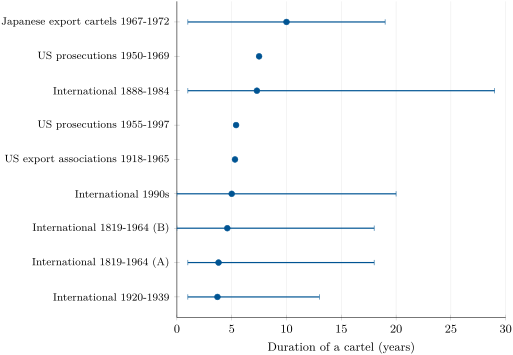
Average durations run from 3.7 years (international cartels of 1920–1939, counting only those not ended by the war) to 10 years, with a median of 5.3, and within each sample the spread is wide: some cartels end within a year, others last 18 to 29 years. These are cartels that were discovered, most of them by prosecutors, so the sample leaves out any that were never found.
The prisoner’s dilemma of Chapter 10 is played once. Firms in a market meet again every week, and what they do today can change what the others do tomorrow. This chapter shows that repetition can sustain cooperation that a single play cannot, works out when, and draws the lessons for collusion and for reputations in markets where buyers cannot see quality before they buy.
You already know
From Chapter 10: the prisoner’s dilemma and Nash equilibrium. From Chapter 12: subgame-perfect equilibrium and backward induction. From the Year 1 volume: Bertrand and Cournot competition.
Notation 13.1 (Symbols of this chapter)
In the prisoner’s dilemma, each player earns when both cooperate, when both defect, when she defects against a cooperator and when she cooperates against a defector, with . is the discount factor per period, its critical value, the number of firms, the monopoly profit of the market per period and the number of periods before a deviation is detected.
13.1 Finite repetition
Definition 13.2 (Stage game)
The stage game of a repeated game is the game in normal form that is played in each period.
Definition 13.3 (Repeated game)
A repeated game is a dynamic game in which the same stage game is played in every period, finitely or infinitely often, each player observing the actions of every earlier period before choosing her action in the current one.
A strategy in a repeated game says what to play in each period after each possible history of play.
Proposition 13.4 (Unravelling)
If the prisoner’s dilemma is repeated a known, finite number of times, every player defects in every period in the unique subgame-perfect equilibrium.
Proof. In the last period nothing follows, so the period is the stage game, and both defect whatever happened before. In the period before, play in the last period is therefore fixed whatever happens now; today’s action has no effect on the future, so both defect today too. Repeating the argument back to the first period, both defect in every period after every history. ∎
The argument relies on a last period that both players know. When the game might go on, the future can reward cooperation today.
13.2 Infinite repetition and discounting
Definition 13.5 (Discounted average payoff)
The discounted average payoff of a stream of stage-game payoffs is . A constant stream has discounted average payoff .
The discount factor need not measure patience alone. If the game continues to the next period with probability and the interest rate is , a payoff next period is worth today: an infinitely repeated game with describes a relationship that ends at a random date that no one can foresee.
13.3 Trigger strategies
Definition 13.6 (Grim-trigger strategy)
In the repeated prisoner’s dilemma, the grim-trigger strategy cooperates in the first period and in every period in which no player has defected before, and defects for ever after any defection.
Definition 13.7 (Tit for tat)
Tit for tat cooperates in the first period and then plays whatever the other player played in the previous period.
Definition 13.8 (Critical discount factor)
The critical discount factor of a strategy profile is the smallest discount factor at which the profile is a subgame-perfect equilibrium.
To check that a profile is subgame perfect, it is enough to check one-shot deviations: that in no subgame can a player gain by changing her action in one period and then following her strategy again. If a deviation of any kind gained, then with discounting a deviation that ends after finitely many periods would gain too, and the last period in which such a deviation differs from the strategy would be a profitable one-shot deviation.
Proposition 13.9 (Grim trigger)
In the infinitely repeated prisoner’s dilemma, both players playing grim trigger is a subgame-perfect equilibrium if and only if
Proof. There are two kinds of subgame. After a defection, both defect for ever; this repeats a Nash equilibrium of the stage game, and since future play does not depend on today’s action, no one-shot deviation gains. With no defection so far, cooperating for ever yields ; a one-shot deviation yields today and then for ever, a discounted average of . Cooperation is a best response if and only if , that is, . ∎
With , , , , the critical discount factor is . The listing computes the discounted average payoffs of four strategies against each other, at a discount factor below the critical value and at one above it.
"""Discounted average payoffs of four strategies in the repeated prisoner's dilemma."""

PAYOFF = {("C", "C"): 3, ("C", "D"): 0, ("D", "C"): 5, ("D", "D"): 1}
STRATEGIES = {
    "always C": lambda mine, theirs: "C",
    "always D": lambda mine, theirs: "D",
    "grim": lambda mine, theirs: "D" if "D" in theirs else "C",
    "tit for tat": lambda mine, theirs: theirs[-1] if theirs else "C",
}


def average(first, second, beta, rounds=400):
    """Row player's (1 - beta) * sum of beta**t * payoff over the play of the pair."""
    mine, theirs, total = [], [], 0.0
    for t in range(rounds):  # beta**400 is negligible for beta <= 0.9
        a, b = first(mine, theirs), second(theirs, mine)
        total += (1 - beta) * beta**t * PAYOFF[(a, b)]
        mine.append(a)
        theirs.append(b)
    return total


for beta in (0.4, 0.9):
    print(f"beta = {beta}: row player's average payoff against each column")
    print(" " * 12 + "".join(f"{name:>12}" for name in STRATEGIES))
    for name, row in STRATEGIES.items():
        cells = [average(row, col, beta) for col in STRATEGIES.values()]
print(f"{name:>12}" + "".join(f"{x:12.3f}" for x in cells))$ python repeated_pd.py
beta = 0.4: row player's average payoff against each column
always C always D grim tit for tat
always C 3.000 0.000 3.000 3.000
always D 5.000 1.000 3.400 3.400
grim 3.000 0.400 3.000 3.000
tit for tat 3.000 0.400 3.000 3.000
beta = 0.9: row player's average payoff against each column
always C always D grim tit for tat
always C 3.000 0.000 3.000 3.000
always D 5.000 1.000 1.400 1.400
grim 3.000 0.900 3.000 3.000
tit for tat 3.000 0.900 3.000 3.000At a player facing grim trigger earns 3.4 by defecting for ever against 3 by cooperating: the gain today outweighs the loss to come. At the same deviation earns 1.4. Tit for tat sustains cooperation too, but it punishes for one period only and then forgives, so it needs more patience against some deviations (Exercise 13.6).
13.4 The folk theorem
Grim trigger sustains the payoffs . Other strategies sustain other payoffs: for instance, alternating between mutual cooperation and mutual defection, with any defection from the pattern punished for ever. The range of what repetition can sustain is wide.
Definition 13.10 (Folk theorem)
A folk theorem is a result stating that, in an infinitely repeated game with patient enough players, every feasible payoff vector that gives each player more than the least she can guarantee herself in the stage game, whatever the others do, is the discounted average payoff of a subgame-perfect equilibrium.
Theorem 13.11 (Folk theorem, with Nash punishment)
Let be a Nash equilibrium of the stage game, and a feasible payoff vector with for every player. There is such that for every the repeated game has a subgame-perfect equilibrium with discounted average payoffs .
Proof. Admitted at this level. ∎
For the prisoner’s dilemma, with mutual defection and , Proposition 13.9 is the proof, with the exact . The figure shows the payoffs the theorem covers. In the prisoner’s dilemma each player can always guarantee herself 1, by defecting, so no equilibrium gives a player less (Exercise 13.10).
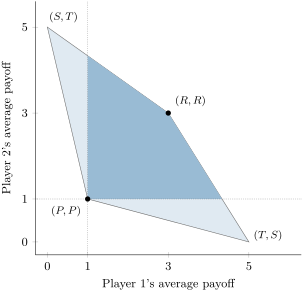
The folk theorem is a result about possibility. It says that repetition makes cooperation possible, and also that almost anything else is possible: the same game has equilibria with full cooperation, with none, and with everything in between. Which one is played the theory does not say.
13.5 When collusion can be sustained
Definition 13.12 (Collusion)
Collusion is an equilibrium of a repeated game between firms in which prices are held above, or quantities below, those of the equilibrium of the stage game, sustained by the threat that a deviation will be followed by lower profits. It is tacit when it involves no explicit agreement.
Take identical firms competing on price, with constant marginal cost: the stage-game equilibrium is price equal to cost, with zero profit. If all charge the monopoly price they share the monopoly profit, each. A firm that undercuts slightly takes the whole market for one period, , and then earns zero if the others revert to the stage-game equilibrium for ever. Collusion is sustainable when :
Two firms need , five need 0.8, ten need 0.9. The more firms, the smaller each one’s share of the collusive profit, and the more tempting the whole market.
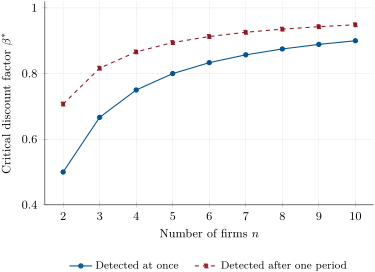
The same reasoning, applied to the other features of a market, gives the model’s comparative statics.
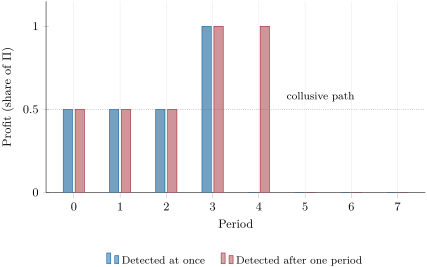
- Detection lags. A deviation that the others see only after periods earns for periods, so collusion requires (Exercise 13.12). Markets in which prices are public and frequent, such as posted prices, make collusion easier than markets with secret, negotiated contracts.
- Demand growth. If demand grows by a factor each period, future collusive profits are worth more relative to today’s gain, and the condition becomes (Exercise 13.7).
- Quantity competition. With Cournot competition the punishment, reversion to the Cournot equilibrium, is milder than price competition at cost, and so is the deviator’s gain. For two firms with linear demand the critical value is (Exercise 13.11).
Model — Collusion in a repeated game
Assumes. Firms that discount future profits, observe one another’s prices or outputs (perhaps with a lag), and punish a deviation by reverting to competition.
Predicts. Collusion is easier with fewer firms, more patient firms, faster detection, growing demand and more transparent prices.
Tested. Records of discovered cartels: durations of a few years on average, with a wide spread (Levenstein and Suslow 2006).
Breaks. Multiplicity: competition is also an equilibrium whatever the discount factor, so the model says when collusion can be sustained, not whether it is. Cartels break up less often from cheating than from entry and from failing to adjust the agreement when conditions change (Levenstein and Suslow 2006).
On the record — How long cartels last
Levenstein and Suslow (2006) review studies of cartel duration. Across them the average is about five years. Many cartels break up within a year, many others last five to ten, and some last decades. In their own sample of 42 international cartels prosecuted by the United States or the European Commission in the 1990s, the average was 5 years with a range of 0 to 20. A price-fixing agreement in aluminium phosphide lasted from January to November 1990 and collapsed when a major producer refused to take part; cartels in cartonboard (1986–91), graphite electrodes (1992–97) and sorbates (1979–97) lasted years. The authors find that cheating and poor monitoring end some cartels, but that entry and the difficulty of adjusting an agreement to changed conditions are the larger threats.
13.6 Reputation
Definition 13.13 (Reputation)
A player’s reputation is what others believe about her future behaviour, or about her type, on the basis of her past actions.
Repetition matters also when the same seller meets a new buyer each time. A buyer cannot see the quality of a good before buying, and a seller saves a cost by delivering low quality. Played once, the seller cheats and buyers, foreseeing it, do not buy. Suppose instead that every buyer can see the seller’s record and buys only from sellers who have never cheated. A seller who earns a price of 100 dalens and spends 30 on honest delivery earns 70 a period by staying honest; cheating once earns 100 and then nothing. Honesty pays when , that is, . The buyers punish, though each buys only once, because the record makes the seller’s past visible to all of them.
When buyers are also unsure what kind of seller they face — careful or careless, honest by nature or by calculation — the record is evidence, and buyers update their beliefs on it. A first complaint against a seller with a clean record is then news, while a fifth is not.
On the record — Ratings on online markets
Cabral and Hortaçsu (2006) followed the feedback records of sellers on eBay, an online auction site, from October 2002 to March 2003, for four goods: notebook computers, two kinds of collectors’ coins and a soft toy. Negative ratings were rare: the median seller had one, and on average they were 0.9 per cent of comments. When a seller received a first negative rating, the weekly growth of his sales fell from about per cent to about per cent; later negatives arrived 25 per cent faster than the first and had much less effect, and sellers with worse records were more likely to leave the market.
The pattern fits a market in which the record carries information: the first negative tells buyers most, and a seller whose reputation has fallen has less to lose by letting quality slip. A rating system, run by the market’s owner, is a private answer to the problem of hidden quality, without a regulator.
13.7 Exercises
Exercise 13.1 ★
In a prisoner’s dilemma with , , , , find the critical discount factor for grim trigger.
Solution
Solution of Exercise 13.1.
.
Exercise 13.2 ★
Read the opening chart. Which sample has the shortest and which the longest average duration? What is the longest duration of a single cartel in the samples that report a range?
Solution
Solution of Exercise 13.2.
Shortest: international cartels of 1920–1939, 3.7 years, for the 28 not ended by the Second World War (8.3 for all 71). Longest: Japanese export cartels of 1967–1972, 10 years. The longest single duration is 29 years, in the international sample of 1888–1984.
Exercise 13.3 ★
Predict, then compute: the critical discount factor for collusion among five firms competing on price; and for two firms when a deviation is detected only after three periods.
Solution
Solution of Exercise 13.3.
Five firms: . Two firms with a lag of three periods: , so .
Exercise 13.4 ★
The model predicts that collusion is easier among fewer firms. What evidence on discovered cartels would count against it, and why might the evidence be hard to read?
Solution
Solution of Exercise 13.4.
Many long-lived cartels with many members, in markets otherwise alike, would count against it. The evidence is hard to read because only discovered cartels are observed: if large cartels are found more easily, or fail before they could be found, the sample’s mix of sizes says little about how often collusion is attempted or succeeds.
Exercise 13.5 ★★
Show by backward induction that in the prisoner’s dilemma repeated three times, both players defect in every period of every subgame-perfect equilibrium. Which step fails if neither player knows when the game ends?
Solution
Solution of Exercise 13.5.
In period 3 both defect, the stage game’s only equilibrium. In period 2 play in period 3 does not depend on what is done now, so both defect; the same holds in period 1. The first step needs a last period known to both: if each period may be followed by another, there is no period in which the future is certainly irrelevant.
Exercise 13.6 ★★
Both players use tit for tat, with , , , and . A player defects in period 0 and then plays tit for tat. Find the sequence of her stage payoffs and its discounted average payoff. Does the deviation pay? For which does it not? Compare with grim trigger at .
Solution
Solution of Exercise 13.6.
The deviator plays D, C, D, C, … and her rival C, D, C, D, …, so she earns . Its discounted average is : the deviation pays. It does not when , that is, . Grim trigger at is an equilibrium: its harsher punishment needs less patience.
Exercise 13.7 ★★
Two firms compete on price, and demand grows by a factor a period. Derive the condition for collusion, and say whether firms with can collude with this growth and without it.
Solution
Solution of Exercise 13.7.
Collusion earns now and in period , worth if ; deviating earns once. The condition is , or : . Firms with can collude with growth, but not without it, since .
Exercise 13.8 ★★
In the eBay record, the notebook sellers’ average weekly growth of sales was per cent in the four weeks before the first negative rating and per cent in the four weeks after, both as log differences. By what factor did sales change over each period of four weeks? What does a model of reputation with uncertain types predict about the effect of later negatives?
Solution
Solution of Exercise 13.8.
Before: , a rise of a third. After: , a fall of about a quarter. A first negative moves buyers’ beliefs about a seller with a long clean record a lot; once beliefs have moved, a further negative adds less, so later negatives should have smaller effects, as the data show.
Exercise 13.9 ★★
A cartel survives from one year to the next with probability 0.9 for reasons outside the firms’ control, and the interest rate is 5 per cent. Find the discount factor relevant for collusion, and the largest number of firms competing on price that can collude.
Exercise 13.10 ★★★
Show that in every Nash equilibrium of the repeated prisoner’s dilemma, finite or infinite, each player’s discounted average payoff is at least .
Solution
Solution of Exercise 13.10.
A player can defect in every period whatever has happened. Against any action of the other she then earns or , at least in every period, so her discounted average is at least . In a Nash equilibrium her strategy is a best response, so it earns at least as much as this one.
Exercise 13.11 ★★★
Two Cournot firms face demand and marginal cost . They collude by each producing half the monopoly output, and revert to the Cournot equilibrium for ever after a deviation. Show that the critical discount factor is , whatever and .
Solution
Solution of Exercise 13.11.
Let . Collusion: each produces , price , profit . Best deviation against : , price margin , profit . Cournot: each, profit . Then ; cancels.
Exercise 13.12 ★★★
Derive the condition for collusion among firms competing on price when a deviation is detected after periods. What is the longest lag at which two firms with per month can collude?
Solution
Solution of Exercise 13.12.
A deviator earns in each of the periods before the others react, then zero: discounted average . Collusion gives . The condition is . With and , , so the longest lag is 12 months.
13.8 Problem: two cement makers of Brenmoor
Problem 13.1
Weekend problem — two cement makers supply Brenmoor, the capital of Brenland, an invented economy: can they hold output down without an agreement, how does a slow flow of information change that, and what happens when a third firm arrives
Demand is , with in dalens per tonne and in thousands of tonnes a year; each firm’s unit cost is 40 dalens. Firms choose outputs once a year. The discount factor is 0.8 a year, covering both interest and the chance that the market changes. Profits are in thousands of dalens a year.
Part I — The stage game.
- Find the Cournot equilibrium: each firm’s output, the price and each firm’s profit.
- Find the outputs that maximise joint profit if split equally, the price and each firm’s profit.
- If one firm produces its collusive output, what is the other’s best output, the price and its profit?
- What does the firm that kept to the collusive output earn in that case?
- Is the collusive outcome a Nash equilibrium of the stage game?
- Explain why the stage game is a prisoner’s dilemma.
Part II — Trigger strategies. Each firm produces its collusive output as long as both have done so, and its Cournot output for ever after any deviation.
- Write the condition for collusion to be an equilibrium.
- Find the critical discount factor.
- Can the two firms collude with a discount factor of 0.8?
- Compare the discounted average payoff of colluding with that of the best deviation.
- Why might the discount factor be lower than interest rates alone suggest?
- Is the threat to revert to Cournot output credible?
Part III — A detection lag. Outputs are not observed directly; a deviation is noticed only after years, from falling prices and lost customers.
- Write the condition for collusion with a lag of years.
- Can the firms collude at the monopoly price with ?
- With ?
- With , find the highest price the firms can sustain with equal outputs.
- What is the longest lag that sustains the monopoly price?
- Why does a public price list help the firms?
Part IV — A third firm. A third cement maker with the same cost enters; outputs are again observed at once.
- Find the Cournot equilibrium with three firms.
- Find each firm’s output and profit under collusion.
- Find the best deviation and its profit.
- Find the critical discount factor.
- Can the three firms collude at the monopoly price with and no lag? With a lag of one year? Of two?
- State the result: the critical discount factor with a lag of years, and the highest price sustainable with two firms and a lag of two years.
Solution
Solution of Problem 13.1.
Part I. 1. Each produces thousand tonnes; the price is 93.3 dalens; each earns 2,844.4. 2. Joint output 80, 40 each; price 120; each earns 3,200. 3. ; price 100; profit 3,600. 4. . 5. No: each firm gains 400 by expanding to 60. 6. Both prefer collusion to the Cournot outcome, but each gains by deviating from it, so a single play ends at the worse outcome. Part II. 7. . 8. . 9. Yes: . 10. Colluding: 3,200. Deviating: . 11. It also reflects the chance that the market changes: entry, a new technology, a slump, or the authorities. 12. Yes: Cournot outputs are a Nash equilibrium of the stage game, so repeating them is an equilibrium of every subgame after a deviation. Part III. 13. , that is, . 14. : yes. 15. : no. 16. With equal outputs , collusion needs . The smallest that satisfies it is 40.46, so the price is dalens. 17. : a lag of one year. 18. It makes a deviation visible at once, shortening the lag. Part IV. 19. each; price 80; profit 1,600. 20. each; price 120; profit 2,133.3. 21. Against two rivals at 26.7: ; price 93.3; profit 2,844.4. 22. . 23. No lag: , yes. One year: , yes. Two years: , no. 24. Collusion at the monopoly price needs with two firms and with three; with two firms and a lag of two years the highest sustainable price is 119.07 dalens, against a monopoly price of 120.