এই বইটি এখনো বাংলা ভাষায় পাওয়া যায় না। সংস্করণ: English।
University Economics — Year 2 · স্নাতক দ্বিতীয় বর্ষ
12Dynamic Games
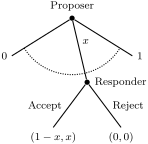
In the ultimatum game one player proposes how to split a sum of money and the other accepts, in which case the split is carried out, or rejects, in which case both get nothing. A responder who cares only about money accepts any positive offer, so a proposer who knows this offers almost nothing. The chart shows what happened when anthropologists and economists ran the game in eighteen groups from fifteen small-scale societies, for stakes of about a day or two’s wages.
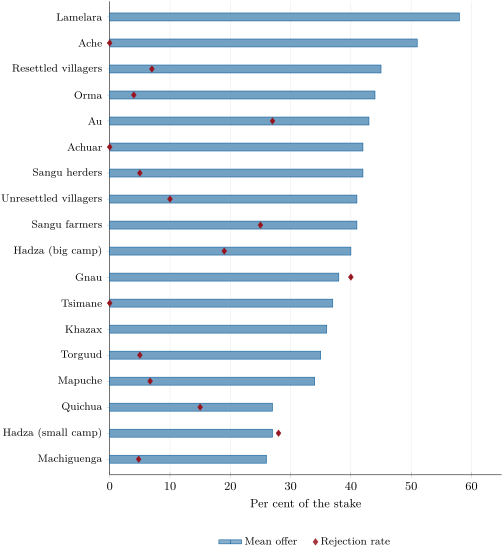
No group’s mean offer is close to zero: the lowest is 26 per cent, the highest 58, and half the groups offer more than 40 per cent. Rejections are rare in some groups and frequent in others: the Tsimane, Achuar and Ache rejected none of 70, 16 and 51 offers, while the Gnau rejected 10 of 25.
This chapter studies games in which players move in turn and see what was done before. Their solution, subgame-perfect equilibrium, rules out threats that a player would not carry out, and it gives sharp predictions for bargaining: who gets what, and that agreement is immediate. The ultimatum game is the simplest bargaining game, and the chart is where its prediction fails.
You already know
From Chapter 10: normal-form games, best responses and Nash equilibrium. From the Year 1 volume: the leader–follower (Stackelberg) model of quantity competition, with linear demand. From Chapter 3: discount factors.
Notation 12.1 (Symbols of this chapter)
In bargaining, the pie has size 1, is player ’s share when she proposes, and is her discount factor per round of bargaining, the value today of one dalen received one round later. In the entry model, and are the outputs of the incumbent and of the entrant, is the entrant’s fixed cost, and demand is linear with .
12.1 Games in extensive form
Definition 12.2 (Extensive-form game)
An extensive-form game is described by a tree: each node where a decision is taken is labelled with the player who moves there, each branch with an action, and each end node with the players’ payoffs. It has perfect information if every player, when she moves, knows every action taken before.
A strategy in an extensive-form game is a complete plan: it says what the player does at every node where she moves, including nodes that will not be reached if she follows it. Take an industry with one incumbent firm and a potential entrant. The entrant moves first: it stays out, and the incumbent keeps its monopoly, or enters. After entry the incumbent either accommodates, sharing the market, or fights with a price war that hurts both.
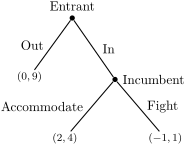
The entry game has two Nash equilibria in pure strategies. In one, the entrant enters and the incumbent accommodates: payoffs . In the other, the entrant stays out and the incumbent’s strategy is “fight if it enters”: payoffs . The second is a Nash equilibrium, since against that plan staying out is the entrant’s best response, and the incumbent loses nothing by planning to fight at a node that is never reached. But the plan is not believable: if entry happened, fighting would earn the incumbent 1 instead of 4.
12.2 Backward induction
Definition 12.3 (Backward induction)
Backward induction solves a finite game of perfect information from its end: at each last decision node the mover’s best action is chosen; each such node is replaced by the payoffs it leads to; and the process is repeated until the first node is reached.
In the entry game, the incumbent accommodates after entry, so entry earns the entrant 2 against 0 for staying out: it enters. Backward induction picks the first of the two Nash equilibria and discards the second.
Definition 12.4 (Credible threat)
A threat to take an action at some node is a credible threat if, were that node reached, taking the action would be a best response for the player who threatens.
“Fight if you enter” is not a credible threat. The idea of ruling out threats that are not credible is made general by asking for equilibrium play not only in the game as a whole but in every part of it that could be reached.
12.3 Subgame-perfect equilibrium
Definition 12.5 (Subgame)
A subgame of a game of perfect information is the part of the tree that starts at one decision node and contains everything that follows it. The whole game is a subgame of itself.
Definition 12.6 (Subgame-perfect equilibrium)
A subgame-perfect equilibrium is a profile of strategies whose restriction to every subgame is a Nash equilibrium of that subgame.
Proposition 12.7 (Backward induction gives subgame-perfect equilibria)
In a finite game of perfect information, the strategies found by backward induction form a subgame-perfect equilibrium. If no player has the same payoff at two different end nodes, it is the only one.
Proof. By induction on the length of the longest path in a subgame. A subgame with one decision node is a choice by one player, and the best action is the only Nash equilibrium (with distinct payoffs). Suppose the claim holds for all subgames shorter than and take one of length , starting with a move by player . Every subgame that follows her move is shorter, so by the induction hypothesis the backward-induction strategies are an equilibrium there and fix the payoffs each of her actions leads to. Backward induction gives her the action with the highest of these payoffs, so no player can gain by deviating, in the subgame or after: the profile is a Nash equilibrium of it. With distinct payoffs every choice is strict, so the profile is unique. ∎
A finite game of perfect information therefore always has a subgame-perfect equilibrium in pure strategies, which the method computes. Its prediction can be stark. In the ultimatum game, the responder accepts every positive offer, since something beats nothing; with money divisible down to a smallest unit, the proposer offers that unit or nothing (Exercise 12.6). The opening chart is the test.
12.4 Commitment
Definition 12.8 (Strategic commitment)
A strategic commitment is an action taken early in a game that cannot be reversed and that changes the later payoffs of the player who takes it, so that a different action becomes her best response later.
A commitment works through the other players: by limiting her own future choices, a player changes what they expect her to do, and so what they do. The leader–follower model of the Year 1 volume is the example: with demand and , a leader that fixes its output first produces 6 and earns 18, more than the 16 each firm earns when both choose at once (4 each). Once the leader’s 6 units are produced, the follower can only make the best of them.
Definition 12.9 (Entry deterrence)
Entry deterrence is an action by an incumbent firm, taken before a potential entrant decides, that makes entry unprofitable so that the entrant stays out.
Let the incumbent choose its output first, by building capacity that it will use. The entrant then decides whether to enter, at a fixed cost , and if it enters chooses . Its best response is , which earns it ; it stays out when this is not positive.
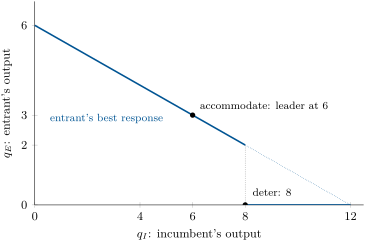
With the entrant stays out once . The incumbent can accommodate, choosing the leader’s output 6, at which the entrant enters with 3 and the price is 3 above cost: profit 18. Or it can deter, choosing 8, at which the price is 4 above cost and the entrant stays out: profit 32. It deters. With a larger fixed cost the monopoly output 6 already deters, and entry is blockaded; with a much smaller one, deterrence needs so much output that accommodating pays more (Exercise 12.11). The output deters only because it is committed: an incumbent that could cut back after entry would do so, and the entrant, knowing it, would enter.
12.5 Bargaining by alternating offers
Definition 12.10 (Ultimatum game)
The ultimatum game is a two-player game in which a proposer offers a division of a fixed sum and a responder either accepts, and the division is carried out, or rejects, and both receive nothing.
Definition 12.11 (Alternating-offers bargaining model)
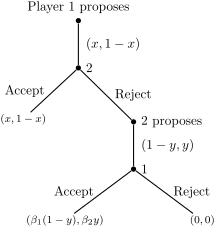
In the alternating-offers bargaining model two players divide a pie of size 1. In round 1 player 1 proposes a division and player 2 accepts or rejects it; after a rejection, player 2 proposes in round 2 and player 1 responds, and so on. A share agreed in round is worth to player , with . Bargaining may end after a fixed number of rounds, with nothing for either player, or go on without limit.
The ultimatum game is the model with one round. With two rounds, player 2 will take the whole pie in round 2, which is worth to her today; so in round 1 she accepts any offer giving her , and player 1 keeps . Each extra round adds one step of the same argument. The listing runs the steps for discount factors and .
"""Alternating offers over a pie of 1, solved by backward induction for T rounds."""

beta_1, beta_2 = 0.95, 0.90  # discount factors: player 1 proposes in round 1


def first_share(rounds):
    """Player 1's share in the subgame-perfect equilibrium of the T-round game."""
    share = 1.0  # in the last round the proposer takes everything
    for t in range(rounds - 1, 0, -1):
        # in round t the proposer must give the responder, who proposes in
        # round t + 1, what waiting is worth to her: her beta times that share
        beta_waiting = beta_2 if t % 2 == 1 else beta_1
        share = 1 - beta_waiting * share
    return share


for rounds in (1, 2, 3, 4, 10, 50, 200):
    print(f"{rounds:>3} rounds: player 1 gets {first_share(rounds):.4f}")
limit = (1 - beta_2) / (1 - beta_1 * beta_2)
print(f"infinite horizon: {limit:.4f}")$ python bargaining.py
1 rounds: player 1 gets 1.0000
2 rounds: player 1 gets 0.1000
3 rounds: player 1 gets 0.9550
4 rounds: player 1 gets 0.1855
10 rounds: player 1 gets 0.3745
50 rounds: player 1 gets 0.6759
200 rounds: player 1 gets 0.6897
infinite horizon: 0.6897With a deadline of one or three rounds, player 1 makes the last offer and gets most of the pie; with two or four, player 2 does. The deadline decides, which is unsatisfactory when real negotiations have none. As the number of rounds grows, the effect of the last round is discounted away and the share settles at 0.6897. That limit is the equilibrium of the game without a deadline.
Theorem 12.12 (Alternating offers without a deadline)
The alternating-offers bargaining model without a deadline has a unique subgame-perfect equilibrium. Each player, when she proposes, offers the other exactly what the other would get by rejecting and proposing next round; each accepts any offer at least that large. Player 1’s offer is accepted at once and gives her
Proof that these strategies form an equilibrium, and the formula. Suppose each player, when she proposes, asks for a share that does not depend on the history, and accepts any offer worth at least what she would get by rejecting. Rejecting an offer from player 1 earns player 2 her own share next round, worth today, so player 1 must leave her that: . In the same way . Substituting, , which gives the formula. No player gains from a single deviation at any node: asking for more is rejected and leaves her, as next round’s responder, in today’s value; asking for less gives away share for nothing; rejecting an offer that meets her threshold earns her no more. Because payoffs are discounted, a strategy that gains from no single deviation gains from none. Uniqueness is
Proof. Admitted at this level. ∎
; Exercise 12.10 sketches it. ∎
The theorem’s predictions are sharp. Agreement is immediate, so no pie is wasted. Patience is power: with and , player 1 gets 0.69. With equal patience the first proposer gets , a small advantage that vanishes as the time between offers shrinks and approaches 1, leaving an even split (Exercise 12.3).
Model — Alternating-offers bargaining
Assumes. Two players who maximise discounted shares, each knowing the other’s discount factor, with no outside options.
Predicts. Immediate agreement; a larger share for the more patient player; a first-mover advantage that vanishes as offers come faster.
Tested. Most directly through its one-round case, the ultimatum game (Henrich et al. 2001; Andersen et al. 2011).
Breaks. The model cannot produce a delay: every negotiation that takes time, or breaks down for a while, lies outside it. Delays appear in versions in which each side is unsure of the other’s patience or costs.
12.6 Ultimatum experiments: where the model breaks
The ultimatum game has been run with student subjects in many countries, and its prediction — a tiny offer, accepted — fails there too.
Offers in industrial societies typically average close to 44 per cent of the stake with a mode at 50, and offers below 20 per cent are rejected with probability 0.40 to 0.60 (Henrich et al. 2001, summarising earlier studies). A responder who rejects 20 per cent gives up money to deny the proposer 80; a proposer who expects this offers more than the minimum, and may also care about fairness himself.
On the record — Ultimatum offers in fifteen societies
Henrich et al. (2001) ran the game in eighteen groups from fifteen small-scale societies, mostly with money, for stakes worth about a day or two’s wages. Mean offers ranged from 26 per cent (Machiguenga, Peru) to 58 per cent (Lamelara, Indonesia), wider than among students. Rejections varied as much: the Tsimane of Bolivia rejected none of 70 offers, although nearly half of the offers were 30 per cent or less, while the Au and Gnau of Papua New Guinea rejected 8 of 30 and 10 of 25. No group behaved as the subgame-perfect equilibrium with money-maximising players predicts.
Model — Subgame-perfect equilibrium with money-maximising players
Assumes. Each player maximises her own money payoff, and this is common knowledge.
Predicts. In the ultimatum game, the smallest possible offer, accepted.
Tested. Ultimatum experiments with students and in small-scale societies (Henrich et al. 2001); at stakes up to 1,600 hours of work (Andersen et al. 2011).
Breaks. Mean offers of 26 to 58 per cent; rejections of positive offers, which fall significantly only at the highest stakes.
The failure is of the payoff assumption, not of backward induction itself: if a responder dislikes unequal splits enough to reject small offers, a proposer reasoning backwards should offer more, as the data show. The open question is how large the stakes must be before money dominates.
Open question — Do higher stakes change ultimatum behaviour?
Earlier experiments found that responders did not markedly change their behaviour as the stakes rose (Slonim and Roth 1998; Cameron 1999; both as summarised by Andersen et al. 2011). Andersen et al. (2011) ran the game in eight villages of Meghalaya, in Northeast India, for 20, 200, 2,000 or 20,000 rupees, from 1.6 to 1,600 hours of work, with instructions that drew many low offers. Rejection rates were 36 per cent at 20 rupees, 43 at 200, 28 at 2,000 and 4 at 20,000; only the drop to the highest stakes was statistically significant. One reading: fairness matters at the stakes of most experiments and of much everyday bargaining, and money dominates only far beyond them. Another: the highest stakes were played by only 24 responders, in one region, and the earlier results stand for the stakes people usually face.
12.7 Exercises
Exercise 12.1 ★
Player 1 chooses Out, ending the game with payoffs , or In. After In, player 2 chooses Low, ending with , or High, after which player 1 chooses , giving , or , giving . Payoffs are player 1’s first. Solve the game by backward induction.
Solution
Solution of Exercise 12.1.
After High, player 1 chooses (4 against 0), so High leads to . Player 2 compares Low, 3, with High, 1, and chooses Low. Player 1 compares Out, 2, with In, which leads to , and chooses Out. The outcome is .
Exercise 12.2 ★
Read the opening chart. What are the lowest and highest mean offers? How many groups made mean offers below 30 per cent, and how many rejected no offer at all?
Solution
Solution of Exercise 12.2.
26 per cent (Machiguenga) and 58 per cent (Lamelara). Three groups offered less than 30 per cent on average: Machiguenga 26, Hadza (small camp) 27, Quichua 27. Three rejected no offer: Tsimane, Achuar and Ache.
Exercise 12.3 ★
Predict, then compute: two equally patient players, , bargain by alternating offers without a deadline. What does the first proposer get? What happens to her share as approaches 1?
Solution
Solution of Exercise 12.3.
. With equal factors , which tends to one half as approaches 1.
Exercise 12.4 ★
A union and an employer bargain for six weeks before agreeing. Does this refute the alternating-offers model? What would a test of the model need to observe?
Solution
Solution of Exercise 12.4.
Not by itself: the model assumes that each side knows the other’s patience, and in its framework a delay cannot happen, so a six-week delay shows that some assumption fails, most likely complete information. A test of the model’s predictions would compare agreements across negotiations whose sides differ in measurable costs of delay, and check that the side with the lower cost gets more.
Exercise 12.5 ★★
Write the entry game in normal form, find all its Nash equilibria in pure strategies, and say which are subgame perfect.
Solution
Solution of Exercise 12.5.
Rows for the entrant, columns for the incumbent: (In, Accommodate) ; (In, Fight) ; (Out, Accommodate) ; (Out, Fight) . (In, Accommodate) is a Nash equilibrium: 2 beats 0 and 4 beats 1. (Out, Fight) is one: 0 beats , and the incumbent gets 9 either way. (Out, Accommodate) is not, since the entrant would enter, nor (In, Fight), since the incumbent would accommodate. Only (In, Accommodate) is subgame perfect.
Exercise 12.6 ★★
In an ultimatum game over 10 coins, offers must be whole coins. Find every subgame-perfect equilibrium.
Solution
Solution of Exercise 12.6.
In every subgame-perfect equilibrium the responder accepts every offer of 1 coin or more. At an offer of 0 she is indifferent. If she accepts it, the proposer offers 0: split . If she rejects it, the proposer offers 1: split . These are the two subgame-perfect equilibria.
Exercise 12.7 ★★
Solve the alternating-offers game with three rounds and by backward induction. Compare with Exercise 12.3.
Solution
Solution of Exercise 12.7.
In round 3 player 1 takes everything. In round 2 player 2 must offer her and keeps . In round 1 player 1 offers player 2 and keeps , against without a deadline: the last proposer’s advantage.
Exercise 12.8 ★★
Use the rejection rates of Andersen et al. (2011) in the debate box. What does the subgame-perfect equilibrium with money-maximising responders predict for them? Do the data move toward the prediction as the stakes rise, and steadily?
Solution
Solution of Exercise 12.8.
No rejection of any positive offer at any stakes. The rejection rates are 36.32, 42.74, 27.52 and 4.17 per cent: at the highest stakes they come close to the prediction, but not steadily, since the rate is higher at 200 rupees than at 20.
Exercise 12.9 ★★
In the entry model with , check that output 8 deters entry and that the incumbent prefers it to the leader’s output. Why must the output be chosen before the entrant decides and be impossible to reduce?
Solution
Solution of Exercise 12.9.
At the entrant’s best output would be , earning , so it stays out. The incumbent then sells 8 at a price 4 above cost: profit 32, against 18 as a leader that accommodates. If the output could be cut after entry, the incumbent facing an entrant would cut it to its best response, and the entrant, foreseeing this, would enter: a threat to keep output high is credible only if it is already carried out.
Exercise 12.10 ★★★
Let and be the largest and smallest payoffs player 1 gets in any subgame-perfect equilibrium of the alternating-offers game without a deadline, in a subgame where she proposes, and , the same for player 2. Show that and , and the same with the roles exchanged, and deduce that .
Solution
Solution of Exercise 12.10.
In a subgame where player 2 proposes she gets at most , so player 2 rejects nothing worth more than to her today, and player 1 can secure by offering a little more: . Player 2 rejects any offer worth less than , so player 1 never gets more than : . The same holds with the roles exchanged: and . Then , so , and , so . Since , both equal .
Exercise 12.11 ★★★
In the entry model, find the fixed cost below which the incumbent prefers to accommodate, and the fixed cost above which entry is blockaded.
Solution
Solution of Exercise 12.11.
Deterrence needs , so with , and it earns . Accommodating earns 18. They are equal when , whose smaller root is , so ; below it the incumbent accommodates. Entry is blockaded when the monopoly output 6 already deters, that is, when .
Exercise 12.12 ★★★
An incumbent has a store in each of 20 towns, and in each town in turn a different entrant plays the entry game of this chapter. Use backward induction to show that every entrant enters and the incumbent always accommodates. Why might a reputation for fighting still pay if the entrants were unsure of the incumbent’s payoffs?
Solution
Solution of Exercise 12.12.
In town 20, the last, the game is the one-town game: the incumbent accommodates and the entrant enters. Nothing done in town 19 can change that, so in town 19 too fighting has no future benefit, and the incumbent accommodates; and so on back to town 1. If entrants believed that the incumbent might be a type that likes fighting, a normal incumbent that fought early would keep that belief alive and deter later entrants, which can pay when many towns remain.
12.8 Problem: harbour wages in Brenmoor
Problem 12.1
Weekend problem — the dockworkers’ union and the harbour employer of Brenmoor, the capital of Brenland, an invented economy, bargain over a wage premium: how is it split, why is there no strike, and what moves the split
The premium to be divided is 1,000 dalens per worker per month above what the workers would earn elsewhere. Each day without agreement the harbour is shut. The employer values a share received one day later at 0.98 of its value today, the union at 0.95. The employer proposes on day 1, the union on day 2, and so on.
Part I — The cost of a strike.
- What is a premium of 1,000 dalens received tomorrow worth to the union today?
- Which side is more patient?
- What does one day of disagreement cost each side on a premium worth 1,000 to it?
- If the union could get the whole premium tomorrow, what is the least it would accept today?
- Why does a day of strike cost the employer anything?
- Name one thing that could raise the union’s discount factor.
Part II — A deadline. Suppose talks must end on day 2, after the union’s offer.
- What does the union propose on day 2?
- What is the least the union accepts on day 1?
- What does the employer offer on day 1, and what is the split?
- Is there a strike?
- Find the split if instead the talks end on day 3, after a second offer by the employer.
- What do these two answers show about deadlines?
Part III — No deadline.
- Write the two conditions that fix the shares each side asks for when it proposes.
- Solve them: what does each side get, in dalens?
- Is there a strike in equilibrium?
- Find the split if the union proposed first. How large is the first-mover advantage?
- A strike fund raises the union’s discount factor to 0.97. Find the new split.
- The union’s members have run down their savings, and its discount factor falls to 0.90. Find the split.
Part IV — An outside option. After rejecting an offer of the employer, the workers can leave for other jobs that are worth dalens of the premium to them; then talks end and the employer gets nothing.
- With , does the split of Part III change?
- With , find the split.
- Why does an outside option matter only when it is large enough?
- Which gives the union more: the strike fund of question 17 or an outside option of 350?
- How many dalens does the strike fund move to the union?
- State the result: the split, and how the union’s cost of a strike day moves it.
Solution
Solution of Problem 12.1.
Part I. 1. 950 dalens. 2. The employer: 0.98 is closer to 1. 3. 20 dalens for the employer, 50 for the union. 4. 950 dalens. 5. The harbour earns nothing on a day it is shut, and that day’s share of the premium is lost to both sides. 6. A strike fund, or temporary work during the strike. Part II. 7. It keeps the whole premium: 1,000 to the union, nothing to the employer. 8. 950: the value today of 1,000 tomorrow. 9. The employer offers 950 and keeps 50. 10. No: the offer is accepted on day 1. 11. On day 2 the union must offer the employer and keeps 20; on day 1 the employer offers and keeps 981. 12. The side that makes the last offer gets almost everything, so the split depends on a deadline that real talks usually do not have. Part III. 13. and . 14. : the employer gets 724.6 dalens, the union 275.4. 15. No: agreement on day 1. 16. : the union gets 289.9 and the employer 710.1; moving first is worth dalens to the union. 17. : the employer gets 607.3, the union 392.7. 18. : the employer gets 847.5, the union 152.5. Part IV. 19. No: the union already gets 275.4 by bargaining, more than 200, so leaving is never its best response and the threat is not credible. 20. The employer must offer 350 and keeps 650. 21. Taking the option ends the talks; the union takes it only if it beats what bargaining gives, so a smaller option changes nothing. 22. The strike fund: 392.7 against 350. 23. dalens per worker per month. 24. Agreement is immediate, with 724.6 dalens to the employer and 275.4 to the union; raising the union’s daily discount factor from 0.95 to 0.97, by making a strike day cheaper for it, moves 117.3 dalens to the union, and an outside option matters only when it is worth more than 275.4.