本书暂未推出简体中文版。现有版本:English。
University Economics — Year 3 · 本科三年级
28Auctions and Market Design
Some markets are designed: a government sells radio licences, a city assigns pupils to schools, surgeons match kidney donors to patients. The designer chooses the rules, and the rules decide who gets what and who pays how much. This chapter proves the central result of auction theory, shows when it fails, and follows it to the auctions that raised billions and those that raised almost nothing. It then turns to markets without prices — matching pupils and schools, and patients and donors — where the algorithms of this chapter are in daily use.
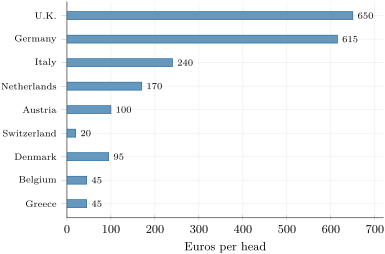
The licences sold were much alike, and analysts expected roughly equal values per head across Western Europe. The auctions of 2000 raised 650 euros a head in the U.K. and 615 in Germany, but 170 in the Netherlands and 20 in Switzerland, where analysts had expected 400 to 600 a week before the auction began. The later auctions of 2001 raised less, as valuations had fallen everywhere. The differences in 2000 come from the rules: how many bidders entered, and whether they could coordinate.
You already know
Bayesian Nash equilibrium, the first- and second-price sealed-bid auctions, the statement of revenue equivalence and the winner’s curse are the Year 2 volume’s; the envelope theorem is the Year 1 volume’s.
Notation 28.1 (Symbols of this chapter)
bidders have values drawn independently from a distribution with density on ; is a bid function, a reserve price and the seller’s own value of the object.
28.1 Auction formats
Definition 28.2 (English auction; Dutch auction)
In an English auction the price rises until one bidder remains, who pays the price at which the last rival dropped out. In a Dutch auction the price falls until the first bidder accepts it, and that bidder pays it.
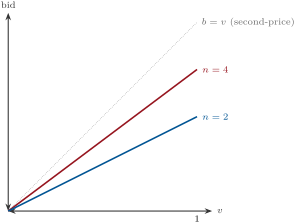
The Dutch auction is strategically the same as the first-price sealed-bid auction: a bidder’s only decision is the price at which to accept, and she learns nothing useful before making it. With independent private values, the English auction is equivalent to the second-price auction: staying in up to one’s value is a dominant strategy, and the winner pays the second-highest value.
28.2 Revenue equivalence
Proposition 28.3 (Revenue equivalence)
Let risk-neutral bidders have independent private values from on . Any auction in which the bidder with the highest value wins, and a bidder with value 0 pays nothing in expectation, gives each bidder the same expected payment, and the seller the same expected revenue, .
Proof. In equilibrium, let be the probability that a bidder of value wins and her expected payment, so her payoff is . She can act as if her value were any , so , and by the envelope theorem . With , , and , which depends only on and , not on the format. Expected revenue is , the same in every such auction; in the second-price auction it is the expected second-highest value. ∎
Model — Independent private values
Assumes. Each bidder knows her own value; values are independent draws from one distribution; bidders are risk neutral.
Predicts. All standard formats raise the same expected revenue; the Dutch and first-price auctions are equivalent, and so are the English and second-price auctions.
Tested. In field experiments selling collectible trading cards over the Internet, the English and second-price formats raised about the same revenue, but the Dutch auction raised 30 % more than the first-price auction, a violation of the prediction.
Breaks. With risk-averse bidders the first-price auction raises more; with asymmetric bidders or common values the formats differ.
Risk aversion is the simplest break. In a second-price auction bidding one’s value remains dominant. In a first-price auction, a risk-averse bidder shades less, trading some profit when she wins for a higher chance of winning, and revenue rises. Exercise 11 measures the difference.
28.3 Reserve prices
Definition 28.4 (Optimal reserve price)
A reserve price is the lowest price at which the seller will sell. The optimal reserve price maximises the seller’s expected revenue plus her own value of the object when it stays unsold.
Proposition 28.5 (The optimal reserve)
In a second-price auction with independent private values, if is increasing, the optimal reserve solves ; it does not depend on . With values uniform on , .
Proof. Let . Integrating the expected payment of the proof of revenue equivalence by parts, a bidder pays in expectation when only values above win, so the seller’s payoff is
Its derivative in is , zero where , positive below and negative above. For the uniform, . ∎
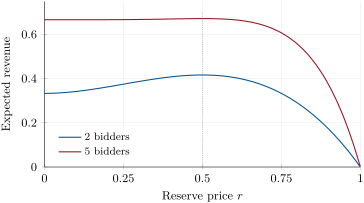
With two bidders, a reserve of one half raises expected revenue from to , a quarter more; with five, the gain is small, because the second-highest value rarely falls below the reserve. A reserve is most useful when competition is thin, which is also when it risks leaving the object unsold.
28.4 Common values and the winner’s curse
When the object has a common value that each bidder estimates with error — the oil in a tract, the future profits of a licence — winning tells the winner that her estimate was the most optimistic. A bidder who bids her unconditional estimate loses money on average: the winner’s curse of the Year 2 volume. Bidders who understand it shade their bids by more as rivals multiply. When values are affiliated (one bidder’s high signal makes high signals of others more likely), the English auction lets each bidder learn from the prices at which others drop out; the linkage principle states that releasing information linked to the value raises expected revenue, and in that environment the English auction raises more than the second-price auction, which raises more than the first-price auction.
28.5 Multi-unit auctions and the record of spectrum sales
Definition 28.6 (Simultaneous ascending auction; clock auction)
In a simultaneous ascending auction several licences are sold at once, in rounds; prices rise on each separately and none is sold until no one bids again on any. In a clock auction the auctioneer announces prices and bidders state the quantities they demand, and prices rise where demand exceeds supply.
When licences are complements, a bidder who wants a pair risks winning one at a price justified only by the pair: the exposure problem. When they are substitutes, bidders can divide them by signalling in early rounds.
On the record — Spectrum auctions: the U.K. and the Netherlands, 2000
The U.K. sold five licences in March and April 2000, with no bidder allowed more than one and one reserved for a new entrant. Nine new entrants bid against the four incumbents and the auction raised 39 billion euros. Four months later the Netherlands used nearly the same design with five incumbents and five licences. The strongest potential entrants joined incumbents instead of bidding; one weak entrant bid, and stopped after an incumbent threatened legal action. The auction raised less than 3 billion euros against almost 10 billion forecast.
The same design produced opposite results because entry differed. An ascending auction lets a strong bidder top any bid, which deters weaker ones; a sealed-bid stage gives them a chance, and so brings them in.
On the record — The U.S. incentive auction, 2016–2017
The United States bought spectrum back from television stations and sold it to mobile operators in one design: a descending clock auction in which broadcasters offered to give up or move their channels, and an ascending clock auction for the licences. It began on 29 March 2016 and closed on 13 April 2017. Fifty winning bidders paid 19.8 billion dollars for 70 MHz of licensed spectrum, with 14 MHz more for unlicensed use; more than 10 billion dollars went to 175 broadcasters, of whom 133 relinquished their licences and 30 moved to a lower channel.
28.6 Matching: schools and kidneys
Definition 28.7 (Stable matching; deferred acceptance algorithm; strategy-proofness)
A matching of pupils to schools is stable if no pupil prefers a school that either has a free seat or holds a pupil of lower priority there. In the deferred acceptance algorithm, each unassigned pupil applies to her most preferred school that has not yet rejected her; each school holds its best applicants up to its capacity and rejects the rest; the algorithm stops when no pupil is rejected. A mechanism is strategy-proof if reporting one’s true preferences is a dominant strategy.
Proposition 28.8 (Deferred acceptance)
Deferred acceptance ends with a stable matching, and each proposer weakly prefers it to every other stable matching.
Proof. It ends, since each pupil applies to each school at most once. Suppose pupil prefers school to her match. Then applied to earlier and was rejected, when held pupils of higher priority; a school’s held set only improves, so at the end is full of pupils of higher priority than : no blocking pair. For optimality, call a school possible for if some stable matching gives it to her, and suppose that some pupil is rejected by a possible school; take the first such rejection, of by , and a stable matching that gives to . At that moment is full with pupils of higher priority than , and at least one of them, , is not at in , since takes one of its seats there. Pupil applied to , so every school she ranks above has rejected her; none of them is possible for , because no possible school has rejected anyone before. Her school in is possible for her, so she ranks it below . Then prefers to her match in and has higher priority there than : blocks , a contradiction. No pupil is ever rejected by a possible school, so each ends at the best of them. ∎
Proposition 28.9 (Incentives)
Deferred acceptance is strategy-proof for the proposing side.
Proof. Admitted at this level. ∎
On the record — Boston’s school choice, 2005
Boston assigned pupils by a priority mechanism that accepted each round’s applications for good: a pupil who ranked a popular school first and missed it could find her second choice already full. Records of choices showed some parents strategising with care and others not; many pupils left unassigned could have had one of their stated choices with a different ranking. In July 2005 the city replaced the mechanism with deferred acceptance, under which ranking schools truthfully is safe; it chose deferred acceptance over top trading cycles, which is also strategy-proof.
Definition 28.10 (Top trading cycles; kidney exchange)
In top trading cycles each agent owns an object and points to the owner of her most preferred remaining object; every cycle that forms trades along itself and leaves; the rest point again. A kidney exchange matches patients who have a willing but incompatible donor, so that each donor gives to another pair’s patient.
Proposition 28.11 (Top trading cycles)
Top trading cycles gives a Pareto-efficient allocation and is strategy-proof.
Proof. Admitted at this level. ∎
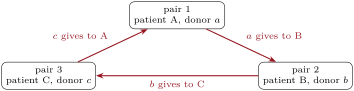
Kidney exchange began with pairs of pairs and with exchanges in which a pair gives to someone on the waiting list in return for priority for its own patient. Run as a clearinghouse over many pairs, with the constraints that law and medicine impose, the design is efficient and gives no pair a reason to hide information; simulations suggest substantial gains, both in transplants and in the quality of the matches.
On the record — Kidney exchange in the United States
Agarwal and co-authors found the American market fragmented: most exchange transplants were arranged by single hospitals, not on the national platforms. A hospital that submits its pairs to a platform counts only part of the gain, which goes in part to other hospitals’ patients, and the platforms rewarded hospitals for submitting patients and donors in ways that did not correct this. Many hospitals ran exchanges below the scale at which pools match well. Removing these failures could raise the number of exchange transplants by 30 to 63 %.
The theory of the clearinghouse was right about what a thick pool achieves; it left out the incentives of the hospitals that decide which pairs enter it.
How it is measured — Measuring a matching market’s stability
Stability can be checked from data: for each participant, list the partners she ranks above her match and ask whether any of them would have preferred her to its own match or had a free place. Each such pair is a blocking pair. A mechanism whose outputs often contain blocking pairs invites participants to arrange matches outside it. Roth’s comparison of seven regional British markets for new doctors, which had adopted different centralised mechanisms, found that those producing unstable matches fared no better than the decentralised markets they had replaced: stability mattered even in those more complex markets.
28.7 Exercises
Exercise 28.1 ★
In the opening chart, what is the ratio of the highest to the lowest revenue per head in 2000? And between the U.K. and the Netherlands?
Solution
Solution of Exercise 28.1.
; .
Exercise 28.2 ★
Three bidders have values uniform on . Find the expected revenue of a second-price auction.
Solution
Solution of Exercise 28.2.
The expected second-highest of three uniform values, .
Exercise 28.3 ★
In a first-price auction with four bidders and values uniform on , what does a bidder of value 0.6 bid?
Solution
Solution of Exercise 28.3.
.
Exercise 28.4 ★
What result of a laboratory or field experiment would contradict revenue equivalence? Name one such result from the chapter.
Solution
Solution of Exercise 28.4.
Different average revenue from two formats that the theory says are equivalent, with the same bidders and objects. The Dutch auction of trading cards raised 30 % more than the first-price auction.
Exercise 28.5 ★★
Values are uniform on and the seller values the object at 0.2. Find the optimal reserve.
Solution
Solution of Exercise 28.5.
: .
Exercise 28.6 ★★
Four pupils and four schools, one seat each, have invented preferences and priorities. Run deferred acceptance with the pupils proposing and with the schools proposing, and compare.
Solution
Solution of Exercise 28.6.
The tested solution is ex06_deferred.py, in the chapter’s exercises/ folder. With the pupils proposing: p1–A, p2–B, p3–D, p4–C. With the schools proposing: p1–B, p2–A, p3–D, p4–C. Both are stable; p1 and p2 get their first choices in the first and their second choices in the second, the schools A and B the reverse. Each side does best when it proposes.
Exercise 28.7 ★★
An incumbent’s value of a licence is known to be higher than an entrant’s. Why might the entrant not bid in an English auction, and how does a final sealed-bid stage change that?
Solution
Solution of Exercise 28.7.
In an English auction the incumbent can always top the entrant’s bid, so the entrant expects to lose and to bear its bidding costs for nothing. A sealed final stage makes the incumbent guess how much to bid; wanting a profit, it may bid less than it could, so the entrant has a chance and enters.
Exercise 28.8 ★★
A tract’s value is ; each of two bidders sees plus an error of or with equal chance, independent of the other’s. A bidder sees 100. What is her expected value of , and what is it given that her signal is the higher of the two (ties broken at random)?
Solution
Solution of Exercise 28.8.
Unconditionally is 90 or 110 with equal chance: 100. If , her signal is higher with probability ; if , with probability . Given that it is higher, with probability : .
Exercise 28.9 ★★
What would applicants’ strategies show if a mechanism were not strategy-proof?
Solution
Solution of Exercise 28.9.
Reported rankings that depend on the reports or priorities of others — for instance, applicants ranking a less popular school first when they have low priority at their preferred one — and applicants who report truthfully doing worse than similar ones who do not.
Exercise 28.10 ★★★
Prove revenue equivalence with the envelope argument, and compute the expected payment for uniform values and bidders.
Solution
Solution of Exercise 28.10.
The proof is in the text. With , .
Exercise 28.11 ★★★
Four bidders with values uniform on have utility of their gain . Simulate the expected revenue of the four formats, using the equilibrium first-price bid .
Solution
Solution of Exercise 28.11.
The tested solution is ex11_risk.py, in the chapter’s exercises/ folder. English and second-price: 0.600; Dutch and first-price: 0.686, against 0.601 with risk-neutral bidders. Risk aversion leaves the first two unchanged and raises the revenue of the other two.
Exercise 28.12 ★★★
Four patient–donor pairs: donor is compatible with B and C, with A, with D, with A and C. Each patient prefers compatible donors in the order listed in her row: A prefers then ; B prefers ; C prefers then ; D prefers . Run top trading cycles.
Solution
Solution of Exercise 28.12.
A points to pair 2 (donor ), B to pair 1 (), C to pair 4 () and D to pair 3 (). Two cycles form at once: pairs 1 and 2 exchange, A receiving and B receiving ; pairs 3 and 4 exchange, C receiving and D receiving . All four patients receive a kidney.
28.8 Problem: Brenland Sells Its Radio Spectrum
Problem 28.1
Weekend problem — Brenland sells its radio spectrum
Brenland sells one national mobile licence. Four operators bid; each one’s value is uniform on million dalens, independent of the others’. Brenmoor, meanwhile, assigns pupils to schools.
Part I — choosing the format.
- Find the expected revenue of an English auction.
- Find the equilibrium bid in a first-price auction, and its expected revenue.
- Find the expected payoff of the winner.
- If the operators are risk averse, which format raises more?
- If one operator is an incumbent whose value is known to be high, which format would you fear in the other three’s place, and why?
Part II — the reserve.
- Find the revenue-maximising reserve when an unsold licence is worth nothing to the government.
- Find the expected revenue with that reserve.
- Find the probability that the licence goes unsold.
- Would the reserve change with eight operators?
- If an unsold licence can be used by a public operator worth 100 million, what is the optimal reserve?
Part III — two licences. Brenland now sells a northern and a southern licence. One operator values each alone at 50 million and the pair at 150.
- Are the licences substitutes or complements for this operator?
- In separate simultaneous ascending auctions, prices reach 70 on each. Should it stay in?
- It stays in and wins the north at 70, but the south rises to 90 and it drops out. What is its payoff?
- Name this problem, and one design that removes it.
- With operators that value the licences as substitutes, what could they do in the early rounds?
Part IV — Brenmoor’s schools. Ana, Ben and Dee rank North first, Cai ranks South first. Ana: North, South, West. Ben: North, West, South. Cai: South, North, West. Dee: North, South, West. North has one seat and priorities Cai, Dee, Ana, Ben; South one seat, priorities Ana, Dee, Ben, Cai; West two seats, priorities Ben, Ana, Cai, Dee.
- Run deferred acceptance with the pupils proposing, round by round.
- Check that the matching is stable.
- Run the old mechanism, in which each round’s applications are accepted for good, with truthful rankings.
- Find a blocking pair in that outcome.
- Show that Ana gains under the old mechanism by ranking South first.
- In the deferred-acceptance matching, which two pupils would both gain by swapping schools? Why does the algorithm not let them?
- Which mechanism would make that swap, and at what cost?
- What evidence from Boston supports the change?
- Why might a city prefer stability to that swap?
- State the result: the revenue-maximising reserve and the expected revenue with it, and the matching that deferred acceptance produces.
Solution
Solution of Problem 28.1.
1. The expected second-highest value: million dalens.
2. ; expected revenue million, as revenue equivalence says.
3. The expected highest value less the expected price: million.
4. The first-price (or Dutch) auction.
5. The English auction: the incumbent can top any bid, so the others may not bid at all, and the price falls to their low values.
6. : million.
7. million.
8. All four values below 200: .
9. No: the optimal reserve does not depend on the number of bidders; its gain shrinks.
10. : million.
11. Complements: the pair is worth 150, more than .
12. Winning both at 70 each costs 140, less than 150: staying in pays if it wins both, but it risks winning one alone at a price above its value of 50.
13. million.
14. The exposure problem. Package bidding, in which a bid for the pair is a single bid, removes it.
15. Signal a division — each bidding on one licence only — and threaten to bid up the other’s licence if it does not stay away.
16. Round 1: Ana, Ben and Dee apply to North, which holds Dee; Cai applies to South. Round 2: Ana applies to South, which holds Ana and rejects Cai; Ben applies to West. Round 3: Cai applies to North, which holds Cai and rejects Dee. Round 4: Dee is rejected by South. Round 5: Dee applies to West. Result: Ana South, Ben West, Cai North, Dee West.
17. Ana prefers only North, where Cai has priority over her; Ben prefers only North (Cai again); Cai prefers South, where Ana has priority; Dee prefers North and South, where Cai and Ana have priority over her. No blocking pair.
18. Round 1: North takes Dee; South takes Cai. Round 2: South is full for Ana; West takes Ben. Round 3: West takes Ana. Result: Ana West, Ben West, Cai South, Dee North.
19. Ana and South: she prefers South to West and has priority there over Cai.
20. Ranking South first, Ana applies there in round 1 with Cai and wins on priority: she gets South, which she prefers to West.
21. Ana (at South, preferring North) and Cai (at North, preferring South). After the swap Dee, at West, would have priority over Ana at North and over Cai at South: the swap breaks her priorities, so stability forbids it.
22. Top trading cycles would make it, at the cost of leaving Dee with a justified complaint at two schools.
23. Some parents strategised and others did not, and many unassigned pupils could have had a stated choice with a different ranking.
24. Priorities often encode rules the city has promised (siblings, distance), and a family with higher priority that sees a lower-priority pupil take its seat has a legal and moral complaint.
25. The revenue-maximising reserve is 200 million dalens and the expected revenue with it 245 million; deferred acceptance places Ana at South, Ben at West, Cai at North and Dee at West.