
Alle boeken

Professioneel

Apps Over Coach Inloggen Begin met lezen

Computer Science · Begrippenlijst

Wat is Aggregate, accounting and potential methods?

Ook bekend als: aggregate method · accounting method · potential function

Definition 14.6 University Computer Science — Year 1 · Hoofdstuk 14 — Dynamic Arrays and Amortised Analysis

Three methods prove amortised bounds. The aggregate method bounds the total cost of any sequence directly. The accounting method charges each operation a fixed number of credits, spends one credit per unit of actual cost, and shows that the credits stored never become negative. The potential method chooses a potential function Φ\Phi from the states of the structure to the reals, and calls ci+Φi−Φi−1c_i + \Phi_i - \Phi_{i-1} the amortised cost of the ii-th operation, of actual cost cic_i; if Φm≥Φ0\Phi_m \geq \Phi_0 after every sequence, the total actual cost is at most the total amortised cost.
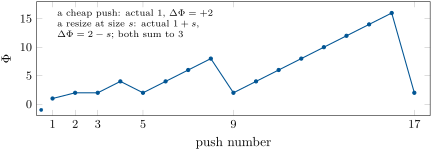
The potential = 2 size - capacity along the same pushes: it rises by 2 at each cheap push, storing credit, and falls to 2 at each resize, spending it on the copies. The first dot is the empty array, = -1.
The potential Φ=2⋅size−capacity\Phi = 2 \cdot \text{size} - \text{capacity} along the same pushes: it rises by 2 at each cheap push, storing credit, and falls to 2 at each resize, spending it on the copies. The first dot is the empty array, Φ=−1\Phi = -1.
Lees in het hoofdstuk →