Todos los libros

Profesional

Apps Acerca de Coach Iniciar sesión Empezar a leer

Computer Science · Glosario

¿Qué es Bloom filter, false positive?

También llamado: Bloom filter · false positive (Bloom filter)

Definition 27.11 University Computer Science — Year 2 · Capítulo 27 — Randomised Algorithms

A Bloom filter is an array of mm bits, all 00 at first, and kk hash functions h1,…,hkh_1, \dots, h_k with values in {0,…,m−1}\{0, \dots, m - 1\}. Adding a key xx sets the bits h1(x),…,hk(x)h_1(x), \dots, h_k(x) to 11. A lookup of yy answers “present” if its kk bits are all 11. A false positive is a lookup that answers “present” for a key that was never added.
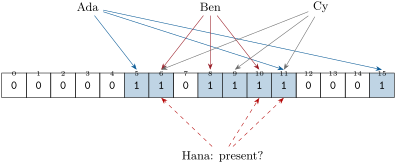
The filter of . Each added name sets 3 bits; the bits 6 and 11 are shared. Hana was never added, but her bits 10, 11 and 6 were all set by Ben and Cy: a false positive.
The filter of Output 27.5. Each added name sets 3 bits; the bits 6 and 11 are shared. Hana was never added, but her bits 10, 11 and 6 were all set by Ben and Cy: a false positive.
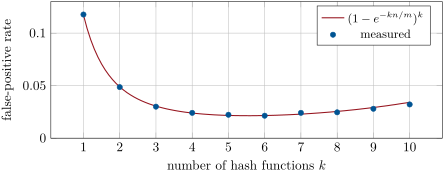
The false-positive rate of  against the formula of , for m/n = 8. Too few functions leave each lookup a weak test; too many fill the array with ones. The minimum is near k = 8 2 5.5.
The false-positive rate of Output 27.6 against the formula of Proposition 27.12, for m/n=8m/n = 8. Too few functions leave each lookup a weak test; too many fill the array with ones. The minimum is near k=8ln⁡2≈5.5k = 8 \ln 2 \approx 5.5.
Leer en el capítulo →