 Coach
A compiler phase is one stage of a compiler: a function from one representation of the program to the next, which may reject the program with an error. The phases that depend on the source language and not on the target machine (cutting into tokens, parsing, checking names and types) form the front end; those that depend on the target machine and not on the source language (choosing instructions, assigning registers, laying out the stack frame) form the back end.
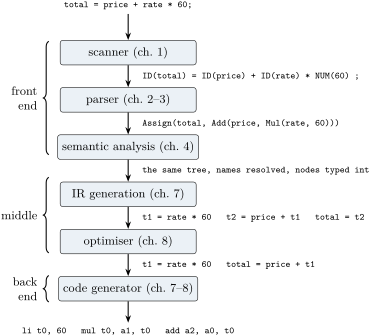
ID and NUM stand for an identifier and a number token). The middle phases work on three-address code, which belongs to neither language; here the optimiser removes a useless copy, and the code generator keeps price, rate and total in registers.