Semua buku

Profesional

Aplikasi Tentang Pelatih Masuk Mulai membaca

Computer Science · Glosarium

Apa itu Decomposition, lossless join, dependency preservation?

Dikenal juga sebagai: decomposition · lossless-join decomposition · dependency preservation

Definition 30.10 University Computer Science — Year 2 · Bab 30 — Database Design: Dependencies, Normal Forms and Transactions

A decomposition of RR is a list of attribute sets R1,…,RmR_1, \dots, R_m whose union is RR; a table TT over RR is stored as its projections πRi(T)\pi_{R_i}(T). The decomposition is lossless for FF if T=πR1(T)⋈⋯⋈πRm(T)T = \pi_{R_1}(T) \bowtie \dots \bowtie \pi_{R_m}(T) for every TT satisfying FF; it preserves the dependencies if the dependencies of FF that hold inside the parts imply all of FF.

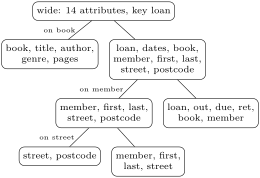
The BCNF decomposition of . Each split takes a violating dependency X Y and makes one table of X with everything it determines, and another of the rest with X kept as the link. The four leaves are the BCNF tables.
The BCNF decomposition of Output 30.2. Each split takes a violating dependency X→YX \to Y and makes one table of XX with everything it determines, and another of the rest with XX kept as the link. The four leaves are the BCNF tables.

Contoh

Example 30.13 (No BCNF decomposition preserves the dependencies)

An address table over street, town and postcode with the rules street town →\to postcode and postcode →\to town. The keys are {street, town} and {street, postcode}, so postcode →\to town violates BCNF; every attribute belongs to a key, so the table is in 3NF. Any BCNF decomposition must separate the three attributes, and street town →\to postcode then lies in no part.

Baca dalam konteks →