
Todos os livros

Profissional

Apps Sobre Coach Entrar Começar a ler

Computer Science · Glossário

O que é Diffie–Hellman key exchange, discrete-logarithm problem, man-in-the-middle attack?

Também chamado de: Diffie--Hellman key exchange · discrete-logarithm problem · man-in-the-middle attack

Definition 28.2 University Computer Science — Year 3 · Capítulo 28 — Public-Key Cryptography and Secure Protocols

Let pp be a prime, qq a prime dividing p−1p - 1, and gg an integer of order qq modulo pp, all public. In the Diffie–Hellman key exchange, one party picks a secret aa in {1,…,q−1}\{1, \ldots, q - 1\} and sends A=ga mod pA = g^a \bmod p; the other picks bb and sends B=gb mod pB = g^b \bmod p; both compute K=Ba=Ab=gab mod pK = B^a = A^b = g^{ab} \bmod p, and derive their keys from KK with a hash. The discrete-logarithm problem is to find xx from gx mod pg^x \bmod p; the Diffie–Hellman problem is to find gabg^{ab} from gag^a and gbg^b. A man-in-the-middle attack is one in which the attacker relays, reads and changes the messages between two parties, who each believe they talk to the other.
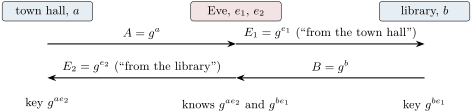
Diffie–Hellman with Eve in the middle. Nothing in the exchange says who sent a public value, so each side runs the protocol correctly with Eve. Eve decrypts each message with one key and re-encrypts it with the other.
Ler no capítulo →