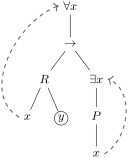
In ∀xA and ∃xA, the formula A is the scope of the quantifier. An occurrence of x is bound if it lies in the scope of a quantifier on x, and then it is bound by the nearest such quantifier above it in the tree; otherwise it is free. The free variables of a formula are those with a free occurrence; a formula without any is a sentence.
উদাহরণ
Example 24.12 (A universal from two universals)
From ∀x(P(x)→Q(x)) and ∀xP(x) follows ∀xQ(x). With Γ the two hypotheses, both sentences, the variable y is free in none of them, and ∀i applies:
Γ⊢∀xQ(x)Γ⊢Q(y)Γ⊢P(y)→Q(y)Γ⊢∀x(P(x)→Q(x)) hyp∀eΓ⊢P(y)Γ⊢∀xP(x) hyp∀e→e∀i
 Coach