Definition 22.6University Computer Science — Year 2 · 第 22 章 — Regular Expressions and the Limits of Regular Languages
Let e have positions 1,…,m, the letter at position j being ℓ(j), and let e′ be the linear expression. Define Null (whether ε∈L(e)), First (the positions that can begin a word of L(e′)), Last (those that can end one), and Follow(j) (the positions that can come right after j in a word of L(e′)). The Glushkov automaton of e has states 0,1,…,m, start state 0, transitions 0ℓ(j)j for j∈First and iℓ(j)j for j∈Follow(i), and accepting statesLast, plus 0 if Null.
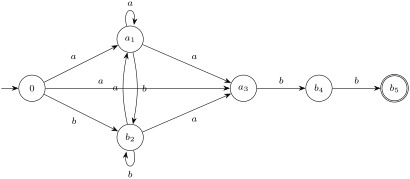
The Glushkov automaton of (a∣b)∗abb: one state per position, and every transition into a position carries that position’s letter. It is nondeterministic: from 0, a1 and a3 both read a.
 Coach