
Alle boeken

Professioneel

Apps Over Coach Inloggen Begin met lezen

Computer Science · Begrippenlijst

Wat is Interrupt, trap, hardware exception, interrupt vector, timer interrupt?

Ook bekend als: trap · hardware exception · interrupt · interrupt vector · timer interrupt

Definition 10.2 University Computer Science — Year 3 · Hoofdstuk 10 — The Kernel and CPU Scheduling

A trap is a transfer of control from the running program to the kernel, made by the processor itself in the middle of an instruction stream. It is caused either by the instruction being executed, a hardware exception (an illegal instruction, a load from an address that faults, a system call), or by an event outside the program, an interrupt (a device has data, a timer has expired). The interrupt vector is the address, or table of addresses, the processor jumps to on a trap. A timer interrupt is an interrupt raised when a clock reaches a value the kernel set.
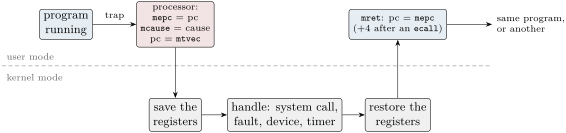
A trap. The processor does three things by itself, all in one step: it records where the program was and why it stopped, and jumps to the kernel’s entry point. The kernel saves the registers the handler will use, handles the event, restores registers (perhaps those of another process), and returns. For a system call, the kernel adds 4 to the saved address, so that the program resumes after its ecall.
Lees in het hoofdstuk →