
All books

Professional

Apps About Coach Log in Start reading

Computer Science · Glossary

What is Memory hierarchy?

Definition 12.2 University Computer Science — Year 2 · Chapter 12 — Caches and the Memory Hierarchy

A memory hierarchy is a sequence of memories, each larger and slower than the one before it, where each level keeps copies of the parts of the next level that were used recently. From the processor outwards: the registers, two or three levels of cache, the main memory, and the disks.
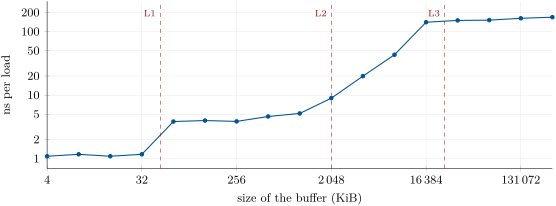
The measurements of , on logarithmic scales. The dashed lines are the capacities of the laptop’s three caches, as getconf reports them below. Each time the buffer outgrows a level, the time of a load rises to that of the next.
The measurements of Output 12.2, on logarithmic scales. The dashed lines are the capacities of the laptop’s three caches, as getconf reports them below. Each time the buffer outgrows a level, the time of a load rises to that of the next.
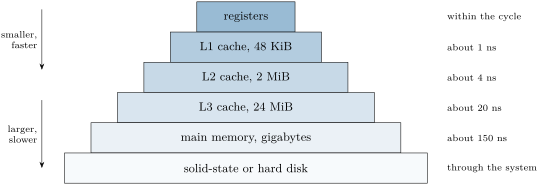
The memory hierarchy of the author’s laptop. The capacities are those of getconf; the times are the plateaus of , the time of one load served by that level.
The memory hierarchy of the author’s laptop. The capacities are those of getconf; the times are the plateaus of Output 12.2, the time of one load served by that level.
Read in context →