جميع الكتب

مهني

1 Markets I: The Ecosystem and Exchange-Traded Marketsالأسواق عبر الإنترنت 2 Markets II: Rates, FX and Creditالأسواق عبر الإنترنت 3 Markets III: Commodities, Energy and Cryptoالأسواق عبر الإنترنت 4 Quantitative Methodsالأساليب عبر الإنترنت 5 Derivatives and Volatilityالمشتقات عبر الإنترنت 6 Rates, Credit, XVA and Riskالفائدة والائتمان والمخاطر عبر الإنترنت 7 Research Craft: Predictors, Backtests, Measurement, Portfoliosالبحث عبر الإنترنت 8 Strategies I: Equities and Futuresالاستراتيجيات عبر الإنترنت 9 Strategies II: Volatility, Relative Value, Macro and the Bank Desksالاستراتيجيات عبر الإنترنت 10 Microstructure and Executionالتنفيذ عبر الإنترنت 11 Market Making and High-Frequency Tradingصناعة السوق عبر الإنترنت 12 Machine Learning for Marketsتعلم الآلة عبر الإنترنت 13 Low-Latency Softwareالتكنولوجيا عبر الإنترنت 14 Networks, Hardware and Trading Infrastructureالتكنولوجيا عبر الإنترنت 15 Research, Data and Risk Platformsالتكنولوجيا عبر الإنترنت 16 The Desk and the Firmالشركة عبر الإنترنت 17 The Industry: Firms, Roles and Careersالمسارات المهنية عبر الإنترنت 18 Interviews I: Maths, Probability and Speedالمسارات المهنية عبر الإنترنت 19 Interviews II: Markets, Trading Games and the Final Roundالمسارات المهنية عبر الإنترنت 20 Interviews III: Codeالمسارات المهنية عبر الإنترنت
التطبيقات حول المدرب تسجيل الدخول ابدأ القراءة

Computer Science · المسرد

ما معنى Mode of operation, ECB, CBC, initialisation vector, padding, CTR, padding oracle؟

يُعرف أيضًا باسم: mode of operation · ECB mode · CBC mode · initialisation vector · padding · CTR mode · padding oracle

Definition 27.5 University Computer Science — Year 3 · الفصل 27 — Symmetric Cryptography and Hash Functions

A mode of operation encrypts a message of several blocks P1,…,PnP_1, \ldots, P_n with a block cipher. ECB mode encrypts each block alone: Ci=Ek(Pi)C_i = E_k(P_i). CBC mode chains them: Ci=Ek(Pi⊕Ci−1)C_i = E_k(P_i \oplus C_{i-1}), starting from C0C_0, an initialisation vector (IV) that must be unpredictable and is sent with the ciphertext; decryption computes Pi=Dk(Ci)⊕Ci−1P_i = D_k(C_i) \oplus C_{i-1}. Padding extends the message to a whole number of blocks; PKCS#7 padding adds pp bytes of value pp, 1≤p≤161 \le p \le 16, and is checked and removed after decryption. CTR mode turns the block cipher into a stream cipher: Ci=Pi⊕Ek(ctr+i)C_i = P_i \oplus E_k(\mathit{ctr} + i), with a counter block that must never repeat under one key. A padding oracle is any way for an attacker to learn whether the padding of a ciphertext of its choice was valid.
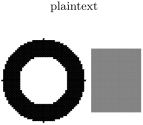
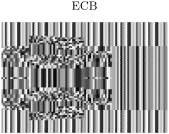
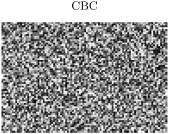
A picture of 96 × 64 one-byte pixels, drawn from figures/ecb.dat, encrypted with AES-128. In ECB each run of 16 equal pixels becomes the same 16 bytes, and the shapes stay visible; in CBC the ciphertext looks random. A picture of 96 × 64 one-byte pixels, drawn from figures/ecb.dat, encrypted with AES-128. In ECB each run of 16 equal pixels becomes the same 16 bytes, and the shapes stay visible; in CBC the ciphertext looks random. A picture of 96 × 64 one-byte pixels, drawn from figures/ecb.dat, encrypted with AES-128. In ECB each run of 16 equal pixels becomes the same 16 bytes, and the shapes stay visible; in CBC the ciphertext looks random.

A picture of 96×6496 \times 64 one-byte pixels, drawn from figures/ecb.dat, encrypted with AES-128. In ECB each run of 16 equal pixels becomes the same 16 bytes, and the shapes stay visible; in CBC the ciphertext looks random.
Two modes. In CBC each ciphertext block feeds the next encryption, so equal plaintext blocks encrypt differently, and encryption is sequential. In CTR the cipher only produces a keystream from the counter, and the blocks can be computed in parallel; a repeated counter repeats the keystream.
اقرأ في الفصل →