جميع الكتب

مهني

1 Markets I: The Ecosystem and Exchange-Traded Marketsالأسواق عبر الإنترنت 2 Markets II: Rates, FX and Creditالأسواق عبر الإنترنت 3 Markets III: Commodities, Energy and Cryptoالأسواق عبر الإنترنت 4 Quantitative Methodsالأساليب عبر الإنترنت 5 Derivatives and Volatilityالمشتقات عبر الإنترنت 6 Rates, Credit, XVA and Riskالفائدة والائتمان والمخاطر عبر الإنترنت 7 Research Craft: Predictors, Backtests, Measurement, Portfoliosالبحث عبر الإنترنت 8 Strategies I: Equities and Futuresالاستراتيجيات عبر الإنترنت 9 Strategies II: Volatility, Relative Value, Macro and the Bank Desksالاستراتيجيات عبر الإنترنت 10 Microstructure and Executionالتنفيذ عبر الإنترنت 11 Market Making and High-Frequency Tradingصناعة السوق عبر الإنترنت 12 Machine Learning for Marketsتعلم الآلة عبر الإنترنت 13 Low-Latency Softwareالتكنولوجيا عبر الإنترنت 14 Networks, Hardware and Trading Infrastructureالتكنولوجيا عبر الإنترنت 15 Research, Data and Risk Platformsالتكنولوجيا عبر الإنترنت 16 The Desk and the Firmالشركة عبر الإنترنت 17 The Industry: Firms, Roles and Careersالمسارات المهنية عبر الإنترنت 18 Interviews I: Maths, Probability and Speedالمسارات المهنية عبر الإنترنت 19 Interviews II: Markets, Trading Games and the Final Roundالمسارات المهنية عبر الإنترنت 20 Interviews III: Codeالمسارات المهنية عبر الإنترنت
التطبيقات حول المدرب تسجيل الدخول ابدأ القراءة

Computer Science · المسرد

ما معنى Nested-loop, block nested-loop, index nested-loop, sort–merge and hash joins؟

يُعرف أيضًا باسم: nested-loop join · block nested-loop join · index nested-loop join · sort--merge join · hash join

Definition 22.4 University Computer Science — Year 3 · الفصل 22 — Query Processing and Optimisation

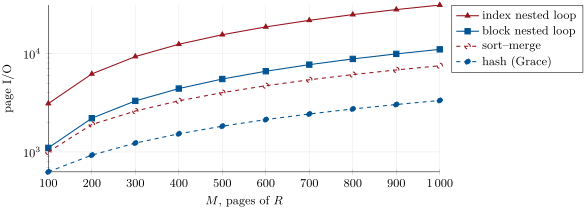
Let RR have MM pages and ∣R∣|R| tuples, SS have NN pages, and BB buffer pages be free. The nested-loop join scans SS once for each tuple of RR: M+∣R∣NM + |R| N page reads. The block nested-loop join loads B−2B - 2 pages of RR at a time and scans SS once per block: M+⌈M/(B−2)⌉NM + \lceil M/(B-2) \rceil N. The index nested-loop join searches an index on SS’s join column for each tuple of RR: M+∣R∣(h+1)M + |R|(h + 1) for an index of height hh and one matching tuple. The sort–merge join sorts both inputs on the join column and merges them: the two sorts plus M+NM + N. The hash join builds a hash table on the smaller input and probes it with the other: M+NM + N if the smaller fits in B−2B - 2 pages; otherwise the Grace variant first partitions both inputs into B−1B - 1 buckets on disk by a hash of the join column and joins bucket by bucket: 3(M+N)3(M + N).

Counted page I/O of four joins as R grows from 100 to 1,000 pages, S fixed at 100 pages, 12 buffer pages. The tuple nested loop is off the chart: 100,100 already at M = 100.
Counted page I/O of four joins as RR grows from 100 to 1,000 pages, SS fixed at 100 pages, 12 buffer pages. The tuple nested loop is off the chart: 100,100 already at M=100M = 100.
اقرأ في الفصل →