全部书籍

专业

应用 关于 Coach 登录 开始阅读

书籍暂未推出简体中文版——当前显示英文版。

Computer Science · 术语表

什么是 Sampling rate, bit depth?

又称: sampling rate · bit depth

Definition 6.3 High School Computer Science · 第 6 章 — Digital Images, Sound and Compression

To sample a signal is to measure it at regular instants. The sampling rate is the number of measurements, or samples, per second, in hertz (Hz). Each sample is then rounded to one of a fixed number of levels, a step called quantisation; the bit depth is the number of bits used for one sample, so that there are 2bit depth2^{\text{bit depth}} levels.

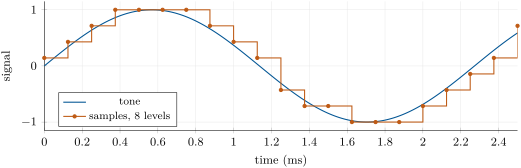
A 440 Hz tone sampled 8000 times per second and quantised on 3 bits, that is 8 levels. Each dot is a stored sample; between two samples nothing is kept. With 16 bits the steps would be more than 9000 times finer.
A 440440 Hz tone sampled 80008000 times per second and quantised on 33 bits, that is 88 levels. Each dot is a stored sample; between two samples nothing is kept. With 1616 bits the steps would be more than 90009000 times finer.
在原文中阅读 →