Coach
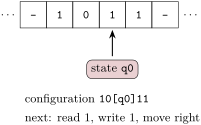
A Turing machine has a finite set of states with a start state, a finite tape alphabet containing a blank symbol, a tape of cells unbounded in both directions, and a head on one cell. Its transition function maps some pairs (state, symbol read) to a triple (new state, symbol written, move left, right or stay). A step applies it; the machine halts when no transition applies, and accepts if it halts in its accepting state. A configuration is the state, the tape contents and the head position: written , the tape left of the head, the state, and the tape from the head on.