Semua buku

Profesional

Aplikasi Tentang Pelatih Masuk Mulai membaca

Economics · Glosarium

Apa itu Constant relative risk aversion?

Definition 1.22 University Economics — Year 2 · Bab 1 — Expected Utility

A utility of money shows constant relative risk aversion (CRRA) with coefficient γ>0\gamma > 0 if

u(z)=z1−γ1−γ(γ≠1),u(z)=ln⁡z(γ=1),u(z) = \frac{z^{1-\gamma}}{1-\gamma} \quad (\gamma \ne 1), \qquad u(z) = \ln z \quad (\gamma = 1),

for z>0z > 0; then R(z)=γ\mathcal{R}(z) = \gamma and A(z)=γ/z\mathcal{A}(z) = \gamma / z.

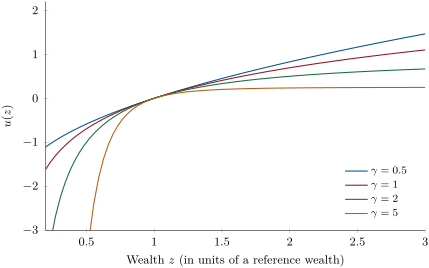
Constant relative risk aversion, u(z) = (z1- - 1)/(1- ), scaled so that every curve passes through (1, 0) with slope 1. The higher , the faster marginal utility falls and the flatter the curve above the reference wealth.
Constant relative risk aversion, u(z)=(z1−γ−1)/(1−γ)u(z) = (z^{1-\gamma} - 1)/(1-\gamma), scaled so that every curve passes through (1,0)(1, 0) with slope 11. The higher γ\gamma, the faster marginal utility falls and the flatter the curve above the reference wealth.
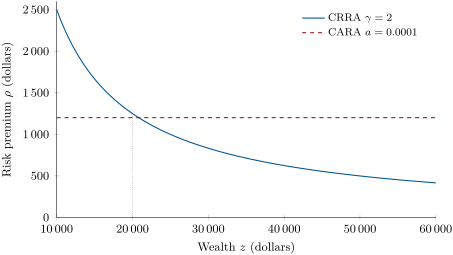
The risk premium of a 50–50 gain or loss of $5000. Under CRRA with = 2 it is h2/z and falls as wealth rises; under CARA it is the same at every wealth. The two utilities have the same absolute risk aversion at $20\,000 (dotted line), where their premiums nearly agree.
The risk premium of a 50–50 gain or loss of $50005000. Under CRRA with γ=2\gamma = 2 it is h2/zh^2/z and falls as wealth rises; under CARA it is the same at every wealth. The two utilities have the same absolute risk aversion at $20 00020\,000 (dotted line), where their premiums nearly agree.

Contoh

Example 1.24 (The premium as wealth rises)

Let a person face a 50–50 gain or loss of $50005000. With CRRA γ=2\gamma = 2, u(z)=−1/zu(z) = -1/z and

E[u]=−12(1z−h+1z+h)=−zz2−h2,c=z2−h2z,ρ=h2z,\mathbb{E}[u] = -\tfrac12\Bigl(\frac{1}{z - h} + \frac{1}{z + h}\Bigr) = -\frac{z}{z^2 - h^2}, \qquad c = \frac{z^2 - h^2}{z}, \qquad \rho = \frac{h^2}{z},

with h=5000h = 5000: $12501250 at a wealth of $20 00020\,000, $500500 at $50 00050\,000. With CARA and a=0.0001a = 0.0001 per dollar (the absolute risk aversion of CRRA γ=2\gamma = 2 at $20 00020\,000), ρ=ln⁡cosh⁡(ah)/a=ln⁡cosh⁡(0.5)/0.0001≈$1201\rho = \ln\cosh(ah)/a = \ln\cosh(0.5)/0.0001 \approx \text{\$}1201 at every wealth (Exercise 1.8 derives the formula). The figure below plots both. Under CARA a household with $1 000 0001\,000\,000 and one with $15 00015\,000 pay the same premium to shed the same risk; part IV of the weekend problem turns this difference between the two families into a test.

Baca dalam konteks →