
全部书籍

专业

应用 关于 Coach 登录 开始阅读

书籍暂未推出简体中文版——当前显示英文版。

Economics · 术语表

什么是 Consumer surplus?

Definition 8.2 High School Economics · 第 8 章 — Surplus and Efficiency

A buyer’s consumer surplus on a unit is its willingness to pay minus the price paid. The consumer surplus of a market is the sum over all units bought.
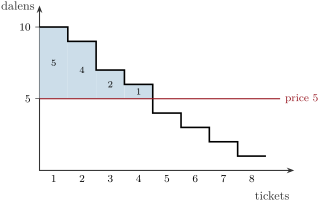
Eight buyers ranked by willingness to pay form a staircase demand curve. At a price of 5 dalens the first four buy, and their consumer surplus is the shaded area, 5 + 4 + 2 + 1 = 12 dalens.
Eight buyers ranked by willingness to pay form a staircase demand curve. At a price of 5 dalens the first four buy, and their consumer surplus is the shaded area, 5+4+2+1=125 + 4 + 2 + 1 = 12 dalens.

示例

Example 8.3 (Consumer surplus under a line)

For the demand Q=120−4pQ = 120 - 4p, nobody buys above 30 dalens. At a price of 24, Q=24Q = 24 units are bought, and the consumer surplus is the triangle with base 24 and height 30−24=630 - 24 = 6: 12×24×6=72\tfrac12 \times 24 \times 6 = 72 dalens.

在原文中阅读 →
Definition 7.4 University Economics — Year 1 · 第 7 章 — Consumer Welfare

The consumer surplus at price pip_i is the area under the (Marshallian) demand curve above the price, CS(pi)=∫pi∞xi(t,m)  ⁣dt\mathrm{CS}(p_i) = \int_{p_i}^{\infty} x_i(t, m)\,\dd t (with the integral stopping at the price where demand reaches zero, if there is one). The change in consumer surplus when the price rises from pi0p_i^0 to pi1p_i^1 is −∫pi0pi1xi(t,m)  ⁣dt-\int_{p_i^0}^{p_i^1} x_i(t, m)\,\dd t.

在原文中阅读 →