全部书籍

专业

应用 关于 Coach 登录 开始阅读

书籍暂未推出简体中文版——当前显示英文版。

Economics · 术语表

什么是 Consumption possibility frontier?

Definition 3.8 High School Economics · 第 3 章 — Ricardo’s Model of Comparative Advantage

A country’s consumption possibility frontier is the set of combinations of the two goods it can consume when it produces at a point of its production possibility frontier and trades at the world price.
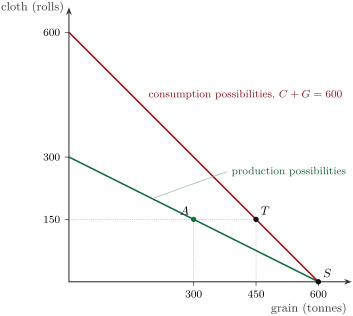
Brenland at p = 1. It produces at S (600 tonnes of grain, no cloth) and trades along the consumption possibility frontier. With 150 rolls of cloth it consumes 450 tonnes of grain at T; on its own it would have only 300 at A.
Brenland at p=1p = 1. It produces at SS (600 tonnes of grain, no cloth) and trades along the consumption possibility frontier. With 150 rolls of cloth it consumes 450 tonnes of grain at TT; on its own it would have only 300 at AA.
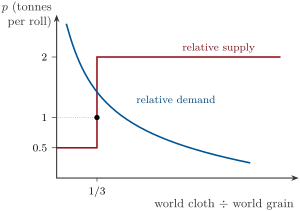
The world relative supply of cloth is a staircase: no cloth below p = 0.5, Kestria’s 200 rolls against Brenland’s 600 tonnes between 0.5 and 2, and any amount of cloth from Brenland too at p = 2. A relative demand curve (drawn here so that it crosses at p = 1) sets the price.
The world relative supply of cloth is a staircase: no cloth below p=0.5p = 0.5, Kestria’s 200 rolls against Brenland’s 600 tonnes between 0.5 and 2, and any amount of cloth from Brenland too at p=2p = 2. A relative demand curve (drawn here so that it crosses at p=1p = 1) sets the price.
在原文中阅读 →
