
全部书籍

专业

应用 关于 Coach 登录 开始阅读

书籍暂未推出简体中文版——当前显示英文版。

Economics · 术语表

什么是 Dornbusch–Fischer–Samuelson model?

Definition 7.5 University Economics — Year 3 · 第 7 章 — Ricardian Trade in Full

The Dornbusch–Fischer–Samuelson model has two countries, one factor, and a continuum of goods z∈[0,1]z \in [0, 1] ranked so that A(z)=a∗(z)/a(z)A(z) = a^*(z)/a(z) is continuous and strictly decreasing. Consumers everywhere spend a fixed share b(z)b(z) of income on good zz (Cobb–Douglas preferences), with ϑ(z)=∫0zb(s) ds\vartheta(z) = \int_0^z b(s)\, ds. Trade is free and balanced, and labour is fully employed.
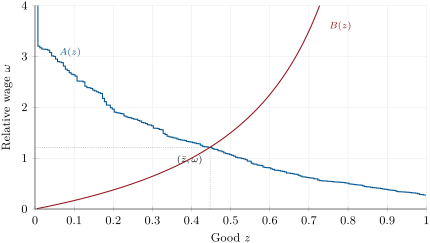
Simulated: the Dornbusch–Fischer–Samuelson diagram for 200 goods with equal spending shares and a Foreign labour force 1.5 times Home’s. A(z) is Home’s relative productivity, falling along the chain; B(z) is the relative wage at which trade balances when Home makes goods up to z.
Simulated: the Dornbusch–Fischer–Samuelson diagram for 200 goods with equal spending shares and a Foreign labour force 1.5 times Home’s. A(z)A(z) is Home’s relative productivity, falling along the chain; B(z)B(z) is the relative wage at which trade balances when Home makes goods up to zz. Source: Simulated by the authors (seed 1977)
在原文中阅读 →