全部书籍

专业

应用 关于 Coach 登录 开始阅读

书籍暂未推出简体中文版——当前显示英文版。

Economics · 术语表

什么是 Event study?

Definition 3.7 University Economics — Year 3 · 第 3 章 — Difference-in-Differences

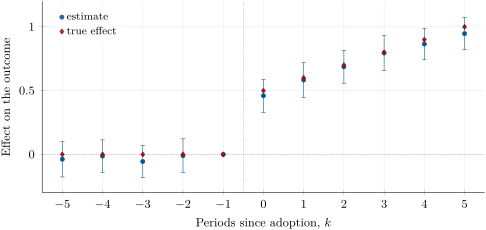
An event study regression, for units first treated at different dates, replaces the single treatment dummy with one dummy for each event time kk (periods since the unit’s first treatment), alongside unit and period effects, and omits one reference period, usually k=−1k = -1. The coefficients on k<0k < 0 (the leads) measure differences before the treatment; those on k≥0k \ge 0 (the lags), the effect kk periods after.

Event study on a simulated staggered roll-out: estimated coefficient for each period relative to adoption, with 95 % confidence intervals clustered by unit (reference period k = -1). Dashed: the true effect, 0.5 + 0.1k from adoption on. 300 units, 16 periods.
Event study on a simulated staggered roll-out: estimated coefficient for each period relative to adoption, with 95 % confidence intervals clustered by unit (reference period k=−1k = -1). Dashed: the true effect, 0.5+0.1k0.5 + 0.1k from adoption on. 300 units, 16 periods. Source: simulated data, the chapter’s seeded script
在原文中阅读 →