
Todos los libros

Profesional

Apps Acerca de Coach Iniciar sesión Empezar a leer

Economics · Glosario

¿Qué es Market demand?

Definition 4.1 High School Economics · Capítulo 4 — Demand

The market demand for a good gives, at each price, the total quantity that all the buyers in the market want to buy: the sum of the individual quantities demanded at that price.
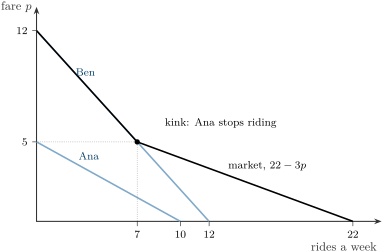
Ana’s and Ben’s demands (light) and the market demand (black), added horizontally. Above a fare of 5 dalens only Ben rides, and the market line is his; below it both ride, and the market line is flatter. The kink is at (7, 5).
Ana’s and Ben’s demands (light) and the market demand (black), added horizontally. Above a fare of 5 dalens only Ben rides, and the market line is his; below it both ride, and the market line is flatter. The kink is at (7,5)(7, 5).

Ejemplos

Example 4.6 (A new rail line)

A train line opens beside Ben’s bus route, and Ben, at every fare, now takes 4 fewer bus rides a week: qB=8−pq_B = 8 - p. Ana’s demand does not change. The market demand becomes 18−3p18 - 3p for p≤5p \le 5 and 8−p8 - p for 5<p≤85 < p \le 8. At a fare of 2 dalens, rides fall from 16 to 12 without any change in the fare: the train is a substitute for the bus, and the demand for bus rides has shifted left.

Leer en el capítulo →
Definition 5.11 University Economics — Year 1 · Capítulo 5 — Consumer Choice

With nn consumers of incomes m1,…,mnm_1, \dots, m_n, the market demand for good ii is the sum of their demands, Xi(p,m1,…,mn)=∑hxih(p,mh)X_i(p, m_1, \dots, m_n) = \sum_{h} x_i^h(p, m_h): graphically, the horizontal sum of the individual demand curves.

Leer en el capítulo →