Tous les livres

Professionnel

Applis À propos Coach Connexion Commencer la lecture

Economics · Glossaire

Qu'est-ce que « Net benefit » ?

Definition 13.4 High School Economics · Chapitre 13 — Marginal Reasoning

The net benefit of doing qq units of an activity is its total benefit minus its total cost, N(q)=B(q)−C(q)N(q) = B(q) - C(q).

Left: total benefit B(q) = 12q - 0.5q2 and total cost C(q) = 2q + 0.5q2. The gap between them, the net benefit, is largest at q = 5, where the two curves are equally steep. Right: the same choice seen at the margin: B'(q) = 12 - q falls, C'(q) = 2 + q rises, and they cross at q = 5.
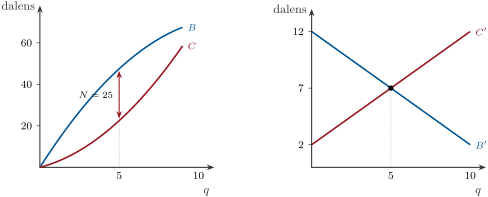
Left: total benefit B(q)=12q−0.5q2B(q) = 12q - 0.5q^2 and total cost C(q)=2q+0.5q2C(q) = 2q + 0.5q^2. The gap between them, the net benefit, is largest at q=5q = 5, where the two curves are equally steep. Right: the same choice seen at the margin: B′(q)=12−qB'(q) = 12 - q falls, C′(q)=2+qC'(q) = 2 + q rises, and they cross at q=5q = 5.
Lire dans le chapitre →