全部书籍

专业

应用 关于 Coach 登录 开始阅读

书籍暂未推出简体中文版——当前显示英文版。

Economics · 术语表

什么是 Permanent-income hypothesis?

Definition 19.5 University Economics — Year 2 · 第 19 章 — Consumption

The permanent-income hypothesis states that households consume their permanent income, so that consumption responds fully to changes in permanent income and little to changes in income that are expected to be temporary.
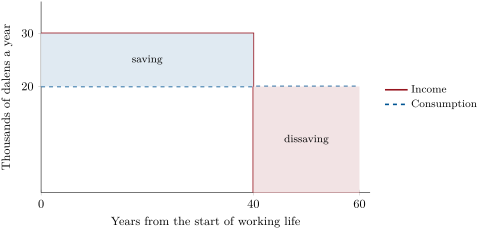
The life cycle. Income is 30 for forty years and zero in retirement; consumption is flat at 20. The household saves 10 a year while working and draws down its savings, 400 at retirement, over the last twenty years.
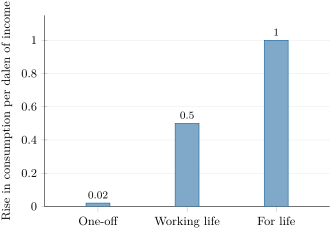
The marginal propensity to consume out of a change in income, for a household with fifty years left of which twenty-five are working years, r = 0: a one-off payment, a raise for the rest of working life, and a raise for life (including the pension).
The marginal propensity to consume out of a change in income, for a household with fifty years left of which twenty-five are working years, r=0r = 0: a one-off payment, a raise for the rest of working life, and a raise for life (including the pension).
在原文中阅读 →
