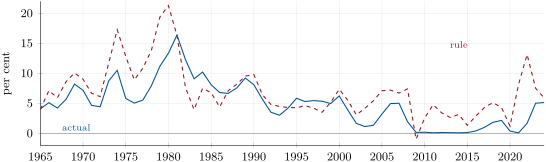
A policy rule is a formula that sets the policy rate from data on the economy. A Taylor rule
sets the nominal rate at
where is a neutral real rate, inflation, the target and the gap is the output gap in per cent; the usual numbers are and .
 Coach
Connexion
Commencer la lecture
Economics · Glossaire
Aussi appelé : policy rule · Taylor rule
A policy rule is a formula that sets the policy rate from data on the economy. A Taylor rule
sets the nominal rate at
where is a neutral real rate, inflation, the target and the gap is the output gap in per cent; the usual numbers are and .