全部书籍

专业

应用 关于 Coach 登录 开始阅读

书籍暂未推出简体中文版——当前显示英文版。

Economics · 术语表

什么是 Poverty gap index; squared poverty gap?

Definition 34.2 University Economics — Year 3 · 第 34 章 — Development Microeconomics

For a line zz, the Foster–Greer–Thorbecke measures are Pα=1N∑yi<z(z−yiz)αP_\alpha = \frac1N\sum_{y_i < z}\left(\frac{z - y_i}{z}\right)^{\alpha}. P0P_0 is the headcount; P1P_1, the poverty gap index, is the average shortfall from the line as a share of it, counting the non-poor as zero; P2P_2, the squared poverty gap, weights each shortfall by itself.
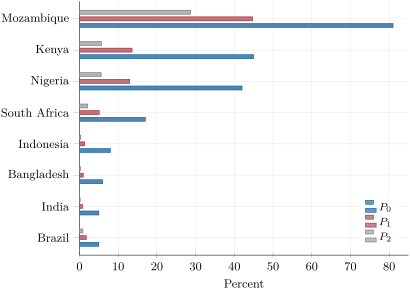
Headcount (P_0), poverty gap (P_1) and squared poverty gap (P_2) at 3.00 dollars a day (2021 PPP), eight countries, 2022, in percent. Computed from the percentile groups of the World Bank’s Poverty and Inequality Platform (each group at its mean, so the headcount moves in steps of one point; consumption, except income for Brazil).
Headcount (P0P_0), poverty gap (P1P_1) and squared poverty gap (P2P_2) at 3.00 dollars a day (2021 PPP), eight countries, 2022, in percent. Computed from the percentile groups of the World Bank’s Poverty and Inequality Platform (each group at its mean, so the headcount moves in steps of one point; consumption, except income for Brazil). Source: World Bank, Poverty and Inequality Platform, world_100bin
在原文中阅读 →
