Tous les livres

Professionnel

Applis À propos Coach Connexion Commencer la lecture

Economics · Glossaire

Qu'est-ce que « Private-ownership economy » ?

Definition 7.2 University Economics — Year 2 · Chapitre 7 — The Two Welfare Theorems

A private-ownership economy has consumers with preferences and endowments, firms jj with technology sets Yj⊂RnY_j \subset \mathbb{R}^n, and ownership shares θij≥0\theta_{ij} \ge 0 with ∑iθij=1\sum_i \theta_{ij} = 1 for each firm. At prices pp, each firm chooses yj∈Yjy_j \in Y_j to maximise its profit p⋅yjp \cdot y_j, and each consumer chooses the best bundle with p⋅xi≤p⋅ωi+∑jθij p⋅yjp \cdot x_i \le p \cdot \omega_i + \sum_j \theta_{ij}\,p \cdot y_j. A competitive equilibrium is a price vector and plans such that every market clears: ∑ixi=∑iωi+∑jyj\sum_i x_i = \sum_i \omega_i + \sum_j y_j.

The Robinson Crusoe economy. The frontier gives the consumption that each amount of leisure leaves. At the real wage w = 0.866 the firm picks the point of the frontier where profit is highest; the household’s budget line has the same slope and meets the axis of full leisure at the profit it receives. The household’s indifference curve touches the same line at the same point.
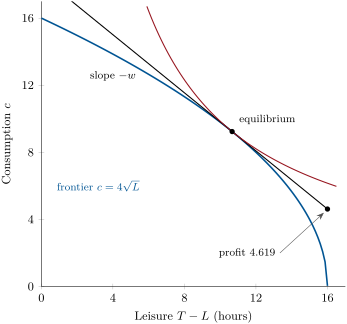
The Robinson Crusoe economy. The frontier gives the consumption that each amount of leisure leaves. At the real wage w=0.866w = 0.866 the firm picks the point of the frontier where profit is highest; the household’s budget line has the same slope and meets the axis of full leisure at the profit it receives. The household’s indifference curve touches the same line at the same point.
Lire dans le chapitre →