
Todos los libros

Profesional

Apps Acerca de Coach Iniciar sesión Empezar a leer

Economics · Glosario

¿Qué es Prospect theory?

Definition 5.11 University Economics — Year 2 · Capítulo 5 — Behavioural Evidence: Where Rational Choice Breaks

Under prospect theory, a person facing a lottery with at most one gain z1>z0z_1 > z_0 with probability p1p_1 and one loss z2<z0z_2 < z_0 with probability p2p_2 values it at

V=ω(p1) v(z1−z0)+ω(p2) v(z2−z0),V = \omega(p_1)\,v(z_1 - z_0) + \omega(p_2)\,v(z_2 - z_0),

and chooses the lottery with the highest VV. Versions for many outcomes apply the weighting function to cumulative probabilities, separately for gains and for losses.
A prospect-theory value function with = 0.9 and = 2 (illustrative values). It is kinked at the reference point: the slope just below it is twice the slope just above. A loss of 100 lowers value by about 126, a gain of 100 raises it by about 63.
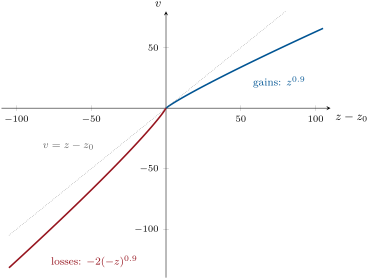
A prospect-theory value function with η=0.9\eta = 0.9 and κ=2\kappa = 2 (illustrative values). It is kinked at the reference point: the slope just below it is twice the slope just above. A loss of 100 lowers value by about 126, a gain of 100 raises it by about 63.
A probability weighting function with d = 0.65 (illustrative). Small probabilities get more weight than their value, large ones less; the curve crosses the diagonal at about 0.36. The weight of a 1 per cent chance is 0.047, almost five times the probability.
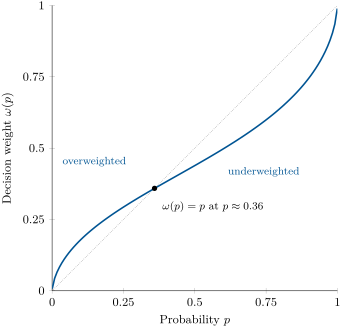
A probability weighting function with d=0.65d = 0.65 (illustrative). Small probabilities get more weight than their value, large ones less; the curve crosses the diagonal at about 0.360.36. The weight of a 1 per cent chance is 0.0470.047, almost five times the probability.
Leer en el capítulo →