Alle boeken

Professioneel

Apps Over Coach Inloggen Begin met lezen

Economics · Begrippenlijst

Wat is Purchasing-power parity?

Definition 39.7 High School Economics · Hoofdstuk 39 — Exchange Rates and the Balance of Payments

Purchasing-power parity is the hypothesis that exchange rates move so that the same basket costs the same in every country: e=P/P∗e = P/P^*, so that the real exchange rate is 1, or at least constant.
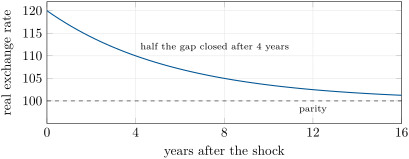
A real exchange rate pushed 20 % away from parity returns with a half-life of four years: 10 % away after four years, 5 % after eight, 2.5 % after twelve.
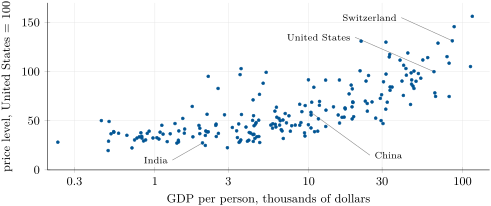
Price level against GDP per person (logarithmic scale), 201 countries, 2019. The price level is the ratio of the purchasing-power conversion factor to the market exchange rate, United States = 100.
Price level against GDP per person (logarithmic scale), 201 countries, 2019. The price level is the ratio of the purchasing-power conversion factor to the market exchange rate, United States = 100. Source: World Bank, World Development Indicators (PA.NUS.PRVT.PLI, NY.GDP.PCAP.CD)
Lees in het hoofdstuk →