Todos los libros

Profesional

Apps Acerca de Coach Iniciar sesión Empezar a leer

Economics · Glosario

¿Qué es Returns to scale?

Definition 9.7 University Economics — Year 1 · Capítulo 9 — Technology

A technology has constant, increasing or decreasing returns to scale if, for every t>1t > 1 and every (K,L)(K, L), f(tK,tL)f(tK, tL) is equal to, greater than or less than tf(K,L)tf(K, L). A function is homogeneous of degree kk if f(tK,tL)=tkf(K,L)f(tK, tL) = t^kf(K, L) for all t>0t > 0; it has constant returns if k=1k = 1, increasing if k>1k > 1, decreasing if k<1k < 1.

Left: isoquants for outputs 10, 20 and 30 of (KL)1/2 (solid, constant returns: evenly spaced on the ray K = L) and of (KL)3/4 (dashed, increasing returns: closer and closer). Right: the isoquant Y = 10 of a CES technology with = 0.6 (blue), after Hicks-neutral progress of 25\% (dashed: it moves in towards the origin along every ray) and after labour-augmenting progress of 50\% (red: every point moves left, to two-thirds of its labour, which shifts the steep part of the isoquant a long way and its flat part hardly at all).
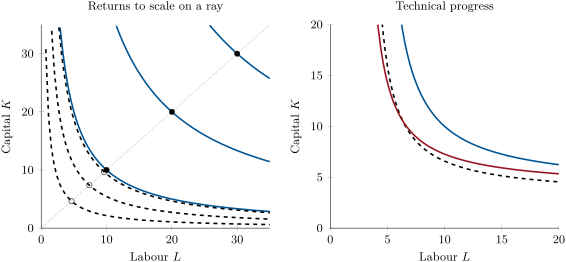
Left: isoquants for outputs 10, 20 and 30 of (KL)1/2(KL)^{1/2} (solid, constant returns: evenly spaced on the ray K=LK = L) and of (KL)3/4(KL)^{3/4} (dashed, increasing returns: closer and closer). Right: the isoquant Y=10Y = 10 of a CES technology with σ=0.6\sigma = 0.6 (blue), after Hicks-neutral progress of 25%25\% (dashed: it moves in towards the origin along every ray) and after labour-augmenting progress of 50%50\% (red: every point moves left, to two-thirds of its labour, which shifts the steep part of the isoquant a long way and its flat part hardly at all).
Leer en el capítulo →