
Semua buku

Profesional

Aplikasi Tentang Pelatih Masuk Mulai membaca

Economics · Glosarium

Apa itu Risk premium?

Definition 1.13 University Economics — Year 2 · Bab 1 — Expected Utility

The risk premium of a random amount is ρ(z~)=E[z~]−c(z~)\rho(\tilde z) = \mathbb{E}[\tilde z] - c(\tilde z): the amount of expected value the person would give up to replace the lottery by a sure payment.
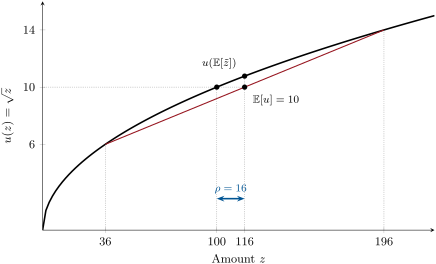
A concave utility of money. The lottery pays 36 or 196; its expected utility, 10, lies on the chord above the mean 116. The curve reaches 10 at z = 100, the certainty equivalent, so the risk premium is 116 - 100 = 16.
A concave utility of money. The lottery pays 3636 or 196196; its expected utility, 1010, lies on the chord above the mean 116116. The curve reaches 1010 at z=100z = 100, the certainty equivalent, so the risk premium is 116−100=16116 - 100 = 16.

Contoh

Example 1.15 (A square-root utility)

Let u(z)=zu(z) = \sqrt z, and let z~\tilde z be 3636 or 196196 with probability 12\tfrac12 each. Its expected value is 116116; its expected utility is 12(6+14)=10\tfrac12(6 + 14) = 10; its certainty equivalent is c=102=100c = 10^2 = 100; its risk premium is 116−100=16116 - 100 = 16. The figure below draws it: the expected utility sits on the chord, below the curve, and the certainty equivalent is read off where the curve reaches that height.

Baca dalam konteks →