সব বই

পেশাদার

1 Markets I: The Ecosystem and Exchange-Traded Marketsবাজার অনলাইন 2 Markets II: Rates, FX and Creditবাজার অনলাইন 3 Markets III: Commodities, Energy and Cryptoবাজার অনলাইন 4 Quantitative Methodsপদ্ধতি অনলাইন 5 Derivatives and Volatilityডেরিভেটিভস অনলাইন 6 Rates, Credit, XVA and Riskসুদহার, ঋণ ও ঝুঁকি অনলাইন 7 Research Craft: Predictors, Backtests, Measurement, Portfoliosগবেষণা অনলাইন 8 Strategies I: Equities and Futuresকৌশল অনলাইন 9 Strategies II: Volatility, Relative Value, Macro and the Bank Desksকৌশল অনলাইন 10 Microstructure and Executionএক্সিকিউশন অনলাইন 11 Market Making and High-Frequency Tradingমার্কেট মেকিং অনলাইন 12 Machine Learning for Marketsমেশিন লার্নিং অনলাইন 13 Low-Latency Softwareপ্রযুক্তি অনলাইন 14 Networks, Hardware and Trading Infrastructureপ্রযুক্তি অনলাইন 15 Research, Data and Risk Platformsপ্রযুক্তি অনলাইন 16 The Desk and the Firmপ্রতিষ্ঠান অনলাইন 17 The Industry: Firms, Roles and Careersক্যারিয়ার অনলাইন 18 Interviews I: Maths, Probability and Speedক্যারিয়ার অনলাইন 19 Interviews II: Markets, Trading Games and the Final Roundক্যারিয়ার অনলাইন 20 Interviews III: Codeক্যারিয়ার অনলাইন
অ্যাপ পরিচিতি Coach সাইন ইন পড়া শুরু করো

বইগুলো এখনো বাংলা ভাষায় পাওয়া যায় না — ইংরেজি সংস্করণ দেখানো হচ্ছে।

Economics · পরিভাষা

Share of a total কী?

অন্য নাম: share (of a total)

Definition 1.7 Middle School Economics · অধ্যায় 1 — Reading Economic Charts

The share of a part in a total is the part divided by the total, written as a percentage:

share=parttotal×100 %.\text{share} = \frac{\text{part}}{\text{total}} \times 100\,\%.

When a total is cut into parts that do not overlap, the shares of all the parts add up to 100 %100\,\%.

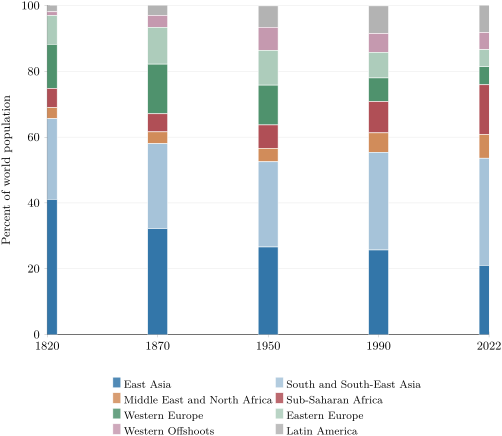
Where the world’s people live: the share of each region in world population, in percent, for five years.
Where the world’s people live: the share of each region in world population, in percent, for five years. Source: Maddison Project Database 2023, regional data: population. “Western Offshoots” are the United States, Canada, Australia and New Zealand

উদাহরণ

Example 1.9 (A smaller share of a bigger world)

In 1820 the world had 1.0421.042 billion people, and East Asia’s share was 41.1 %41.1\,\%, so East Asia had about

1.042×41.1100≈0.43 billion people.1.042 \times \frac{41.1}{100} \approx 0.43 \text{ billion people.}

In 2022 the world had 7.8027.802 billion people and the share was 21.0 %21.0\,\%: 7.802×0.210≈1.647.802 \times 0.210 \approx 1.64 billion people. The share of East Asia was halved, while the number of its people was multiplied by almost four.

প্রসঙ্গসহ পড়ো →