全部书籍

专业

应用 关于 Coach 登录 开始阅读

书籍暂未推出简体中文版——当前显示英文版。

Economics · 术语表

什么是 Shut-down price?

Definition 11.2 University Economics — Year 1 · 第 11 章 — Profit Maximisation and Supply

In the short run a firm can shut down, losing its fixed cost but paying no variable cost. It produces only if revenue covers variable cost, pq≥Cv(q)pq \ge C_v(q), that is p≥Cv(q)/qp \ge C_v(q)/q. The shut-down price is the minimum of average variable cost; below it the firm supplies nothing.
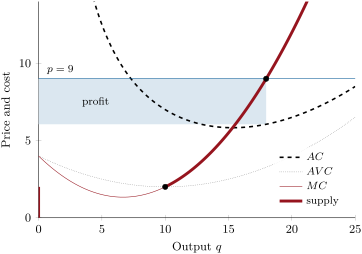

C(q) = 50 + 4q - 0.4q2 + 0.02q3. The supply curve (thick red) is marginal cost above the minimum of average variable cost, (10, 2); below the price 2 the firm supplies nothing. At p = 9 it makes 17.97 units at an average cost of 6.05: the shaded profit is 17.97 × (9 - 6.05) 53.0 (52.96 unrounded).
C(q)=50+4q−0.4q2+0.02q3C(q) = 50 + 4q - 0.4q^2 + 0.02q^3. The supply curve (thick red) is marginal cost above the minimum of average variable cost, (10,2)(10, 2); below the price 2 the firm supplies nothing. At p=9p = 9 it makes 17.97 units at an average cost of 6.05: the shaded profit is 17.97×(9−6.05)≈53.017.97 \times (9 - 6.05) \approx 53.0 (52.96 unrounded).
在原文中阅读 →