
جميع الكتب

مهني

1 Markets I: The Ecosystem and Exchange-Traded Marketsالأسواق عبر الإنترنت 2 Markets II: Rates, FX and Creditالأسواق عبر الإنترنت 3 Markets III: Commodities, Energy and Cryptoالأسواق عبر الإنترنت 4 Quantitative Methodsالأساليب عبر الإنترنت 5 Derivatives and Volatilityالمشتقات عبر الإنترنت 6 Rates, Credit, XVA and Riskالفائدة والائتمان والمخاطر عبر الإنترنت 7 Research Craft: Predictors, Backtests, Measurement, Portfoliosالبحث عبر الإنترنت 8 Strategies I: Equities and Futuresالاستراتيجيات عبر الإنترنت 9 Strategies II: Volatility, Relative Value, Macro and the Bank Desksالاستراتيجيات عبر الإنترنت 10 Microstructure and Executionالتنفيذ عبر الإنترنت 11 Market Making and High-Frequency Tradingصناعة السوق عبر الإنترنت 12 Machine Learning for Marketsتعلم الآلة عبر الإنترنت 13 Low-Latency Softwareالتكنولوجيا عبر الإنترنت 14 Networks, Hardware and Trading Infrastructureالتكنولوجيا عبر الإنترنت 15 Research, Data and Risk Platformsالتكنولوجيا عبر الإنترنت 16 The Desk and the Firmالشركة عبر الإنترنت 17 The Industry: Firms, Roles and Careersالمسارات المهنية عبر الإنترنت 18 Interviews I: Maths, Probability and Speedالمسارات المهنية عبر الإنترنت 19 Interviews II: Markets, Trading Games and the Final Roundالمسارات المهنية عبر الإنترنت 20 Interviews III: Codeالمسارات المهنية عبر الإنترنت
التطبيقات حول المدرب تسجيل الدخول ابدأ القراءة

Economics · المسرد

ما معنى Times-ten scale؟

Definition 1.15 Middle School Economics · الفصل 1 — Reading Economic Charts

On a times-ten scale, the gridlines of the vertical axis are placed at equal distances, and each gridline is ten times the one below it: 1, 10, 100, 1 000, 10 000… Two values that are the same number of times larger than each other are always the same distance apart.
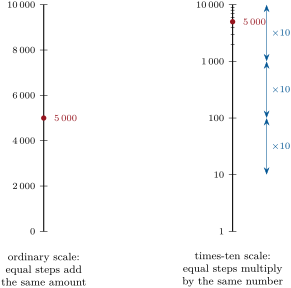
Two rulers from 0 (or 1) to 10 000. On the ordinary scale, 5 000 is halfway up. On the times-ten scale, each step multiplies by ten, so 5 000 sits high in the top step; the small ticks mark 2 000, 3 000, …, 9 000.

أمثلة

Example 1.17 (Reading the United Kingdom on both scales)

On the times-ten panel, the line starts at about 3 000 dollars, between the 1 000 and 10 000 gridlines, crosses the 10 000 gridline around 1940, and ends just under 40 000. On the ordinary panel, the line seems to shoot up after 1950, as if something new had started. The times-ten panel corrects the impression. Income per person was multiplied by 1.81.8 from 1820 to 1870 (5 829÷3 3065\,829 \div 3\,306), by 1.21.2 from 1870 to 1920, by 2.42.4 from 1920 to 1970 and by 2.02.0 from 1970 to 2020. Growth was faster after 1920, but no fifty-year stretch came near multiplying income by ten. The steepness of the left panel comes mostly from the larger starting value: the same rate of change adds many more dollars when the starting value is larger.

اقرأ في الفصل →