
Todos os livros

Profissional

Apps Sobre Coach Entrar Começar a ler

Economics · Glossário

O que é Total fertility rate; net reproduction rate?

Definition 33.5 University Economics — Year 3 · Capítulo 33 — Population and the Demographic Transition

The total fertility rate of a year is the sum over ages 15 to 49 of that year’s age-specific birth rates: the number of children a woman would have if she lived through her childbearing years at those rates. The net reproduction rate counts only daughters and allows for mortality: the number of daughters per woman who survive to the mothers’ ages. A net reproduction rate of 1, a total fertility rate near 2.1 where mortality is low, replaces the population in the long run.
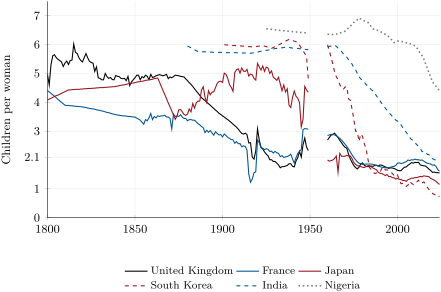
Total fertility rate, 1800–2024, six countries (Gapminder to 1949; World Bank from 1960; the two sources are not joined across the 1950s). Each early series starts at the source’s first estimate — South Korea 1901, India 1880, Nigeria 1925 — because the source repeats that estimate back to 1800; between estimates it interpolates, so the early lines are smoother than the data behind them.
Total fertility rate, 1800–2024, six countries (Gapminder to 1949; World Bank from 1960; the two sources are not joined across the 1950s). Each early series starts at the source’s first estimate — South Korea 1901, India 1880, Nigeria 1925 — because the source repeats that estimate back to 1800; between estimates it interpolates, so the early lines are smoother than the data behind them. Source: Gapminder Fast Track, children_per_woman_total_fertility; World Bank, World Development Indicators, SP.DYN.TFRT.IN
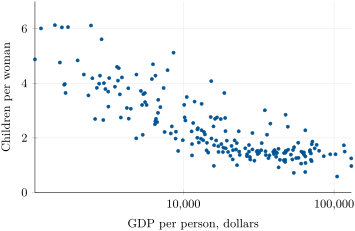
Total fertility rate against GDP per person (PPP, constant 2021 dollars, logarithmic scale), 2023, 197 countries.
Total fertility rate against GDP per person (PPP, constant 2021 dollars, logarithmic scale), 2023, 197 countries. Source: World Bank, World Development Indicators, SP.DYN.TFRT.IN and NY.GDP.PCAP.PP.KD
Ler no capítulo →