
सभी किताबें

पेशेवर

1 Markets I: The Ecosystem and Exchange-Traded Marketsबाज़ार ऑनलाइन 2 Markets II: Rates, FX and Creditबाज़ार ऑनलाइन 3 Markets III: Commodities, Energy and Cryptoबाज़ार ऑनलाइन 4 Quantitative Methodsविधियाँ ऑनलाइन 5 Derivatives and Volatilityडेरिवेटिव्स ऑनलाइन 6 Rates, Credit, XVA and Riskब्याज दरें, क्रेडिट और जोखिम ऑनलाइन 7 Research Craft: Predictors, Backtests, Measurement, Portfoliosअनुसंधान ऑनलाइन 8 Strategies I: Equities and Futuresरणनीतियाँ ऑनलाइन 9 Strategies II: Volatility, Relative Value, Macro and the Bank Desksरणनीतियाँ ऑनलाइन 10 Microstructure and Executionनिष्पादन ऑनलाइन 11 Market Making and High-Frequency Tradingमार्केट मेकिंग ऑनलाइन 12 Machine Learning for Marketsमशीन लर्निंग ऑनलाइन 13 Low-Latency Softwareतकनीक ऑनलाइन 14 Networks, Hardware and Trading Infrastructureतकनीक ऑनलाइन 15 Research, Data and Risk Platformsतकनीक ऑनलाइन 16 The Desk and the Firmफ़र्म ऑनलाइन 17 The Industry: Firms, Roles and Careersकरियर ऑनलाइन 18 Interviews I: Maths, Probability and Speedकरियर ऑनलाइन 19 Interviews II: Markets, Trading Games and the Final Roundकरियर ऑनलाइन 20 Interviews III: Codeकरियर ऑनलाइन
ऐप्स परिचय Coach लॉग इन पढ़ना शुरू करें

Quantitative Finance · शब्दावली

Accrued interest, clean and dirty price क्या है?

अन्य नाम: accrued interest · dirty price · clean price

Definition 3.3 Markets II: Rates, FX and Credit · अध्याय 3 — Government Bonds

Between two coupon dates the seller of a bond has earned part of the next coupon, and the buyer pays it to her: this is accrued interest, A=cf (1−w)A = \frac{c}{f}\,(1 - w) under actual/actual, where ww is the fraction of the current period still to run. The dirty price (or full, or invoice price) is what changes hands; the clean price quoted on screens is the dirty price less accrued interest.
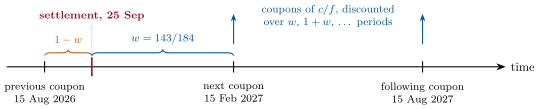
A settlement between coupon dates. The seller is paid the fraction 1 - w of the coming coupon as accrued interest; the buyer receives the whole coupon. The street convention discounts each later flow over w, 1 + w, 2 + w, … periods.
Figure 3.1. A settlement between coupon dates. The seller is paid the fraction 1−w1 - w of the coming coupon as accrued interest; the buyer receives the whole coupon. The street convention discounts each later flow over ww, 1+w1 + w, 2+w2 + w, … periods.

उदाहरण

Example 3.4 (Forty-one days)

A note paying 4.25% semiannually on 15 February and 15 August settles on 25 September 2026. The current period runs 184 days, of which 41 have elapsed: A=2.125×41/184=0.473505A = 2.125 \times 41/184 = 0.473505 per 100, USD 4 735 per million, USD 47 351 on the trade of the opening paragraph.

Example 3.10 (The ten-year note)

At 4.200% the note of Example 3.4 has a clean price of 100.397405 (100-12+), a dirty price of 100.870911, a Macaulay duration of 8.142 years, a modified duration of 7.975, a DV01 of USD 804 per million and a convexity of 75.8. A 100-basis-point rise costs 7.675 points; duration alone predicts 8.044, duration and convexity together 7.662 (Figure 3.2).

अध्याय में पढ़ें →