সব বই

পেশাদার

1 Markets I: The Ecosystem and Exchange-Traded Marketsবাজার অনলাইন 2 Markets II: Rates, FX and Creditবাজার অনলাইন 3 Markets III: Commodities, Energy and Cryptoবাজার অনলাইন 4 Quantitative Methodsপদ্ধতি অনলাইন 5 Derivatives and Volatilityডেরিভেটিভস অনলাইন 6 Rates, Credit, XVA and Riskসুদহার, ঋণ ও ঝুঁকি অনলাইন 7 Research Craft: Predictors, Backtests, Measurement, Portfoliosগবেষণা অনলাইন 8 Strategies I: Equities and Futuresকৌশল অনলাইন 9 Strategies II: Volatility, Relative Value, Macro and the Bank Desksকৌশল অনলাইন 10 Microstructure and Executionএক্সিকিউশন অনলাইন 11 Market Making and High-Frequency Tradingমার্কেট মেকিং অনলাইন 12 Machine Learning for Marketsমেশিন লার্নিং অনলাইন 13 Low-Latency Softwareপ্রযুক্তি অনলাইন 14 Networks, Hardware and Trading Infrastructureপ্রযুক্তি অনলাইন 15 Research, Data and Risk Platformsপ্রযুক্তি অনলাইন 16 The Desk and the Firmপ্রতিষ্ঠান অনলাইন 17 The Industry: Firms, Roles and Careersক্যারিয়ার অনলাইন 18 Interviews I: Maths, Probability and Speedক্যারিয়ার অনলাইন 19 Interviews II: Markets, Trading Games and the Final Roundক্যারিয়ার অনলাইন 20 Interviews III: Codeক্যারিয়ার অনলাইন
অ্যাপ পরিচিতি Coach সাইন ইন পড়া শুরু করো

বইগুলো এখনো বাংলা ভাষায় পাওয়া যায় না — ইংরেজি সংস্করণ দেখানো হচ্ছে।

Quantitative Finance · পরিভাষা

Backward-looking caplet কী?

Definition 10.2 Rates, Credit, XVA and Risk · অধ্যায় 10 — Modelling Overnight-Rate Products

A backward-looking caplet pays δmax⁡(R(S,E)−K,0)\delta\max(R(S,E)-K,0) at EE (or a few days later) on the compounded rate of its own period.

A forward-looking rate carries risk until the start of its period and is known from then on; a compounded overnight rate keeps moving until the last fixing at the end, so an option on it carries risk through its whole accrual period.
Figure 10.1. A forward-looking rate carries risk until the start of its period and is known from then on; a compounded overnight rate keeps moving until the last fixing at the end, so an option on it carries risk through its whole accrual period.
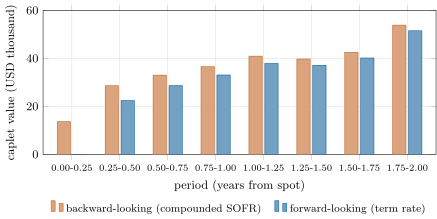
Caplets of a two-year cap at 3.75% on USD 100 million, on compounded SOFR and on a term rate for the same quarters. The current quarter has a caplet only in the backward-looking cap; each later backward-looking caplet is worth more by its period’s in-arrears variance. Data: chapter 1’s curve, Hull–White =3\%, =90 basis points; the chapter’s tutorial.
Figure 10.2. Caplets of a two-year cap at 3.75% on USD 100 million, on compounded SOFR and on a term rate for the same quarters. The current quarter has a caplet only in the backward-looking cap; each later backward-looking caplet is worth more by its period’s in-arrears variance. Data: chapter 1’s curve, Hull–White κ=3%\kappa=3\%, σ=90\sigma=90 basis points; the chapter’s tutorial.

উদাহরণ

Example 10.4 (A two-year SOFR cap)

On chapter 1’s SOFR curve with κ=3%\kappa=3\% and σ=90\sigma=90 basis points, a two-year cap on three-month compounded SOFR at 3.75% on USD 100 million costs USD 288 963: eight caplets from USD 13 623 (the current quarter) to 53 846 (Figure 10.2). The same cap on a three-month term rate, whose first caplet has already fixed, costs USD 250 741: the backward-looking cap is USD 38 222 more expensive, of which 13 623 is the first caplet and 24 599 the in-period variance of the other seven. A Monte Carlo of the short rate with 260 steps a year reprices the caplet on the fifth quarter (USD 40 944) to within a fifth of a standard error.

প্রসঙ্গসহ পড়ো →