
All books

Professional

Apps About Coach Log in Start reading

Quantitative Finance · Glossary

What is Balance-sheet cost?

Definition 12.2 Strategies II: Volatility, Relative Value, Macro and the Bank Desks · Chapter 12 — Swap-Spread and Asset-Swap Trades

The balance-sheet cost of a trade is the return a bank or dealer requires on the capital that regulation makes it hold against the trade’s gross assets, whatever their risk, charged as a running rate on the notional; it makes low-risk, high-volume trades such as repo-financed bond positions expensive to hold.
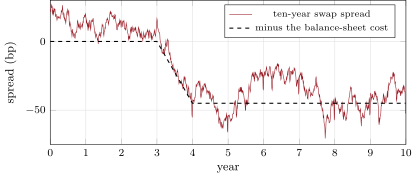
The synthetic ten-year swap spread over ten years: a small premium, then a balance-sheet cost phased in from year 3, with quarter-end dips and noise. Data: s2_swapspread.market.
Figure 12.2. The synthetic ten-year swap spread over ten years: a small premium, then a balance-sheet cost phased in from year 3, with quarter-end dips and noise. Data: s2_swapspread.market.
Read in context →