সব বই

পেশাদার

1 Markets I: The Ecosystem and Exchange-Traded Marketsবাজার অনলাইন 2 Markets II: Rates, FX and Creditবাজার অনলাইন 3 Markets III: Commodities, Energy and Cryptoবাজার অনলাইন 4 Quantitative Methodsপদ্ধতি অনলাইন 5 Derivatives and Volatilityডেরিভেটিভস অনলাইন 6 Rates, Credit, XVA and Riskসুদহার, ঋণ ও ঝুঁকি অনলাইন 7 Research Craft: Predictors, Backtests, Measurement, Portfoliosগবেষণা অনলাইন 8 Strategies I: Equities and Futuresকৌশল অনলাইন 9 Strategies II: Volatility, Relative Value, Macro and the Bank Desksকৌশল অনলাইন 10 Microstructure and Executionএক্সিকিউশন অনলাইন 11 Market Making and High-Frequency Tradingমার্কেট মেকিং অনলাইন 12 Machine Learning for Marketsমেশিন লার্নিং অনলাইন 13 Low-Latency Softwareপ্রযুক্তি অনলাইন 14 Networks, Hardware and Trading Infrastructureপ্রযুক্তি অনলাইন 15 Research, Data and Risk Platformsপ্রযুক্তি অনলাইন 16 The Desk and the Firmপ্রতিষ্ঠান অনলাইন 17 The Industry: Firms, Roles and Careersক্যারিয়ার অনলাইন 18 Interviews I: Maths, Probability and Speedক্যারিয়ার অনলাইন 19 Interviews II: Markets, Trading Games and the Final Roundক্যারিয়ার অনলাইন 20 Interviews III: Codeক্যারিয়ার অনলাইন
অ্যাপ পরিচিতি Coach সাইন ইন পড়া শুরু করো

বইগুলো এখনো বাংলা ভাষায় পাওয়া যায় না — ইংরেজি সংস্করণ দেখানো হচ্ছে।

Quantitative Finance · পরিভাষা

Bayesian update কী?

Definition 30.3 Markets II: Rates, FX and Credit · অধ্যায় 30 — Market-Making Games

A Bayesian update revises a probability distribution over an unknown value after an observation, in proportion to how likely the observation would be under each value: posterior ∝\propto prior ×\times likelihood.

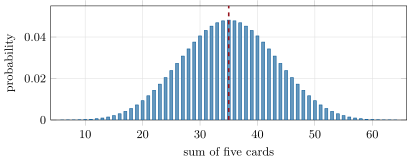
Distribution of the sum of five cards dealt from a 52-card deck, aces counting 1 and kings 13: mean 35 (dashed), standard deviation 8.03, from 6 to 64. Exact, by counting. Data: the chapter’s tutorial.
Figure 30.1. Distribution of the sum of five cards dealt from a 52-card deck, aces counting 1 and kings 13: mean 35 (dashed), standard deviation 8.03, from 6 to 64. Exact, by counting. Data: the chapter’s tutorial.
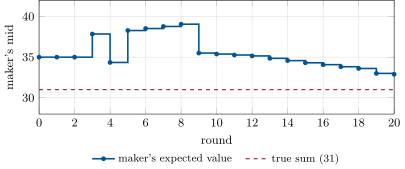
One game at a width of 11.5: the maker’s expected value of the sum before each round, updated by Bayes’ rule after every trade and pass, against the true sum, 31. Early buys push the estimate up; the sales that follow bring it down towards the truth. The maker ends the game with a profit of 18.6. Data: the chapter’s tutorial, seeded.
Figure 30.2. One game at a width of 11.5: the maker’s expected value of the sum before each round, updated by Bayes’ rule after every trade and pass, against the true sum, 31. Early buys push the estimate up; the sales that follow bring it down towards the truth. The maker ends the game with a profit of 18.6. Data: the chapter’s tutorial, seeded.

উদাহরণ

Example 30.4 (The first trade)

The maker opens 30 at 40, a width of 10. An uninformed trader trades with probability e−10/8=0.29e^{-10/8} = 0.29. If someone buys at 40, it was an informed trader with probability 0.31; the maker’s expected value of the sum rises from 35 to 38.13, and its next market is centred there. After a sale at 30 it falls to 31.87; after a pass it stays at 35, since a pass is equally likely from a high or a low sum.

প্রসঙ্গসহ পড়ো →