 Coach
CoachA Bayesian update revises a probability distribution over an unknown value after an observation, in proportion to how likely the observation would be under each value: posterior prior likelihood.
Exemples
Example 30.4 (The first trade)
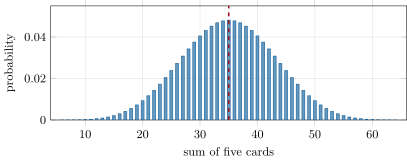
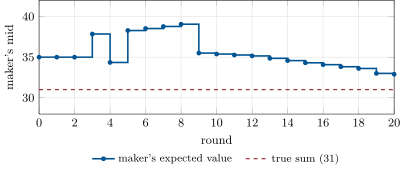
The maker opens 30 at 40, a width of 10. An uninformed trader trades with probability . If someone buys at 40, it was an informed trader with probability 0.31; the maker’s expected value of the sum rises from 35 to 38.13, and its next market is centred there. After a sale at 30 it falls to 31.87; after a pass it stays at 35, since a pass is equally likely from a high or a low sum.