
Todos los libros

Profesional

Apps Acerca de Coach Iniciar sesión Empezar a leer

Quantitative Finance · Glosario

¿Qué es Block trade and risk bid?

También llamado: block trade

Definition 2.5 Markets I: The Ecosystem and Exchange-Traded Markets · Capítulo 2 — The Sell Side

A block trade is a transaction much larger than the market’s displayed size, negotiated away from the order book. In a risk bid the dealer buys the whole block as principal at a discount to the market price; the discount pays it for the cost and the risk of selling the shares afterwards.
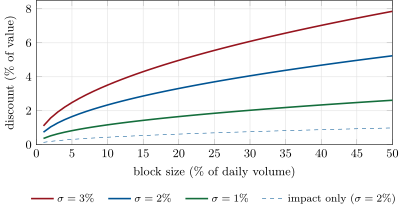
The 95% break-even discount of a risk bid, at 10% participation. Most of the discount pays for risk, not for impact. Data: computed by the chapter’s script from .
Figure 2.2. The 95% break-even discount of a risk bid, at 10% participation. Most of the discount pays for risk, not for impact. Data: computed by the chapter’s script from Proposition 2.8.

Ejemplos

Example 2.9 (The pension fund’s block)

Q=2Q = 2 million shares at $50, V=10V = 10 million, σ=2%\sigma = 2\% a day, π=10%\pi = 10\%. Then T=2T = 2 days, I=0.7×0.02×0.2=0.63%I = 0.7 \times 0.02 \times \sqrt{0.2} = 0.63\%, and the risk term at 95% (z=1.645z = 1.645) is 1.645×0.02×2/3=2.69%1.645 \times 0.02 \times \sqrt{2/3} = 2.69\%. The break-even discount is 3.31%3.31\%, or $1.66 a share: the dealer who bids $48.34 expects to make 2.69%2.69\% of $100 million, $2.7 million, and loses money one time in twenty. Both terms grow like Q\sqrt{Q}: a block four times larger costs twice as much per share.

Leer en el capítulo →