
सभी किताबें

पेशेवर

ऐप्स परिचय Coach लॉग इन पढ़ना शुरू करें

Quantitative Finance · शब्दावली

Capital valuation adjustment, hurdle rate क्या है?

अन्य नाम: capital valuation adjustment · hurdle rate

Definition 19.9 Rates, Credit, XVA and Risk · अध्याय 19 — Funding, Margin and Capital Adjustments

The capital valuation adjustment (KVA) is the value of the return shareholders require on the capital a trade consumes over its life, KVA=h∫0TE[K(t)]P(0,t)QC(t)QB(t) dt\mathrm{KVA} = h\int_0^T\E[K(t)]P(0,t)Q_C(t)Q_B(t)\,dt, where hh is the hurdle rate: the return on capital, above the risk-free rate, that the bank requires of its activities.
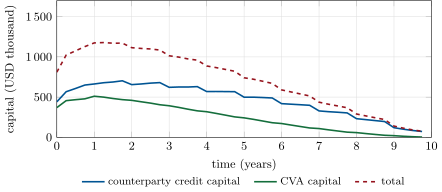
Projected capital of the uncollateralised ten-year swap: counterparty credit capital from SA-CCR and CVA capital from the reduced basic approach. Capital rises as the expected replacement cost builds, then falls with the remaining maturity. Data: the chapter’s tutorial.
Figure 19.3. Projected capital of the uncollateralised ten-year swap: counterparty credit capital from SA-CCR and CVA capital from the reduced basic approach. Capital rises as the expected replacement cost builds, then falls with the remaining maturity. Data: the chapter’s tutorial.

उदाहरण

Example 19.10 (KVA of the swap)

With an illustrative 100% risk weight and 8% capital ratio, counterparty capital today is USD 440 686; CVA capital, at a 3% risk weight and an effective maturity of 5.5 years (the average time of the swap’s payments), is USD 368 944. Projected along the swap’s life with the replacement cost set to the expected exposure, the capital peaks at USD 1.18 million after 1.25 years (Figure 19.3). At a 10% hurdle rate the KVA is USD 558 718, the largest adjustment of all.

अध्याय में पढ़ें →