
सभी किताबें

पेशेवर

1 Markets I: The Ecosystem and Exchange-Traded Marketsबाज़ार ऑनलाइन 2 Markets II: Rates, FX and Creditबाज़ार ऑनलाइन 3 Markets III: Commodities, Energy and Cryptoबाज़ार ऑनलाइन 4 Quantitative Methodsविधियाँ ऑनलाइन 5 Derivatives and Volatilityडेरिवेटिव्स ऑनलाइन 6 Rates, Credit, XVA and Riskब्याज दरें, क्रेडिट और जोखिम ऑनलाइन 7 Research Craft: Predictors, Backtests, Measurement, Portfoliosअनुसंधान ऑनलाइन 8 Strategies I: Equities and Futuresरणनीतियाँ ऑनलाइन 9 Strategies II: Volatility, Relative Value, Macro and the Bank Desksरणनीतियाँ ऑनलाइन 10 Microstructure and Executionनिष्पादन ऑनलाइन 11 Market Making and High-Frequency Tradingमार्केट मेकिंग ऑनलाइन 12 Machine Learning for Marketsमशीन लर्निंग ऑनलाइन 13 Low-Latency Softwareतकनीक ऑनलाइन 14 Networks, Hardware and Trading Infrastructureतकनीक ऑनलाइन 15 Research, Data and Risk Platformsतकनीक ऑनलाइन 16 The Desk and the Firmफ़र्म ऑनलाइन 17 The Industry: Firms, Roles and Careersकरियर ऑनलाइन 18 Interviews I: Maths, Probability and Speedकरियर ऑनलाइन 19 Interviews II: Markets, Trading Games and the Final Roundकरियर ऑनलाइन 20 Interviews III: Codeकरियर ऑनलाइन
ऐप्स परिचय Coach लॉग इन पढ़ना शुरू करें

Quantitative Finance · शब्दावली

CPU steal time, noisy neighbour क्या है?

अन्य नाम: CPU steal time · noisy neighbour

Definition 16.7 Networks, Hardware and Trading Infrastructure · अध्याय 16 — Trading in a Public Cloud

CPU steal time is the time a virtual CPU was ready to run but the hypervisor ran something else on the physical CPU; Linux reports it as “involuntary wait”. A noisy neighbour is another tenant of the same physical server or network whose load takes resources (CPU, cache, memory bandwidth, network queues) from a customer’s machine and so adds delay to it.

Casep50p90p99p99.9p99.99
Same zone (published)270–395–760
Same zone (model)270333396463743
Cross zone (published)555–755–1 905
Cross zone (model)5556577558511 908
Shared host, noisy neighbour (model)2703334007 47413 940
Table 16.1. Round-trip percentiles in microseconds: the published measurement (Hilyard et al., AWS, same subnet and cross AZ) and the simulation that firm.cloudplan fits to it; the noisy-neighbour case is an assumption. Data: nw_cloud.percentiles().
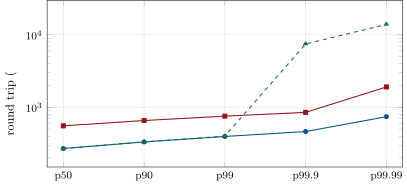
Simulation fitted to a published measurement: round-trip percentiles within a zone and across zones, and on a shared host with an assumed noisy neighbour. Crossing a zone doubles the body of the distribution; a noisy neighbour leaves the body alone and multiplies the tail. Data: fig_cloud.py.
Figure 16.3. Simulation fitted to a published measurement: round-trip percentiles within a zone and across zones, and on a shared host with an assumed noisy neighbour. Crossing a zone doubles the body of the distribution; a noisy neighbour leaves the body alone and multiplies the tail. Data: fig_cloud.py.
अध्याय में पढ़ें →