
সব বই

পেশাদার

1 Markets I: The Ecosystem and Exchange-Traded Marketsবাজার অনলাইন 2 Markets II: Rates, FX and Creditবাজার অনলাইন 3 Markets III: Commodities, Energy and Cryptoবাজার অনলাইন 4 Quantitative Methodsপদ্ধতি অনলাইন 5 Derivatives and Volatilityডেরিভেটিভস অনলাইন 6 Rates, Credit, XVA and Riskসুদহার, ঋণ ও ঝুঁকি অনলাইন 7 Research Craft: Predictors, Backtests, Measurement, Portfoliosগবেষণা অনলাইন 8 Strategies I: Equities and Futuresকৌশল অনলাইন 9 Strategies II: Volatility, Relative Value, Macro and the Bank Desksকৌশল অনলাইন 10 Microstructure and Executionএক্সিকিউশন অনলাইন 11 Market Making and High-Frequency Tradingমার্কেট মেকিং অনলাইন 12 Machine Learning for Marketsমেশিন লার্নিং অনলাইন 13 Low-Latency Softwareপ্রযুক্তি অনলাইন 14 Networks, Hardware and Trading Infrastructureপ্রযুক্তি অনলাইন 15 Research, Data and Risk Platformsপ্রযুক্তি অনলাইন 16 The Desk and the Firmপ্রতিষ্ঠান অনলাইন 17 The Industry: Firms, Roles and Careersক্যারিয়ার অনলাইন 18 Interviews I: Maths, Probability and Speedক্যারিয়ার অনলাইন 19 Interviews II: Markets, Trading Games and the Final Roundক্যারিয়ার অনলাইন 20 Interviews III: Codeক্যারিয়ার অনলাইন
অ্যাপ পরিচিতি Coach সাইন ইন পড়া শুরু করো

বইগুলো এখনো বাংলা ভাষায় পাওয়া যায় না — ইংরেজি সংস্করণ দেখানো হচ্ছে।

Quantitative Finance · পরিভাষা

Descriptor ring কী?

Definition 3.1 Networks, Hardware and Trading Infrastructure · অধ্যায় 3 — Network Cards and Kernel Bypass

A descriptor ring is a circular array of descriptors, each pointing at a packet buffer in host memory and carrying an ownership flag. On the receive side the card fills the next descriptor it owns with an arriving packet (by direct memory access), marks it as the host’s, and advances its head; the host processes the descriptors it owns in order and hands them back to the card. When the next descriptor still belongs to the host, the card has nowhere to put the packet and drops it.
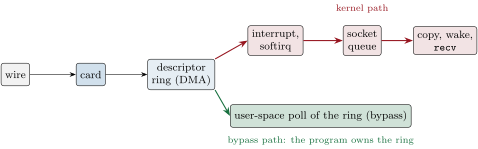
Two ways out of a descriptor ring. The kernel path (top) takes an interrupt, processes the packet in a software interrupt, queues it on a socket and copies it to a program that must be woken. A kernel-bypass stack (bottom) maps the ring into the program, which polls it and reads the packet where the card wrote it.
Figure 3.1. Two ways out of a descriptor ring. The kernel path (top) takes an interrupt, processes the packet in a software interrupt, queues it on a socket and copies it to a program that must be woken. A kernel-bypass stack (bottom) maps the ring into the program, which polls it and reads the packet where the card wrote it.
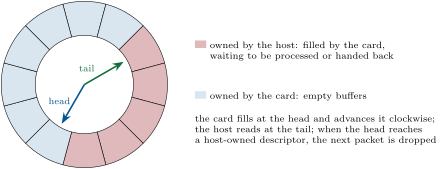
A receive ring of twelve descriptors. Five are the host’s (filled and not yet handed back), seven are the card’s. The card writes at the head, the host reads at the tail; the ring is full when the head meets a descriptor the host still owns, whether the host has read it or merely not yet handed it back.
Figure 3.2. A receive ring of twelve descriptors. Five are the host’s (filled and not yet handed back), seven are the card’s. The card writes at the head, the host reads at the tail; the ring is full when the head meets a descriptor the host still owns, whether the host has read it or merely not yet handed it back.
প্রসঙ্গসহ পড়ো →