جميع الكتب

مهني

1 Markets I: The Ecosystem and Exchange-Traded Marketsالأسواق عبر الإنترنت 2 Markets II: Rates, FX and Creditالأسواق عبر الإنترنت 3 Markets III: Commodities, Energy and Cryptoالأسواق عبر الإنترنت 4 Quantitative Methodsالأساليب عبر الإنترنت 5 Derivatives and Volatilityالمشتقات عبر الإنترنت 6 Rates, Credit, XVA and Riskالفائدة والائتمان والمخاطر عبر الإنترنت 7 Research Craft: Predictors, Backtests, Measurement, Portfoliosالبحث عبر الإنترنت 8 Strategies I: Equities and Futuresالاستراتيجيات عبر الإنترنت 9 Strategies II: Volatility, Relative Value, Macro and the Bank Desksالاستراتيجيات عبر الإنترنت 10 Microstructure and Executionالتنفيذ عبر الإنترنت 11 Market Making and High-Frequency Tradingصناعة السوق عبر الإنترنت 12 Machine Learning for Marketsتعلم الآلة عبر الإنترنت 13 Low-Latency Softwareالتكنولوجيا عبر الإنترنت 14 Networks, Hardware and Trading Infrastructureالتكنولوجيا عبر الإنترنت 15 Research, Data and Risk Platformsالتكنولوجيا عبر الإنترنت 16 The Desk and the Firmالشركة عبر الإنترنت 17 The Industry: Firms, Roles and Careersالمسارات المهنية عبر الإنترنت 18 The Interview Bookالمسارات المهنية عبر الإنترنت
التطبيقات حول المدرب تسجيل الدخول ابدأ القراءة

Quantitative Finance · المسرد

ما معنى Golden-file test؟

Definition 27.3 Research, Data and Risk Platforms · الفصل 27 — Testing and Continuous Delivery

A golden-file test compares a program’s outputs with reviewed values stored with the code — the golden file — each with a tolerance and the provenance of the value; any difference beyond the tolerance fails the test, and changing a golden value is itself a reviewed change.
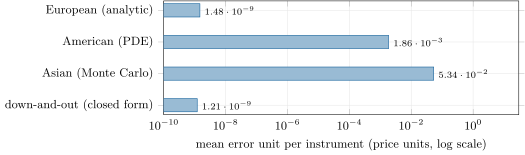
The error unit behind each golden value, averaged by product: a relative 10-10 of prices near 12–15 for the closed forms, the 0.0019 gap between two PDE grids for American puts near 11, and the 0.053 Monte Carlo standard error of Asian calls near 8. The tolerance is k times this unit, so one k means eight orders of magnitude between products. Data: fig_goldtest.py.
Figure 27.1. The error unit behind each golden value, averaged by product: a relative 10−1010^{-10} of prices near 12–15 for the closed forms, the 0.0019 gap between two PDE grids for American puts near 11, and the 0.053 Monte Carlo standard error of Asian calls near 8. The tolerance is kk times this unit, so one kk means eight orders of magnitude between products. Data: fig_goldtest.py.
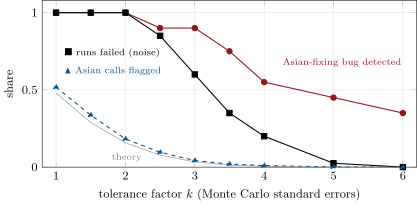
The Monte Carlo tolerance trade-off. With the seed free to change, noise alone flags each Asian call with the probability that two estimates differ by more than k standard errors (theory in grey) and fails every run for k 2; the Asian-fixing bug, which only the Monte Carlo instruments see, is caught on all twenty at k 2 but on 9 of 20 at k=5, where noise still fails 2.5% of runs. Data: fig_goldtest.py.
Figure 27.2. The Monte Carlo tolerance trade-off. With the seed free to change, noise alone flags each Asian call with the probability that two estimates differ by more than kk standard errors (theory in grey) and fails every run for k≤2k\le 2; the Asian-fixing bug, which only the Monte Carlo instruments see, is caught on all twenty at k≤2k\le2 but on 9 of 20 at k=5k=5, where noise still fails 2.5% of runs. Data: fig_goldtest.py.
اقرأ في الفصل →