 Coach
CoachA hedging band is a range around the target delta within which the hedge is left alone; when the delta leaves it, the hedge trades back to the band’s nearest edge, not to its centre, so that trades are only as large as the risk requires.
Exemplos
Example 26.4 (Bands against the clock)
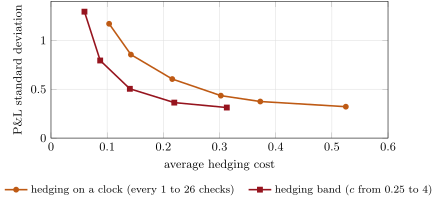
A short one-month at-the-money straddle on a share at 100 (20% volatility) is hedged over its life, checking 13 times a day, with a cost of 5 basis points of the traded notional. Hedging at every check costs 0.525 on average and leaves a P&L standard deviation of 0.321. Once a day costs 0.142 with a standard deviation of 0.855. A band with costs 0.140, the same as daily hedging, with a standard deviation of 0.505, 41% less. With it costs 0.313 with 0.313, and every-third-check hedging costs about the same (0.302) with 0.434 (Figure 26.2).