
جميع الكتب

مهني

1 Markets I: The Ecosystem and Exchange-Traded Marketsالأسواق عبر الإنترنت 2 Markets II: Rates, FX and Creditالأسواق عبر الإنترنت 3 Markets III: Commodities, Energy and Cryptoالأسواق عبر الإنترنت 4 Quantitative Methodsالأساليب عبر الإنترنت 5 Derivatives and Volatilityالمشتقات عبر الإنترنت 6 Rates, Credit, XVA and Riskالفائدة والائتمان والمخاطر عبر الإنترنت 7 Research Craft: Predictors, Backtests, Measurement, Portfoliosالبحث عبر الإنترنت 8 Strategies I: Equities and Futuresالاستراتيجيات عبر الإنترنت 9 Strategies II: Volatility, Relative Value, Macro and the Bank Desksالاستراتيجيات عبر الإنترنت 10 Microstructure and Executionالتنفيذ عبر الإنترنت 11 Market Making and High-Frequency Tradingصناعة السوق عبر الإنترنت 12 Machine Learning for Marketsتعلم الآلة عبر الإنترنت 13 Low-Latency Softwareالتكنولوجيا عبر الإنترنت 14 Networks, Hardware and Trading Infrastructureالتكنولوجيا عبر الإنترنت 15 Research, Data and Risk Platformsالتكنولوجيا عبر الإنترنت 16 The Desk and the Firmالشركة عبر الإنترنت 17 The Industry: Firms, Roles and Careersالمسارات المهنية عبر الإنترنت 18 The Interview Bookالمسارات المهنية عبر الإنترنت
التطبيقات حول المدرب تسجيل الدخول ابدأ القراءة

Quantitative Finance · المسرد

ما معنى In-flight order, cancel–fill race؟

يُعرف أيضًا باسم: in-flight order · cancel--fill race

Definition 21.2 Low-Latency Software · الفصل 21 — Order Gateway and Order Management

An in-flight order is an order in a pending state: a request about it has been sent and its answer has not arrived, so the order may have changed at the venue in ways the firm does not know yet. A cancel–fill race occurs when a fill and a request to cancel or replace the same order cross: the fill happens at the venue before the request arrives there, and its report reaches the firm after the request was sent.
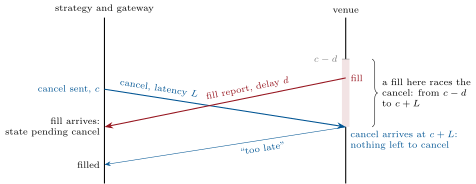
A cancel–fill race. The cancel leaves at c and arrives L later; a fill at the venue between c - d and c + L is reported after the cancel was sent. The gateway, in the state pending cancel, applies the fill and then the “too late” answer, and ends in filled.
Figure 21.2. A cancel–fill race. The cancel leaves at cc and arrives LL later; a fill at the venue between c−dc - d and c+Lc + L is reported after the cancel was sent. The gateway, in the state pending cancel, applies the fill and then the “too late” answer, and ends in filled.
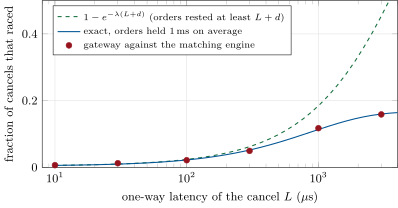
Cancel–fill races against the latency of the cancel, with fills at = 200 per second and reports delayed d = 20\, µ s. The points are the Python gateway against Book 10’s matching engine (two seeded runs of 2 000 orders each per point); the solid curve is the exact probability for orders held 1\, m s on average, the dashed one the formula for orders that have rested at least L + d when cancelled. Data: fig_races.py (deterministic).
Figure 21.3. Cancel–fill races against the latency of the cancel, with fills at λ=200\lambda = 200 per second and reports delayed d=20 µsd = 20\,\text{µ}\mathrm{s}. The points are the Python gateway against Book 10’s matching engine (two seeded runs of 2 000 orders each per point); the solid curve is the exact probability for orders held 1 ms1\,\mathrm{m}\mathrm{s} on average, the dashed one the formula for orders that have rested at least L+dL + d when cancelled. Data: fig_races.py (deterministic).
اقرأ في الفصل →